Mullion Cove
A Picturesque National Trust Fishing Harbour on The Lizard
Mullion Cove Road, Mullion, Helston, Cornwall, TR12 7EP
Mullion Cove is one of the most recognisable small harbours anywhere on the Cornish coast, and one of the most photographed: a tight cluster of grey stone cottages and a boatyard gathered around a tiny tidal harbour, protected by two curving stone breakwaters that between them have kept boats safe here since the Victorian era. Below the harbour walls lies a small beach of sand and shingle, popular with families, rockpoolers and, increasingly, coasteering groups drawn to this exposed and dramatic stretch of coast. The whole cove, harbour walls included, has been in the care of the National Trust since 1945, and just offshore sits Mullion Island, a protected seabird colony that adds a genuine wildlife dimension to what is already one of The Lizard peninsula's most complete and characterful coastal scenes.
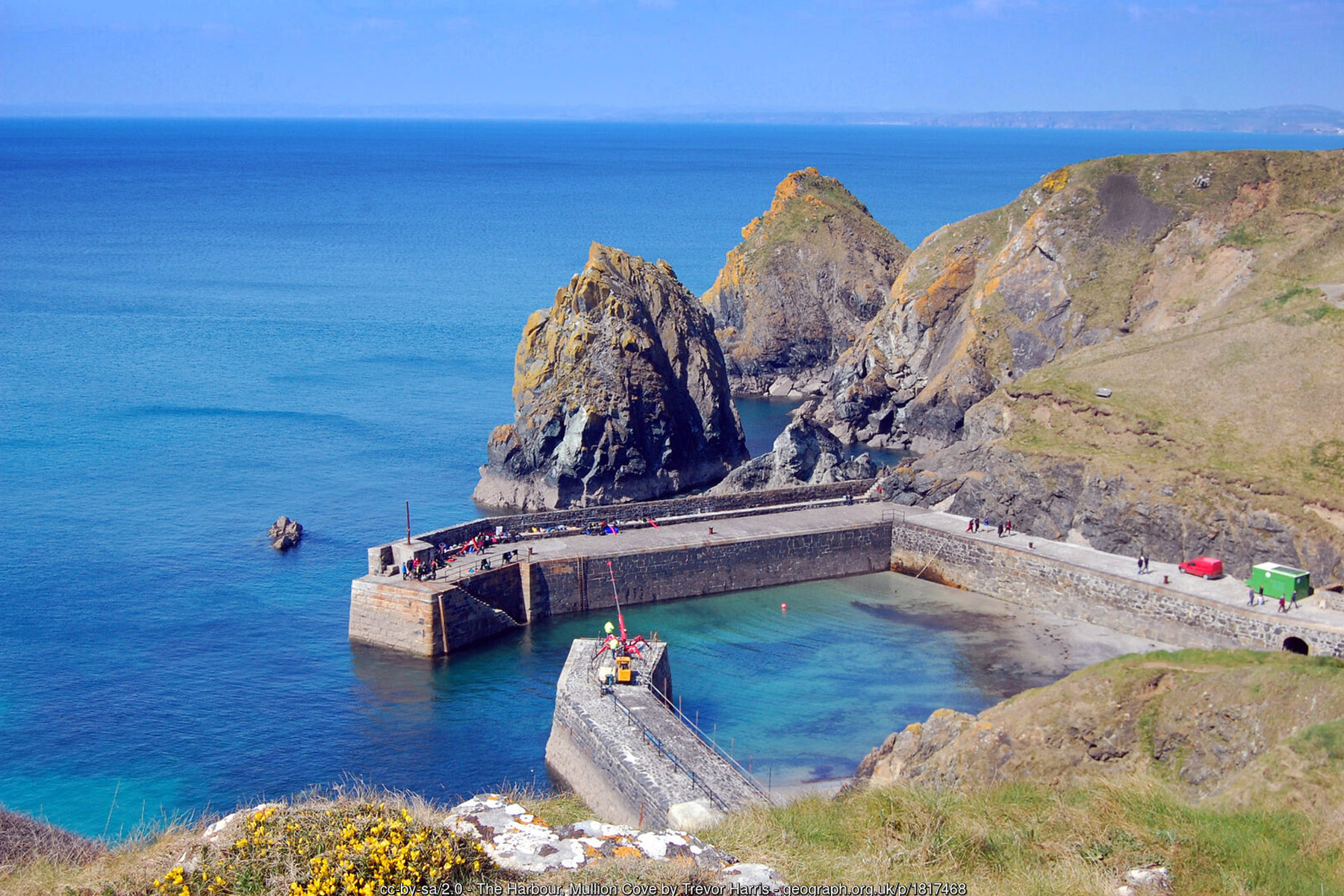
The harbour visitors see today was not built in a single phase. An inner pier was first constructed in 1868, giving Mullion's fishing boats their first proper shelter from this exposed western coast. As the pilchard fishing trade grew through the later nineteenth century, that early structure proved insufficient, and between 1893 and 1897 the harbour was substantially rebuilt and extended by the Mullion Harbour Company, with funding that came partly from Lord Robartes of Lanhydrock, to give the fishing fleet proper protection from the Atlantic swell. The result, broadly, is the twin-walled harbour still seen today - though "still seen today" undersells how much ongoing work it takes to keep it that way. Mullion Cove faces directly into some of the most powerful winter storms on the Cornish coast, and the National Trust, as the harbour's owner since 1945, has had to carry out repeated repairs to storm-damaged sections of the walls over the decades since, a maintenance challenge that has become steadily more demanding as coastal storms and sea levels shift, and one the Trust itself openly discusses as an ongoing part of caring for this exposed and much-loved site.
Offshore, and visible from almost anywhere around the cove, sits Mullion Island: a small, National Trust-owned island that plays host to a genuinely significant seabird colony and carries Site of Special Scientific Interest status in recognition of it. Cormorants and shags are a near-constant sight around its rocky shores, alongside various gulls, and the island's isolation from the mainland - it has no public landing and is left undisturbed for its breeding birds - is precisely what makes it such a valuable nesting site. For visitors with binoculars, or simply a few minutes to stand and look, the island adds a genuine wildlife dimension to a visit that might otherwise be entirely about the harbour and beach.
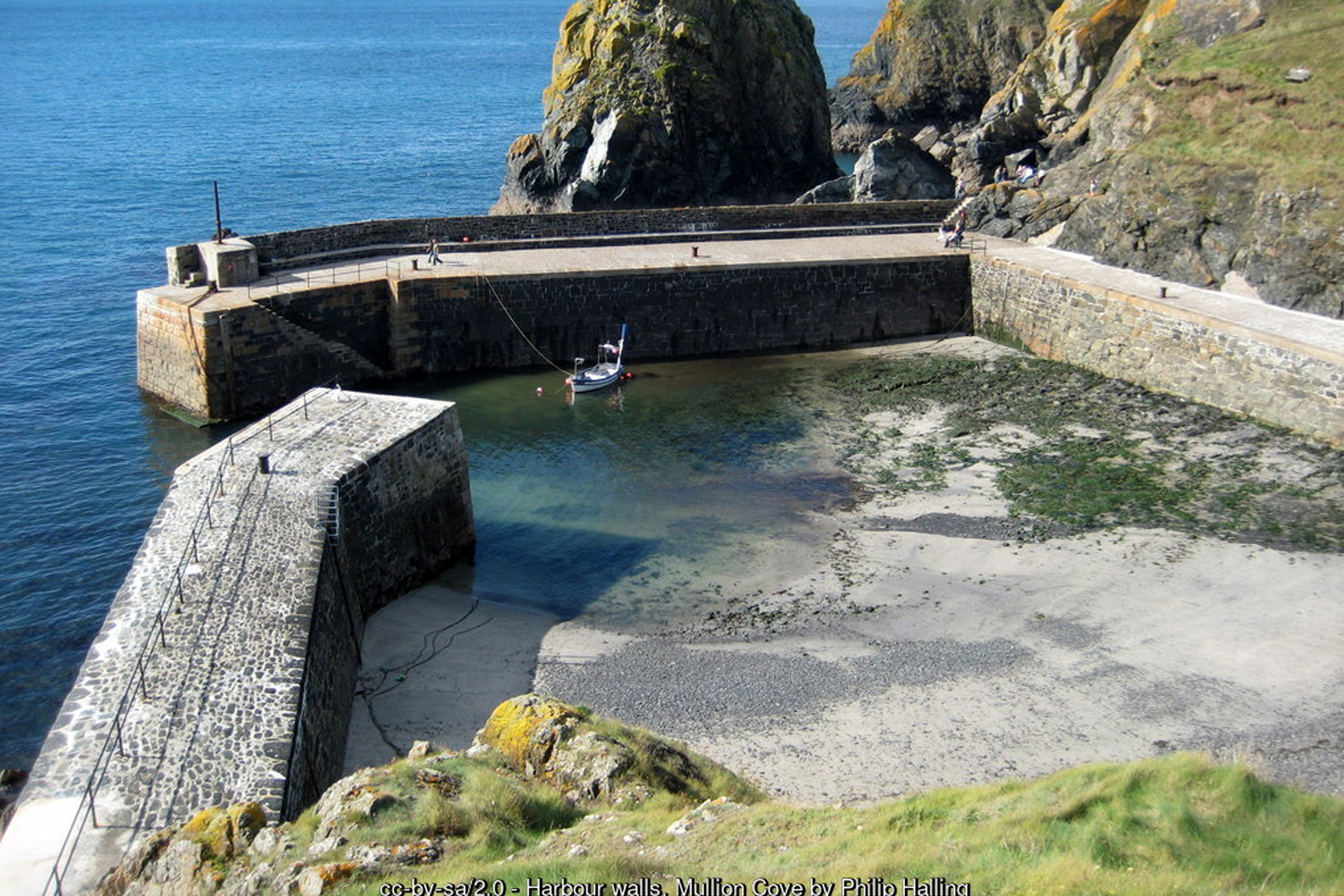
The beach itself sits directly beside the harbour, a modest but genuinely pleasant stretch of sand merging into shingle, sheltered to a degree by the harbour walls on one side and open to the sea on the other. It's a popular spot with families for exactly that reason - safe enough for building sandcastles and paddling close to the harbour wall, with rockpools worth exploring among the harbour's own rocks at low tide, where crabs, anemones and small fish are easy enough to find for anyone willing to look closely. Beyond the harbour walls, the wider coastline around Mullion Cove has become a well-known venue for coasteering, the increasingly popular combination of clifftop scrambling, rock-hopping and cliff-jumping into deep water, taking advantage of the rugged granite and serpentine coastline that defines so much of The Lizard.
Reaching the cove involves a genuinely steep descent: the National Trust pay-and-display car park sits at the top of Mullion Cove Road, roughly 250 yards above the harbour by the shortest route down, and the gradient between the two is steep enough to be a real consideration for anyone with limited mobility, a pushchair, or simply tired legs on the way back up. Once down at sea level, though, the cove rewards the walk with a working boatyard, a small seasonal café and shop serving the steady stream of summer visitors, and council-run public toilets nearby. Dogs are welcome at Mullion Cove year-round, but must be kept on a lead throughout, in recognition of the cove's continued use as a working harbour with boat traffic and moorings to navigate around. There is no RNLI lifeguard patrol here, so swimmers and coasteering groups alike should take the same sensible precautions they would at any unsupervised stretch of Cornish coast.
Mullion Cove is also a genuinely useful starting point for exploring this part of The Lizard on foot. The South West Coast Path runs directly through the cove, offering a walk south towards Predannack Head and, beyond it, the wilder coves further down the peninsula towards Kynance Cove and Lizard Point, or north past Polurrian Cove towards Poldhu and Gunwalloe Church Cove, taking in some of the most dramatic serpentine cliff scenery anywhere in Cornwall along the way. For a shorter outing, the walk north to Polurrian Cove - Mullion's quieter, undeveloped neighbour, reached down its own clifftop path a little further along the coast - takes only fifteen to twenty minutes each way and makes an easy, rewarding pairing with a visit to the harbour, giving a real sense of how different two coves born of the same pair of river valleys can turn out to be: one a bustling working harbour, the other a near-empty stretch of sand below the cliffs.
Like Mullion Cove's harbour, the rock underfoot here tells its own story. This stretch of The Lizard sits close to one of the most geologically significant boundaries in Britain, where the peninsula's distinctive dark-green serpentine rock meets older gabbro and schist - part of the wider Lizard Complex, a slice of ancient oceanic crust and upper mantle thrust up onto the Cornish coast millions of years ago and studied by geologists from across the world. It's this same underlying geology, and the polishable serpentine found further round the coast towards Kynance and Lizard Point, that gave rise to the Victorian craft trade in carved serpentine ornaments sold to visitors right along this coastline. Before the harbour walls were built, Mullion's fishermen worked the same seine-net pilchard fishery that sustained Cadgwith, Coverack and every other village on this coast, with huers stationed on the cliffs above the cove to spot the shoals - a trade that, here as elsewhere on The Lizard, declined through the twentieth century as pilchard stocks and demand both fell away, leaving crab and lobster potting as the mainstay of what remains of Mullion's small working fleet today.
Mullion Cove's fully exposed westerly aspect means conditions can change quickly: on a calm summer's day the harbour and beach are about as sheltered and family-friendly as this coast gets, but the same cove can be genuinely wild in an Atlantic storm, with spray clearing the harbour walls and waves breaking hard against the outer pier - a spectacle in its own right for anyone visiting from a safe vantage point, but a reminder of why the National Trust's repair work here is never really finished. Visitors hoping for calm water and full facilities are best advised to aim for late spring through early autumn, when the seasonal café and shop are open and the harbour is at its busiest and most picturesque; outside those months the cove takes on a much quieter, more elemental character, popular with storm-watchers and coast-path walkers rather than beachgoers.
Visitor Information
Parking
A National Trust pay-and-display car park (charges apply, including for National Trust members) sits at the top of Mullion Cove Road, about 250 yards above the harbour via a steep approach.
Facilities
A seasonal café/shop and a working boatyard sit near the harbour, with council-run public toilets nearby. There is no RNLI lifeguard patrol at Mullion Cove.
Disabled Access
The approach is a steep gradient of roughly 250 yards from the car park down to the harbour and beach, and is not easy going for wheelchair or pushchair users. No dedicated Blue Badge bays are confirmed at the car park - check current signage on arrival.
Things to Do Nearby
- Polurrian Cove, a quieter, undeveloped sandy cove a short coast path walk north
- Mullion & Poldhu Coast Path Walk, a circular route taking in this stretch of the South West Coast Path
Places to Stay
Mullion village, just above the cove, has a good range of places to stay:
Frequently Asked Questions
Page last updated: 16 September 2026