Porthmeor Beach
St Ives' Famous Surf Beach Beneath Tate St Ives
Porthmeor Beach, St Ives, Cornwall, TR26 1JU Blue Flag 2026
Porthmeor is St Ives' great open beach, a wide, north-facing sweep of soft golden sand running along the western edge of the town below Barnoon Hill. Where the harbour side of St Ives turns its back to the Atlantic, Porthmeor faces it head-on, and that single fact explains almost everything about the beach: its reputation as Cornwall's best-known surf beach outside the main Newquay cluster, its long white lines of breaking swell, and its status as the backdrop to one of the most photographed gallery views in the country. At low tide the sand opens out into a broad, level expanse well over half a mile from end to end, bounded to the east by the harbour arm and Smeaton's Pier and to the west by the low headland below The Island, with the rocky sweep of Man's Head and the coast path to Clodgy Point beyond. It is, by a wide margin, the biggest and most exposed of St Ives' beaches, and the one most visitors picture when they think of the town.
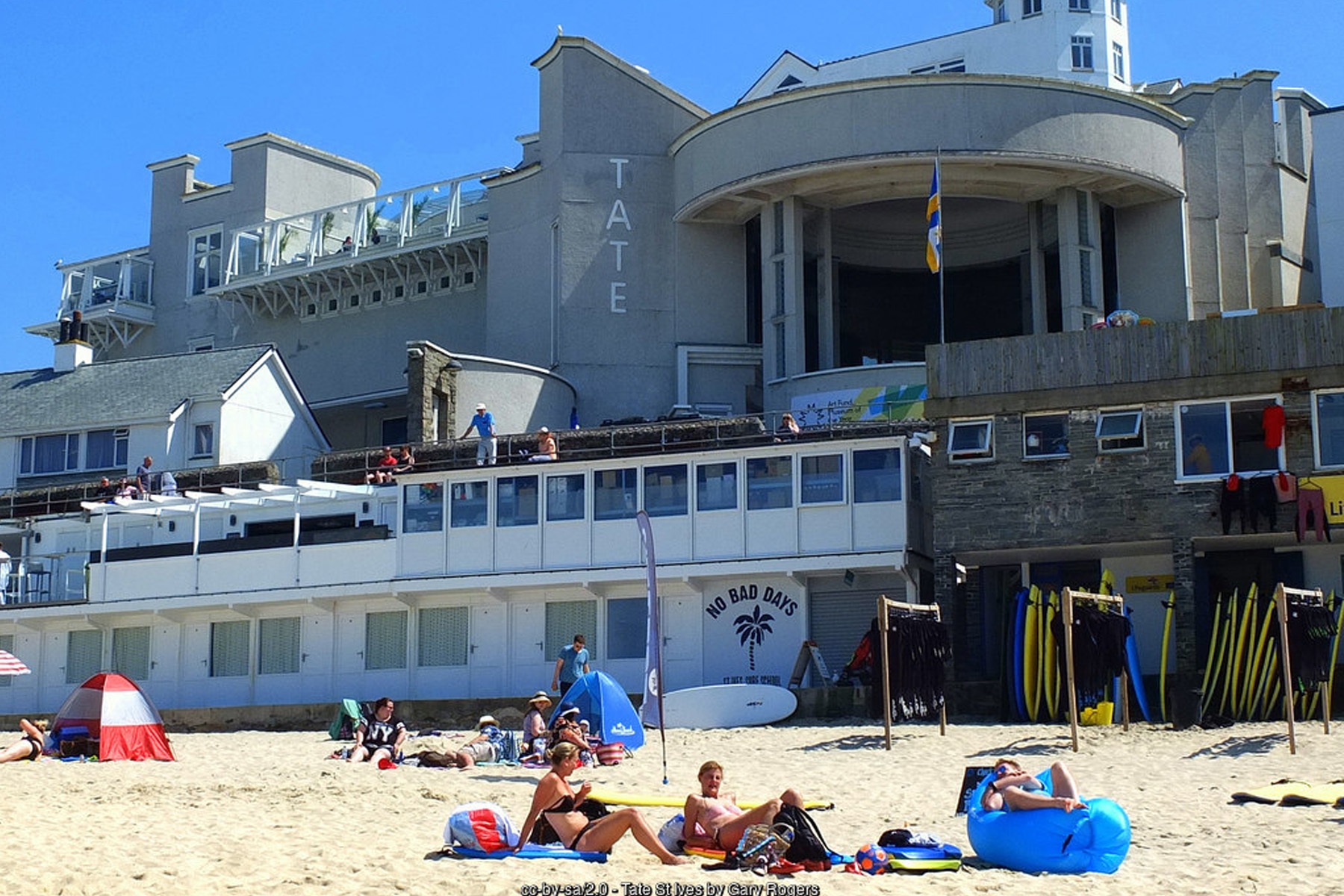
What sets Porthmeor apart from every other beach in Cornwall, though, is what stands directly above it. Tate St Ives occupies the low headland at the eastern end of the beach, its curved rotunda front looking straight out over the sand to the ocean beyond - one of the most famous gallery-and-beach pairings in Britain, and arguably the single image most associated with St Ives worldwide. The gallery opened in June 1993 on the site of a demolished gasworks, built to a design by architects Eldred Evans and David Shalev that deliberately echoed the shape of the gasholders it replaced, and it exceeded every expectation of the town: more than 120,000 people visited in its first six months alone. A major refurbishment and extension, designed by Jamie Fobert Architects working alongside the original architects, doubled the gallery's exhibition space and reopened to the public in 2017. Tate St Ives exists specifically to show the work of the artists who lived and worked in the town, drawn from Tate's own collection, and a walk along Porthmeor's sand with the gallery rising above it is as close as Cornwall comes to standing inside the story it tells. Read more about Tate St Ives.
That story is a genuinely significant one in British art history, and it begins with light. West Cornwall's unusually clear, reflective quality of light - a product of the peninsula's exposure to the sea on almost every side - had already drawn landscape painters to the far west of Cornwall by the late nineteenth century, when the fishing town of Newlyn, on the county's south coast, became home to the earlier and more traditional Newlyn School: painters working largely in a realist, plein-air style, depicting fishing and rural life much as it was lived around them. St Ives, twenty miles north across the peninsula, developed its own separate colony from around the same period, but its identity changed dramatically in the twentieth century. In 1928 the painters Ben Nicholson and Christopher Wood, visiting St Ives, came across Alfred Wallis, a retired fisherman and marine store dealer who had taken up painting in his seventies, working from memory on scraps of cardboard and ship's paint in a deliberately untrained, instinctive style. Wallis's work had a profound effect on Nicholson's own move toward abstraction, and the encounter is now regarded as a founding moment of what became known as the St Ives School.
The School properly took shape after 1939, when Nicholson and the sculptor Barbara Hepworth - by then married - settled permanently in St Ives at the outbreak of the Second World War, shortly joined by the Russian constructivist sculptor Naum Gabo. Around this nucleus of pre-war modernists grew a wider and increasingly influential postwar generation: painters Patrick Heron, Terry Frost, Roger Hilton, Bryan Wynter and Peter Lanyon, the St Ives-born painter whose work drew directly on the cliffs, mines and moorland of his native Penwith, the Scottish painter Wilhelmina Barns-Graham, the German-born painter Karl Weschke, and the potter Bernard Leach, whose pottery on the edge of town became internationally influential in its own right. The Penwith Society of Arts, formed in St Ives in 1948 after a split within the older St Ives Society of Artists, gave the newer, more abstract generation of artists a home of their own, and by the 1950s and 1960s - the St Ives School's acknowledged heyday - the town had become one of the most important centres of modern British art and sculpture anywhere in the country, its reputation resting on exactly the combination of dramatic Atlantic landscape and unusual light that had first drawn painters here.
Barbara Hepworth remained in St Ives for the rest of her life, working from Trewyn Studio, a walled garden and workshop just up the hill from Porthmeor that she bought in September 1949. She died there in 1975, in a fire in her studio, and left instructions in her will that Trewyn should be preserved and opened to the public as a museum of her work - it opened as the Barbara Hepworth Museum and Sculpture Garden in 1976, and her family transferred it to Tate's care in 1980. It remains almost exactly as Hepworth left it: her tools, half-finished carvings and working materials in the studio, and a series of her large bronze and stone sculptures set among sub-tropical planting in the walled garden she designed herself - the largest permanent public collection of her work anywhere, and a short, level walk up from the beach. Read more about the Barbara Hepworth Museum & Sculpture Garden. Close by on Barnoon Hill, overlooking the beach from much the same vantage point, Barnoon Workshops continues that working-studio tradition into the present day, housing a cluster of practising artists in modest converted premises typical of the net lofts and fish cellars that have been repurposed as studios across this part of St Ives since the early twentieth century. Read more about Barnoon Workshops.
Long before any of this, Porthmeor's edge was a working shoreline rather than a gallery backdrop. The terrace of tall, narrow buildings immediately above the beach - now partly absorbed into Tate St Ives and partly still in use as studios - began life as pilchard cellars and net lofts, where the once-vast Cornish pilchard fishery salted, pressed and stored its catch and where nets were tarred and mended between seasons. As that fishery declined through the late nineteenth and early twentieth centuries, many of these buildings were taken over cheaply by painters drawn to their tall windows, north light and sea views - the same practical qualities that had suited fishermen's nets suited an artist's easel just as well, and the conversion of Porthmeor's working waterfront into one of the most concentrated clusters of studio space in Britain happened gradually, building by building, rather than as any single planned transformation.
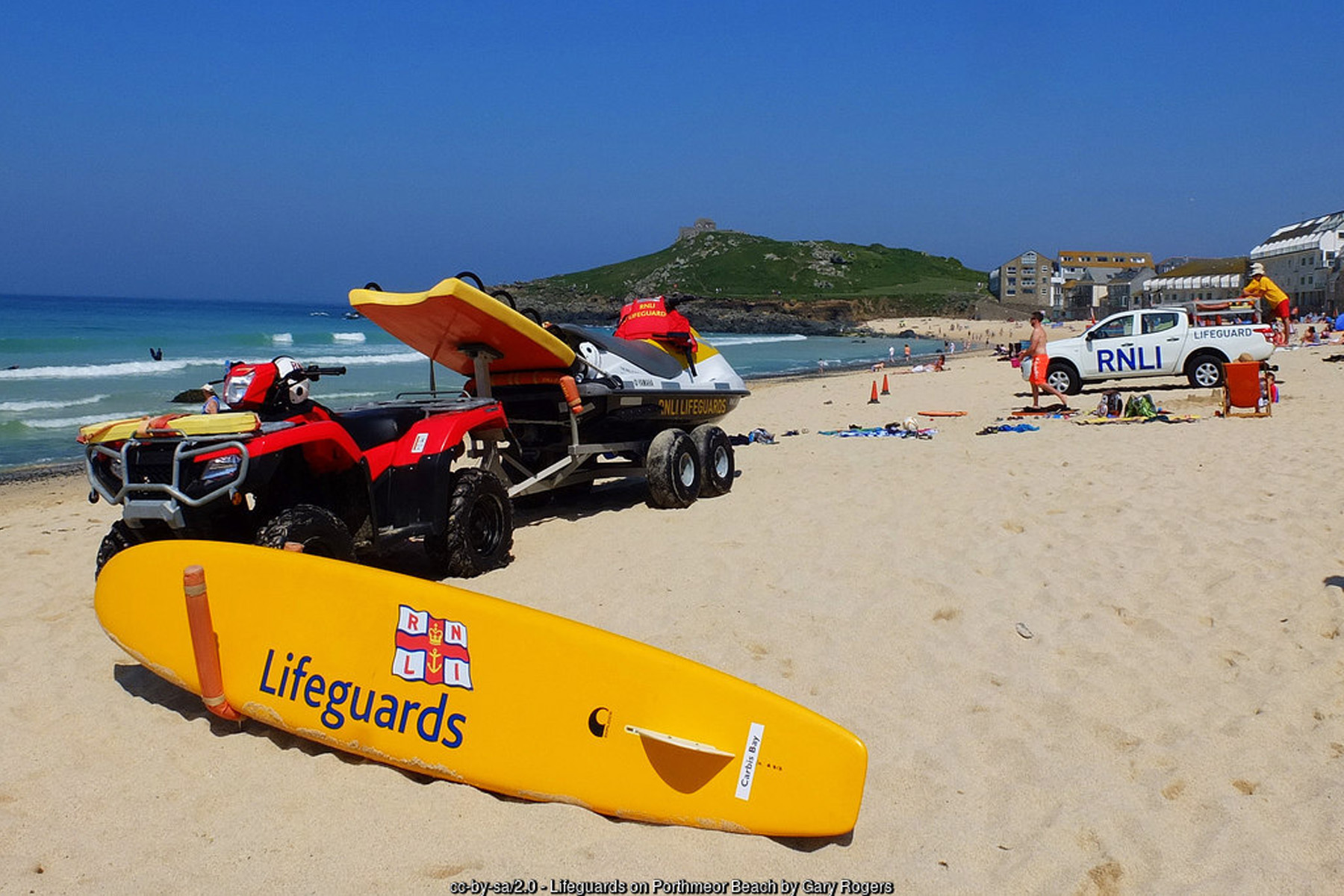
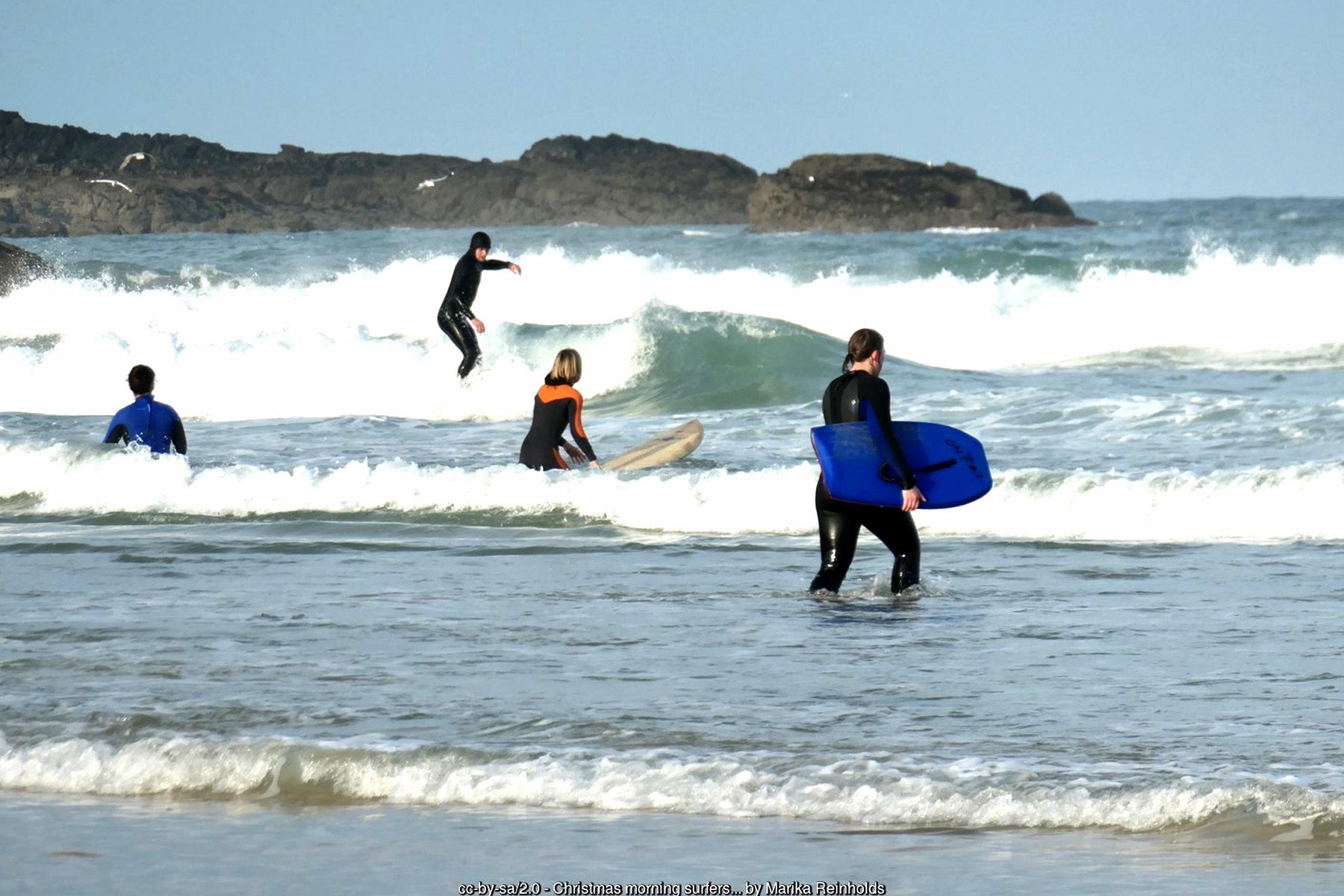
Today, Porthmeor's main claim on most visitors is much simpler: it is an exceptionally good beach for surfing. Its wide, open, north-facing aspect exposes it directly to Atlantic swell with no offshore islands or headlands to soften it, giving Porthmeor more consistent, better-shaped waves through more of the year than most other beaches in the immediate area, and a sandy, gently shelving bottom that suits learners as well as more experienced surfers. Several surf schools operate directly from the beach through the season, offering lessons and board and wetsuit hire, and Porthmeor is regularly named among the best beginner-friendly surf beaches in West Cornwall - the county's dedicated Cornwall Surfing Guide covers conditions and operators across the region in more detail. RNLI lifeguards patrol the beach through the main season, with flagged zones separating swimmers from the surf area, and conditions can change quickly with the state of the tide and the swell, so it is worth checking the flags and any posted safety information before going in.
The same north and north-west facing aspect that brings in the swell also makes Porthmeor one of the best places in St Ives to watch the sun go down, with nothing but open Atlantic between the beach and the horizon - on a clear evening, the sand fills with people simply sitting to watch the light change over the water, and the outdoor terrace above the beach is one of the most popular vantage points in town for exactly that reason. At low tide, rock ledges and small pools appear at the beach's western fringe below The Island, worth a look for shore crabs, anemones and the occasional small fish left behind by the retreating sea, though most of the exposed sand at low water is clean, open and firm underfoot rather than rocky. Geologically, Porthmeor sits within the same resistant granite and metamorphosed slate that forms the whole of the Penwith peninsula, with the harder rock at each end of the bay - Pedn Olva and the harbour arm to the east, Man's Head and Clodgy Point to the west - doing the work of framing the beach and breaking up the swell that reaches the sand between them.
West of Porthmeor, the South West Coast Path climbs out past Clodgy Point onto some of the wildest and least developed cliff scenery in Cornwall, tracing the old coastal mining and fishing paths on toward Zennor - a walk of dramatic granite headlands, isolated coves and far fewer people than the town beaches, popular with walkers looking to extend a day at Porthmeor into an afternoon on the coast path. To the east, around the harbour and The Island, St Ives' quieter town beaches - Porthgwidden tucked into its own small sandy cove, and Harbour Beach within the working harbour itself - offer a calmer, more sheltered alternative on days when Porthmeor's open Atlantic exposure makes it too rough or too busy for younger children, while Porthminster and Carbis Bay lie further round the headland on the town's more sheltered, south-eastern side.
Porthmeor's popularity, its Blue Flag status and its position beneath one of Britain's best-known modern art galleries make it, by some distance, the flagship beach of St Ives - the one place in town where a morning surf lesson, an afternoon in a world-class gallery, and an evening watching the sun go down over the Atlantic are all within a two-minute walk of one another. Parking in St Ives itself is limited and the town's own hilly, narrow streets are not well suited to driving in high season, so most visitors find it easier to park in one of the town's main car parks and walk down to the beach, or to arrive by the branch railway line from St Erth, whose final approach into St Ives station gives one of the most celebrated sea views of any railway journey in England, with Porthmeor itself visible from the carriage window in the last few minutes before arrival.
Visitor Information
Parking
No dedicated car park directly on the beach. The nearest Cornwall Council car park is Porthmeor (TR26 1JU), just above the beach, with further pay-and-display parking at Island (TR26 1SY) and Trenwith (TR26 1DD). St Ives' streets are narrow and hilly, and car parks fill early in summer - many visitors park on the edge of town and use the park-and-ride, or arrive by the St Erth branch railway line.
Facilities
Public toilets at the surf lifesaving clubhouse on the beach, with cafes, restaurants and surf shops close by in the town. Surf schools offer lessons and board and wetsuit hire directly on the sand. RNLI lifeguards patrol through the main season, broadly Easter to the end of October.
Disabled Access
Access to the beach is via a slipway and steps from the road above, with some slopes and rougher ground rather than fully level access - Porthmeor is rated as having good but not full accessibility. Confirm current Blue Badge parking provision with Cornwall Council before you travel.
Things to Do Nearby
- Tate St Ives, the internationally known gallery of modern art directly above the beach
- Barbara Hepworth Museum & Sculpture Garden, the sculptor's former home, studio and garden on Barnoon Hill
- Barnoon Workshops, working artist studios close to the Hepworth Museum
- Porthgwidden, the sheltered sandy cove around The Island, east of Porthmeor
- Zennor Cove, reached along the coast path west of Porthmeor past Clodgy Point
- Cornwall Surfing Guide - surf schools, hire and conditions across the county, including Porthmeor
Places to Stay
Frequently Asked Questions
Page last updated: 9 September 2026.