Bamaluz Beach
St Ives' Hidden Cove Below Wheal Dream
Bamaluz Beach, St Ives, Cornwall, TR26 1PR
Bamaluz Beach is the one St Ives beach that most visitors walk straight past without ever noticing. Wedged into the short stretch of shoreline between the harbour and Porthgwidden, below the lane and cluster of houses called Wheal Dream, it has none of the obvious signposting or beach-café bustle of its neighbours - just a flight of steep, uneven steps down from the road, easy to miss unless you already know it is there. That obscurity is exactly its appeal: a small, sheltered, east-facing patch of sand and rock with a clear view out across St Ives Bay, quiet even in the height of summer, and - almost uniquely among St Ives' beaches - open to dogs all year round with no seasonal restriction at all.
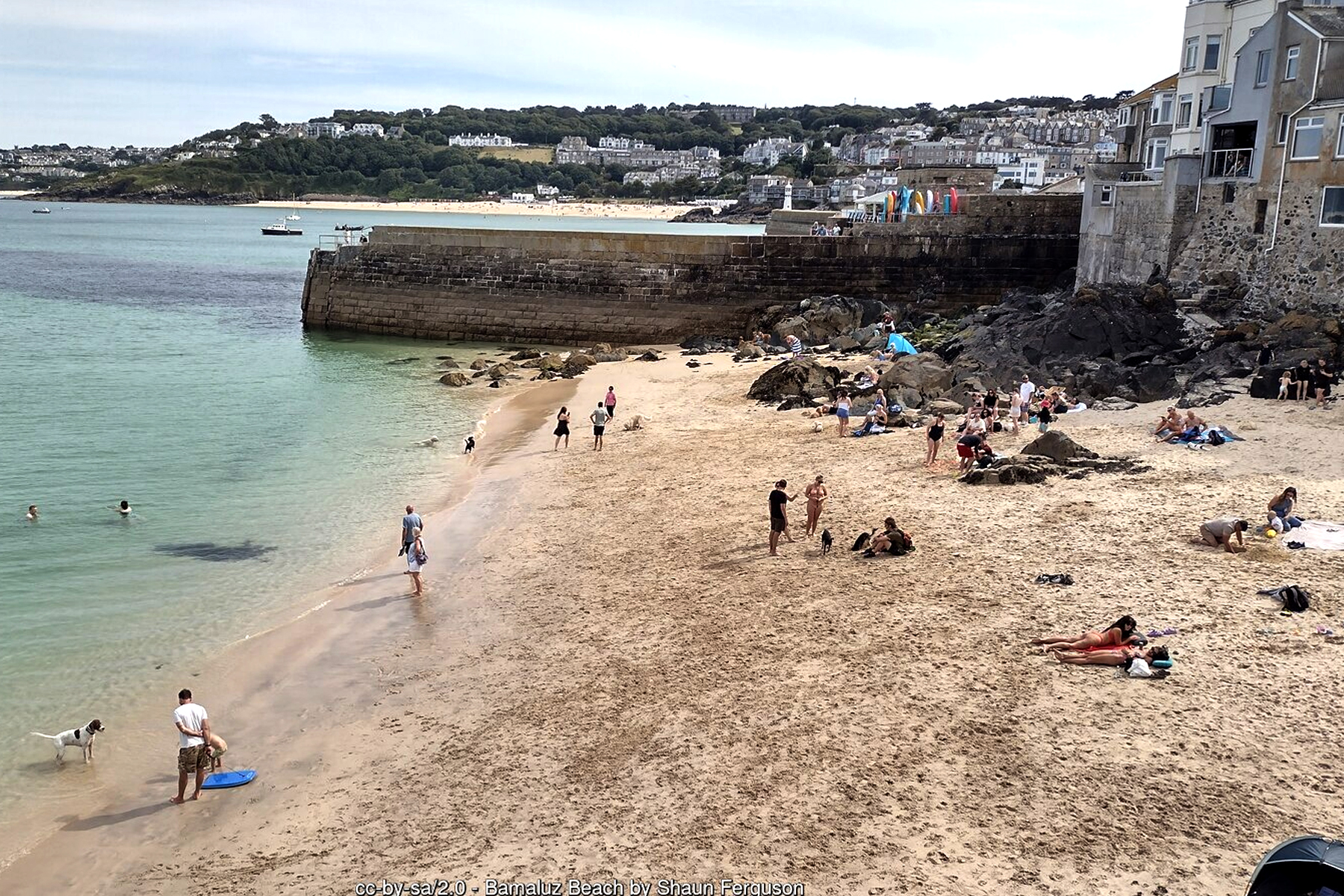
The beach takes its name from Wheal Dream, the lane that leads down to it and the site of a former small, by all accounts not especially successful, tin mine - sections of old mine walling are still visible around the cove itself. "Wheal" is the standard Cornish word for a mine, found all over the county's place names, and some sources give the beach's own name, Bamaluz, as a corruption of Cornish words roughly meaning "grey stone mine" - a plausible but not entirely certain derivation, consistent at least with the site's mining past. Whatever the precise etymology, the name has stuck to this particular corner of the harbourside for a very long time, long after the mine workings themselves fell silent.
The old mine building above the beach has led an unusually varied life since. Through the mid-19th century it became a "pilchard palace" - one of the cellars around the harbour where the town's vast catches of pilchards were salted, cured and packed for export, the same trade described on the Harbour Beach page a short walk away - before later serving in turn as a religious meeting house, a laundry and, for a time, a cinema. In 1963 three partners, the artist Leslie Illsley, the potter Benny Siroto and the architect Jan Thompson, bought an existing pottery business and set up Troika Pottery in the building's basement, going on to produce the chunky, textured studio pottery that became a defining, now highly collectible, product of 1960s and 1970s St Ives. The building's upper floor meanwhile served for some years as a mission for the town's sailors and fishermen. Troika eventually moved elsewhere in Cornwall before ceasing production in 1983, and in 1968 the ground floor of the Wheal Dream building had already begun its current life as the home of St Ives Museum - meaning the little cove below has, at various points, looked up at a mine, a fish cellar, a pottery studio and now a museum, all on the same small patch of ground.
Today, the most prominent building on Wheal Dream is St Ives Museum, which overlooks Bamaluz from directly above. The museum traces its own origins to 1920, when a group of local people led by the folklorist and Cornish-language scholar Robert Morton Nance formed the St Ives Old Cornwall Society specifically to preserve the town's history and artefacts; the collection moved through more than one home over the following decades - beginning, by its own account, in a small space on Pudding Bag Lane and later occupying part of the town's library building - before settling permanently at its current Wheal Dream premises, where it now holds an eclectic collection covering St Ives' fishing, mining, artistic and everyday social history. Visitors who spot Bamaluz from the museum's windows, or from the lane above, are seeing much the same view of the cove that the museum's founders would have known a century ago.
Access to the beach itself is part of what keeps it so quiet: from the harbourfront, the route turns inland just before Smeaton's Pier, climbs briefly up onto Wheal Dream, and then drops back down to the cove via a flight of steps that is fairly steep and somewhat uneven underfoot - manageable for anyone reasonably sure-footed, but not a realistic option for a pram, a wheelchair, or anyone with limited mobility. There is no direct road access to the sand. Once down at beach level, the reward is a small, east-facing cove that is genuinely sheltered from the prevailing south-westerly winds, catches good sun through the earlier part of the day before the houses above begin to throw shade across it in the afternoon, and looks straight out across St Ives Bay towards Hayle, Gwithian and the distant silhouette of Godrevy Lighthouse - very nearly the same view enjoyed from Porthminster and Carbis Bay a little further round the bay, but from a spot most people never find.
Like several of the more tucked-away coves around St Ives harbour, Bamaluz is strongly tidal. At low water, a reasonable expanse of sand opens up, interspersed with rocks that are worth a scramble and a look in the shallow pools they leave behind; as the tide comes in, the sand narrows quickly and, on the bigger spring tides in particular, can all but disappear beneath the sea. This makes Bamaluz a beach best planned around the tide timetable rather than turned up to on a whim - check the tides before setting off, and don't leave belongings too low down the beach if you plan to stay through a rising tide.
The single clearest point of difference between Bamaluz and its immediate neighbours, Harbour Beach and Porthgwidden, is dogs: both of those beaches restrict dogs between 1 July and 31 August, but Bamaluz carries no such seasonal restriction and welcomes dogs all year round, which makes it a genuine favourite with local dog walkers, particularly in the summer months when so much of the rest of the town's shoreline is off-limits to them. Given that houses on Wheal Dream look directly down onto the cove, visitors bringing dogs are asked to keep barking to a minimum where possible and to clear up thoroughly, as a matter of simple neighbourliness rather than any council rule specific to the beach.
Bamaluz has also made a small mark in local popular culture: it features as a setting in Phil Moran's "Soggy" series of St Ives-set children's books, a detail that local families sometimes use as a reason to seek the beach out with children who already know the stories. Beyond that, it remains a place with very little written about it and correspondingly few visitors - which, for many who do find their way down the steps from Wheal Dream, is precisely the point.
Visitor Information
Parking
No parking at the beach itself. Nearest options are the public car parks around Smeaton's Pier and The Sloop on the harbourfront, or the Island car park above Porthgwidden, all a short walk away.
Facilities
None at the beach. Nearest toilets and refreshments are around Smeaton's Pier or at the Porthgwidden beach café, both a short walk away. No lifeguard cover.
Disabled Access
Not accessible - reached only via a steep, uneven flight of steps from Wheal Dream, unsuitable for wheelchairs or pushchairs. No Blue Badge parking is available at or near the beach.
Things to Do Nearby
- Harbour Beach, a short walk around the harbourfront
- Porthgwidden, the next cove around towards St Ives Head
- St Ives Museum, overlooking the beach from Wheal Dream above
- Tate St Ives, a short walk via the harbour and Porthmeor
Places to Stay
Frequently Asked Questions
Page last updated: 10 September 2026.