Carbis Bay Beach
Blue Flag Sands and Home of the 2021 G7 Summit
Carbis Bay Beach, St Ives, Cornwall, TR26 2NZ Blue Flag 2026
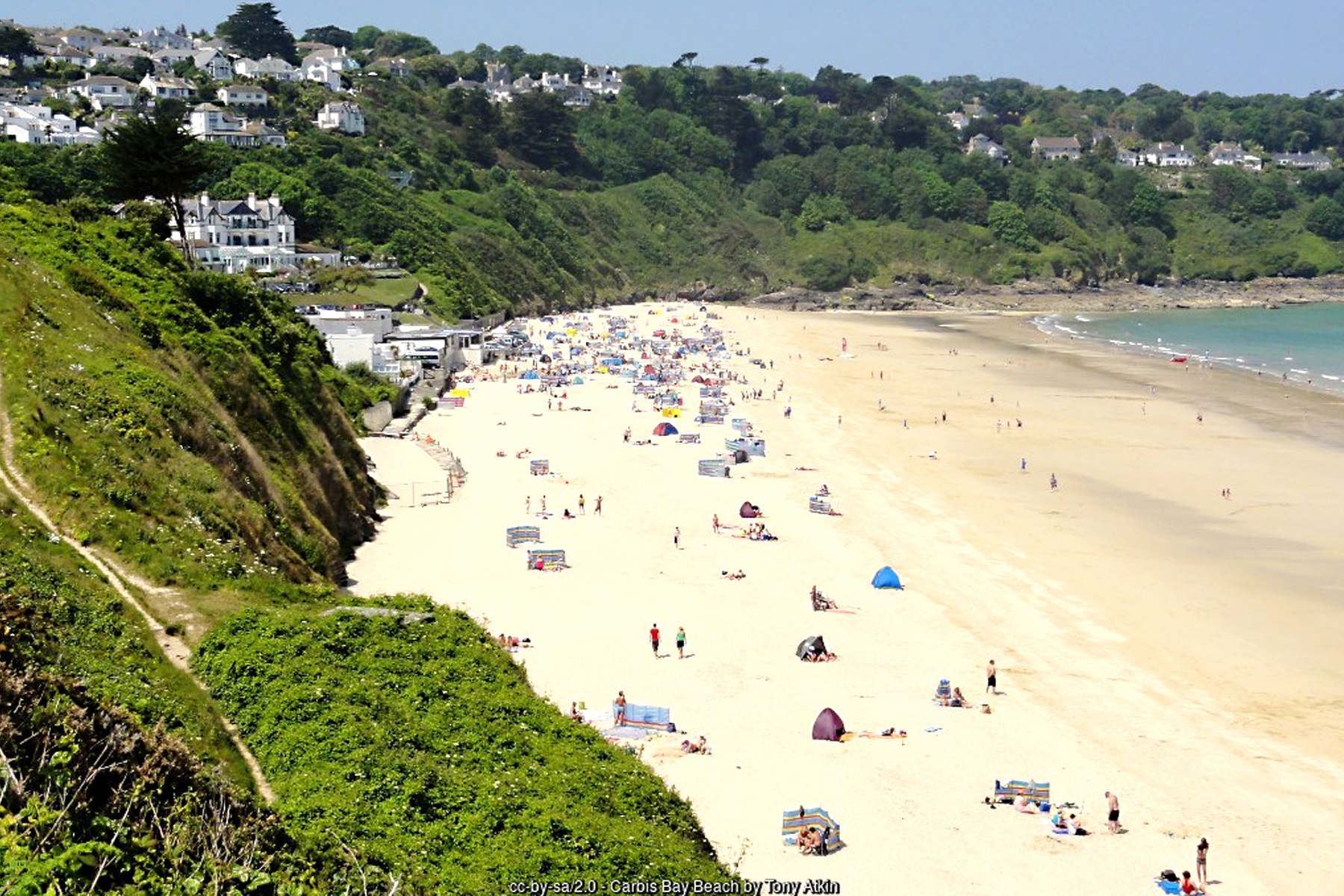
Carbis Bay is a mile-long, north-facing crescent of soft golden sand a little over a mile southeast of St Ives, tucked between the wooded slopes of Porthminster Point and Hawk's Point. Those flanking headlands give the bay unusually good shelter from the wind, and the water here is calmer than almost anywhere else on this stretch of coast - little more than gentle ripples where neighbouring beaches see proper Atlantic swell. That combination of soft sand, warmth and calm, safe water has made Carbis Bay one of the most consistently popular family beaches in West Cornwall for well over a century, and it holds Blue Flag award status for 2026, one of only ten Cornwall beaches to do so.
Carbis Bay is also unusual among Cornwall's Blue Flag beaches for who owns it. Nine of Cornwall's ten Blue Flag beaches are managed by Cornwall Council; Carbis Bay is the exception, owned and run privately by the Carbis Bay Estate, the company behind the Carbis Bay Hotel that overlooks the sand. The beach remains fully open and free to the public in the usual way - the private ownership shows up in who maintains it and runs its beachfront concessions, not in any restriction on access.
The bay's present name comes from the railway rather than the other way around: Carbis Bay station opened on 1 June 1877 as part of the Great Western Railway's new branch line from St Erth to St Ives, and the scattering of farms and mine cottages that grew up around it in the following decades took their identity from the station rather than an older village. Earlier maps and records knew the cove itself as Porthrepta, a name that survives today in Porthrepta Road and the clifftop Porthrepta car park above the beach. Before the railway and the holiday trade that followed it, this was mining country - the long-vanished Wheal Providence mine once worked the hillside close by, and is recorded as the type locality for the rare copper mineral connellite, first identified and named from ore found here in the early nineteenth century. By the Victorian era the area was already drawing visitors: pleasure grounds at Hawk's Point, complete with a tea house and an artificial grotto, were a popular gathering spot, and by 1880 the local entrepreneur William Payne is said to have run the largest establishment of its kind in the west of England there.
The Carbis Bay Hotel itself, standing prominently above the beach, was built in 1894 to a design by Silvanus Trevail, generally regarded as Cornwall's foremost Victorian architect and the man behind a string of the county's grand seaside hotels. It has a genuine literary pedigree: Virginia Woolf stayed there for three weeks in the spring of 1914 while recuperating, in the same period of her life that produced the vivid memories of childhood holidays at nearby Talland House which are widely believed to have shaped the fictional Ramsay family's holiday home in her 1927 novel To the Lighthouse - though Woolf relocated the actual setting to the Hebrides in the finished book, so the connection is one of atmosphere and memory rather than a literal setting. The film director David Lean also stayed at the hotel, and the novelist Rosamunde Pilcher used it, thinly disguised as "the Sands Hotel," as a setting in both The Shell Seekers (1988) and Winter Solstice (2000).
It was this same hotel and its grounds that put Carbis Bay firmly on the world stage in June 2021, when it hosted the 47th G7 summit from 11 to 13 June. UK Prime Minister Boris Johnson, as host, welcomed the leaders of the other G7 members - Joe Biden of the United States, Emmanuel Macron of France, Angela Merkel of Germany, Mario Draghi of Italy, Justin Trudeau of Canada and Yoshihide Suga of Japan, alongside the European Union's Ursula von der Leyen and Charles Michel - plus guest leaders from Australia, India, South Korea and South Africa, with UN Secretary-General António Guterres and the heads of the WHO and IMF also taking part. For three days the quiet Cornish bay was ringed with security and international press; Boris Johnson marked the occasion by unveiling a new sign for Carbis Bay railway station made from old railway sleepers, stones and seashells, which still stands today as a small, tangible reminder of the summit long after the world's television cameras moved on.
One of the most photographed ways to reach the sand is on foot from that same railway station, which sits on a steep hillside a short way above the bay on the scenic St Ives Bay Line between St Erth and St Ives. A flight of steps drops down through gardens planted with palms and other sub-tropical species characteristic of this mild corner of Cornwall, bringing walkers out directly onto the beach - a quick, memorable descent that turns the short train ride itself into part of the day out, and a genuine rarity among British seaside stations. Those who prefer a longer approach can instead ride the branch line as far as St Ives and follow the South West Coast Path back around the headland to Carbis Bay, a walk of a little over a mile with fine views back across the bay towards Godrevy on a clear day.
Today the beach is run by the Carbis Bay Estate as a genuine visitor destination in its own right, not just an extension of the hotel gardens. A Beach Club & Spa sits directly on the sand, alongside Walter's on the Beach restaurant and bar and the more casual Lower Deck kiosk for ice cream, pizza and barbecue food, while the Ocean Sports centre offers accredited kayaking, paddleboarding and Hawaiian canoe sessions for anyone wanting to get out on the water rather than just beside it. It amounts to a fuller range of on-the-sand facilities than most Cornish beaches offer, reflecting the beach's private management as much as its popularity.
Given its shelter from the prevailing wind and the modest surf that reaches the bay even in poorer weather, Carbis Bay is consistently rated as one of the safer beaches in the St Ives area for family swimming, though the usual sea-safety rules still apply. RNLI lifeguards patrol daily from 18 July to 6 September 2026, 10am to 6pm, and swimmers are advised to stay within the red-and-yellow flagged area whenever lifeguards are on duty - remembering the standard "no flags, no lifeguards" rule outside those hours and dates. At low tide the sand stretches a considerable distance and firms up nicely for beach games and rockpooling around the fringes of the headlands on either side; incoming tides narrow the beach again fairly quickly, so it is worth keeping an eye on the state of the tide, particularly with young children or belongings left near the foot of the cliffs.
Looking north along the curve of St Ives Bay from the sand, the view takes in Godrevy Lighthouse in the distance and, closer at hand, the mouth of the Hayle estuary, where the RSPB's Hayle Estuary reserve is one of Cornwall's better sites for wintering wading birds and wildfowl. It is not a wildlife destination in its own right in the way Godrevy or the estuary itself are, but the backdrop adds an extra layer of interest for anyone walking the coast path around the bay rather than simply lying on the beach.
Getting there without a car is genuinely straightforward: the St Ives Bay Line runs a frequent service in summer between St Erth, on the main line from London and Plymouth, and St Ives, calling at Carbis Bay along the way, and Cornwall Council operates a park-and-ride service from St Erth for visitors who would rather avoid driving into the narrow lanes around St Ives altogether. Combined with the direct step access onto the sand, it makes Carbis Bay one of the easiest Cornish beaches to reach by public transport, G7 motorcades notwithstanding.
Out of season, Carbis Bay is a noticeably quieter place - the beach clubs and watersports centre wind down, the crowds thin out, and the crescent of sand and its wooded backdrop can be enjoyed at a walking pace instead. Whatever the season, the combination of a genuinely sheltered microclimate, direct rail access and a real slice of recent political history make Carbis Bay one of the more distinctive beaches on this stretch of the Cornish coast.
Visitor Information
Parking
A small beachside pay-and-display car park run by the Carbis Bay Estate sits right by the sand; a larger Cornwall Council car park at Porthrepta, up on the clifftop, is cheaper but involves a five-to-ten minute steep walk down. Carbis Bay railway station, on the St Ives Bay Line, sits partway down the hill and gives direct step access onto the beach without a car at all.
Facilities
Toilets, a Beach Club & Spa, Walter's on the Beach restaurant and bar, the Lower Deck kiosk, and the Ocean Sports watersports centre (kayaking, paddleboarding, Hawaiian canoe). RNLI lifeguards patrol daily from 18 July to 6 September 2026, 10am to 6pm.
Disabled Access
A ramp leads from the beachside car park directly onto the sand, described by the Carbis Bay Estate as suitable for pushchairs and wheelchairs, and refurbished disabled toilets are available. Blue Badge holders can use family/disabled parking bays at the beachside car park, subject to availability.
Things to Do Nearby
- Porthkidney Sands, a broad, quieter beach at the mouth of the Hayle Estuary, a short walk or drive away
- Porthminster Beach, St Ives' own Blue Flag beach, a little further round the headland towards town
- The Carbis Bay Hotel & Estate, overlooking the beach and the venue for the 2021 G7 summit
- Carbis Bay railway station, on the scenic St Ives Bay Line, with its well-known flight of garden steps straight down to the sand
Places to Stay
Frequently Asked Questions
Page last updated: 9 September 2026.