Porthgwidden
St Ives' Quietest Sun-Trap Cove
Porthgwidden Beach, St Ives, Cornwall, TR26 1PL
Porthgwidden is the small, sheltered cove tucked between St Ives harbour and St Ives Head - the grassy headland everyone in the town simply calls "the Island," even though it has not been a true island for many centuries. Facing east and shielded by the headland on one side and the rising ground of the town on the other, it is a natural sun-trap, and consistently rated the quietest and most sheltered of St Ives' beaches. Its soft golden sand, gently shelving water and general lack of swell make it a longstanding favourite with families with young children, while its size - modest even by the standards of St Ives' other small coves - keeps it from ever feeling as busy as Porthminster or Porthmeor just around the headland.
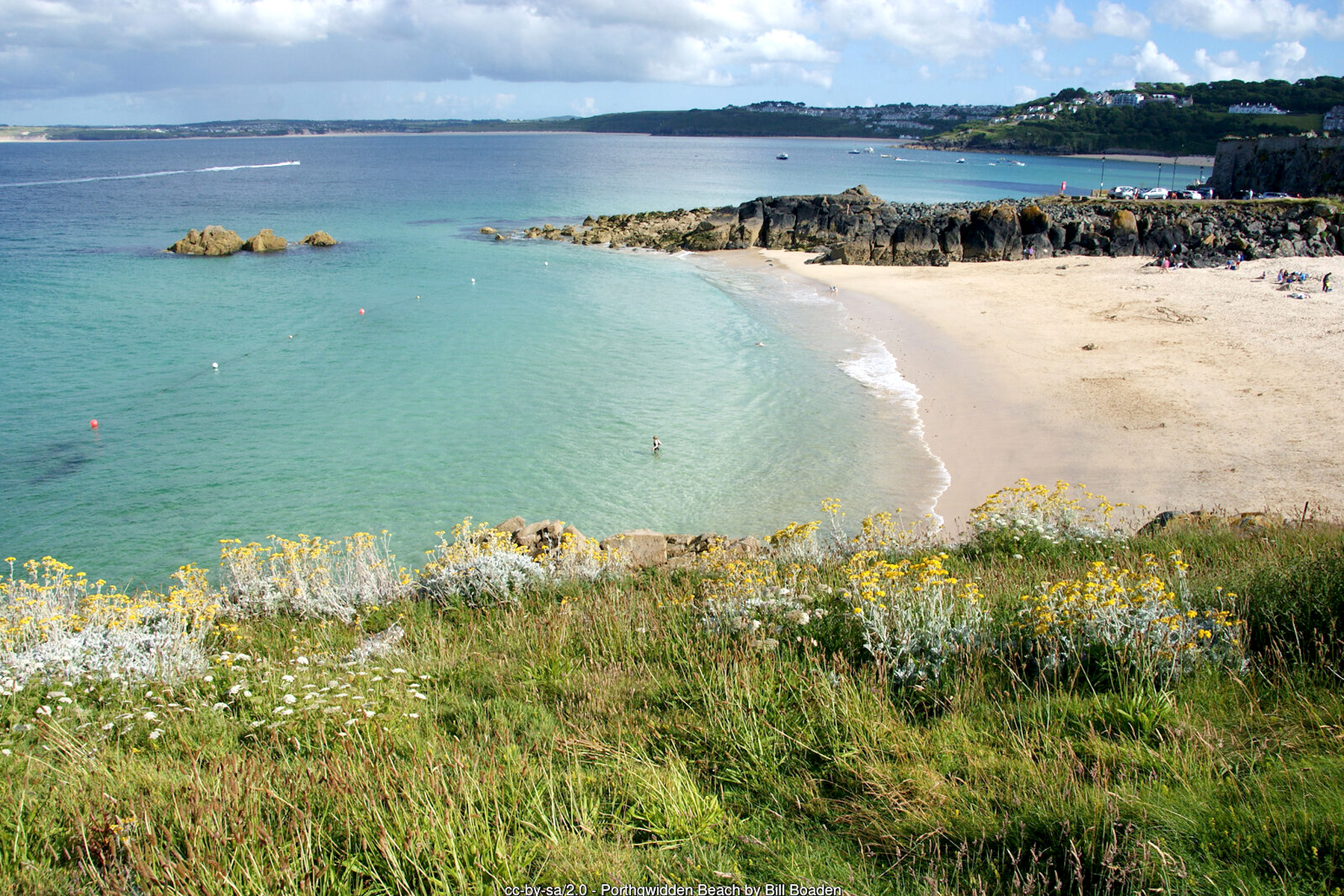
Reaching Porthgwidden is part of the pleasure of it: a short, easy walk around the base of St Ives Head from the harbour and Wharf Road, along a level path with the Island's grassy slopes rising on one side and the sea on the other. The headland above was known historically as Pendinas, an old Cornish name meaning roughly "fortified headland," and it is genuinely a headland rather than an island - a narrow neck of land, or isthmus, has always connected it to the town, though at the highest tides of the past it is thought to have come close to being cut off. Today the Island is common land, laced with footpaths that loop right around its clifftop perimeter, giving walkers uninterrupted views back over the rooftops of St Ives, across the harbour and Smeaton's Pier, and out over St Ives Bay towards Godrevy Lighthouse in the distance. The same paths connect Porthgwidden, on the sheltered east side, to Porthmeor beach and the Tate gallery on the exposed, Atlantic-facing west side - so it is entirely possible to stand on two very different beaches within a few minutes of each other, simply by walking around the headland.
At the top of the Island stands the little Chapel of St Nicholas, a small, plain, one-room granite building that Historic England lists as a medieval structure, "probably 14th century" in origin, dedicated to St Nicholas as the patron saint of sailors and fishermen. A record from 1538 describes "a chapel of St Nicholas and a pharos for light for ships sailing by night" on the site - suggesting that, long before any formal lighthouse existed at St Ives, a beacon here was already helping guide boats safely home. By the 18th and 19th centuries the chapel had taken on a very different role, used by "preventative men" - the customs officers of the day - as a lookout post for smugglers, since the Island's high, commanding position over the coves below made it an obvious place to watch for boats trying to land contraband quietly at Porthgwidden or Porthmeor. Nearby, on Lamp Rock at the Island's north-eastern tip, a pole fitted with a lantern once served a similar navigational purpose, guiding fishing boats into Porthgwidden itself when the cove was the town's principal landing place, long before Smeaton's Pier and the harbour took on that role.
The chapel's own survival was not guaranteed. It fell out of religious use and by the late 19th century was being used by the War Office for storage; in 1904, without recognising its historical or architectural value, the War Office partially demolished it. Public opposition in the town followed, and in 1911 - coronation year for King George V - the St Ives ship owner Sir Edward Hain funded its restoration, largely using the original materials. A further, more extensive restoration took place in 1971, funded by J. F. Holman with the cooperation of the then borough council. The chapel is Grade II listed today, and still occasionally hosts wedding blessings, though it holds no licence for legal marriage ceremonies and seats only a handful of people.
The Island's military history runs deeper than the chapel alone. Parish records describe the headland being fortified as early as 1638, reportedly with as many as fifteen guns in place, and the granite battery walls still visible to the south of the modern lookout date from 1860, built amid fears of a French invasion under Napoleon III - complete with three gun emplacements and small armouries, though the guns themselves were removed as the invasion scare passed, by 1895. The Island might easily have been lost to development altogether: St Ives Town Council bought the headland outright in 1907 for £650 specifically to keep it as public open space, and it went on to host travelling circuses and fairs in the years that followed. Its most famous rescue came in the 1960s, when a proposal to extend the car park across part of the headland was fought off by a local campaign - led by the historian Frank Halliday and backed by the sculptor Barbara Hepworth, who had made St Ives her home - that succeeded in blocking the scheme through a High Court injunction, preserving the Island much as it appears today.
The old 1860s battery position is still in use as a lookout, though for a very different purpose. HM Coastguard operated an enclosed watch station here until local stations were closed nationally in 1994; volunteers from the National Coastwatch Institution formed a new St Ives station in 1999, leased the site from the council, and refurbished the lookout in 2012. It remains staffed 365 days a year, watching over the bay, Porthgwidden and the approaches to the harbour - useful to know, since it means there is always a trained eye on the water even though no RNLI lifeguards patrol the sand at Porthgwidden itself. The Island is also well regarded among birdwatchers, with autumn seawatches from the headland turning up a good variety of passing seabirds, and dolphins and porpoises are seen from here from time to time out in the bay.
Porthgwidden even had a brief spell as the base for St Ives' lifeboat. A boathouse was built above the beach in the early 1860s to house the town's newly arrived lifeboat, but the site was abandoned within a few years once it became clear that hauling a loaded lifeboat carriage back through St Ives' narrow lanes - Fish Street among them - to a useful launch point was simply impractical. The station moved on, eventually settling at its present home on Wharf Road beside the West Pier, but the short-lived Porthgwidden boathouse is a reminder of how central this small cove once was to the working life of the town, long before it became a beach for sunbathing and rock pooling.
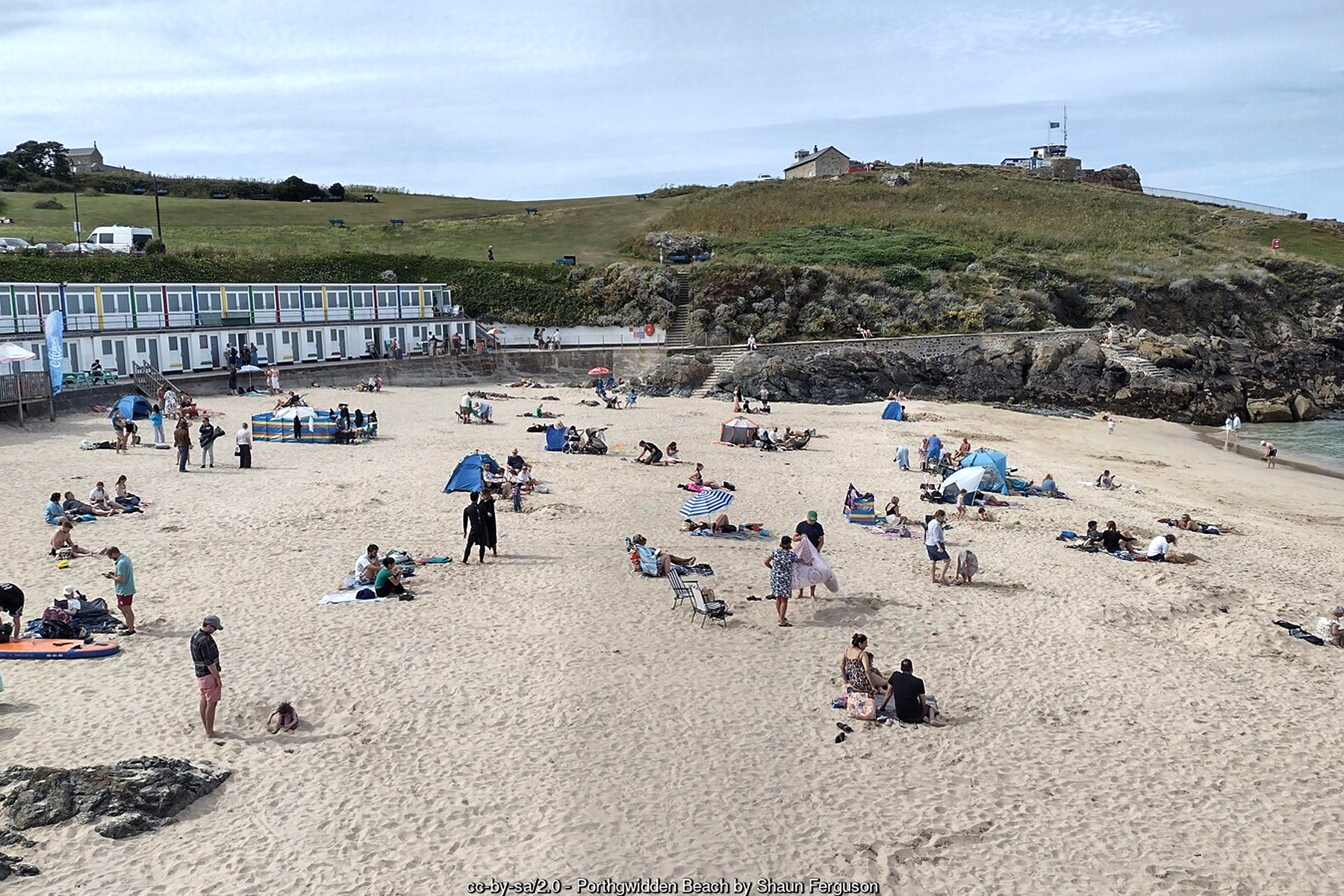
On the sand itself, today's Porthgwidden is a straightforward, low-key pleasure: soft golden sand backed by a row of colourful, two-storey beach huts and chalets - around three dozen of them, hired out by the day, week or season, each including a couple of deckchairs - with a beach café serving food, drinks and ice creams from a small terrace above the sand. Rocky outcrops close in the cove at both ends, exposing rock pools at low tide and offering some sheltered snorkelling close to shore when the water is clear. Because the beach faces east into the shelter of the headland, it stays calm in the south-westerly winds that trouble much of the rest of the Cornish coast, and is generally safe for swimming and paddling - the one exception being a spell of easterly wind, which blows straight into the cove and can quickly raise a chop, so it is worth checking the forecast if that is the plan for the day.
Practicalities are straightforward too, if you know where to look for parking. There is no car park built specifically for beach visitors right on the sand, but Cornwall Council's "Island" car park, a short walk above Porthgwidden with room for well over a hundred cars, is the practical option and the one most visitors use - it fills early on a fine summer day, so arriving before mid-morning pays off. Slightly confusingly, a second, separate car park is also named "Porthgwidden," but this one is long-stay and permit-holders only, so it is not available for a casual visit to the beach - the Island car park, not the Porthgwidden car park, is the one to head for. Toilets and showers are provided behind the beach, and access down to the sand involves some slope and uneven ground rather than a level path, so wheelchair and pushchair users should expect a degree of difficulty, particularly at the lower end of the tide.
Visitor Information
Parking
No car park sits directly on the beach. Cornwall Council's Island car park, just above the cove, is the main option and fills early in summer - not to be confused with the separate, permit-only "Porthgwidden" car park nearby.
Facilities
Beach café, toilets and showers behind the beach, plus colourful beach huts and chalets available to hire by the day, week or season.
Disabled Access
Partially accessible - the approach involves some slope and uneven ground rather than a level path down to the sand. No dedicated Blue Badge bays at the beach itself, though Blue Badge holders benefit from Cornwall Council's standard concessions at the nearby Island car park.
Things to Do Nearby
- Harbour Beach, a short walk around the harbourside
- Bamaluz Beach, a small hidden cove tucked below Wheal Dream, between here and the harbour
- Porthmeor, the Atlantic-facing beach on the far side of the Island
- Tate St Ives, overlooking Porthmeor Beach
- Barbara Hepworth Museum & Sculpture Garden, in the artist's former studio and garden
- St Nicholas Chapel, the tiny medieval chapel atop St Ives Head above the beach
Places to Stay
Frequently Asked Questions
Page last updated: 9 September 2026.