Trevellas Porth
A Quiet Tidal Cove in a Historic Cornish Mining Valley
Trevellas Porth, near St Agnes, Cornwall, TR5 0XP
Trevellas Porth is a small, secluded cove tucked into the mouth of Trevellas Coombe, a steep wooded valley on Cornwall's north coast midway between St Agnes and Perranporth. It sits immediately north of the much better-known Trevaunance Cove, separated from it by a short stretch of rocky shoreline, and it receives a fraction of the visitors that its larger neighbours in St Agnes and Perranporth attract. There is no cafe, no shop and no lifeguard here, parking is limited to a small informal car park down a steep lane, and the beach itself is genuinely tidal - a good deal of it disappears entirely at high water. What draws people down into the valley regardless is the setting: a quiet, rocky cove ringed by the unmistakable remains of Cornwall's tin and copper mining industry, with old engine houses, a chimney stack and processing-floor ruins still standing in the coombe just above the sand.
The cove itself is composed mainly of shingle and coarse sand, with substantial areas of exposed rock towards both sides and a small stream - the same watercourse that once powered the valley's tin-processing machinery - running down across the beach to the sea. It is not a large, open sand beach in the way Perranporth is; it is compact, enclosed by low cliffs, and its size and character change considerably with the state of the tide. At low water there is a reasonable spread of sand and rock to explore, with rock pools along the margins, while at high tide the beach narrows sharply and much of it is submerged. Some walkers scramble over the rocks between Trevellas Porth and Trevaunance Cove when the tide is well out, but this route crosses unstable ground beneath the cliffs and should not be relied on - anyone tempted to try it should check tide times carefully and be prepared to turn back rather than risk being caught out by the incoming sea.
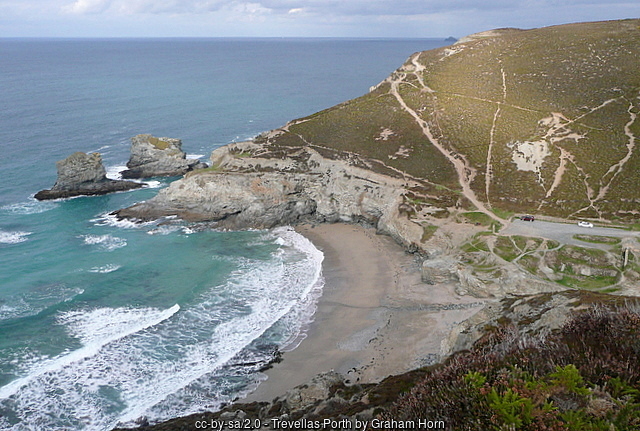
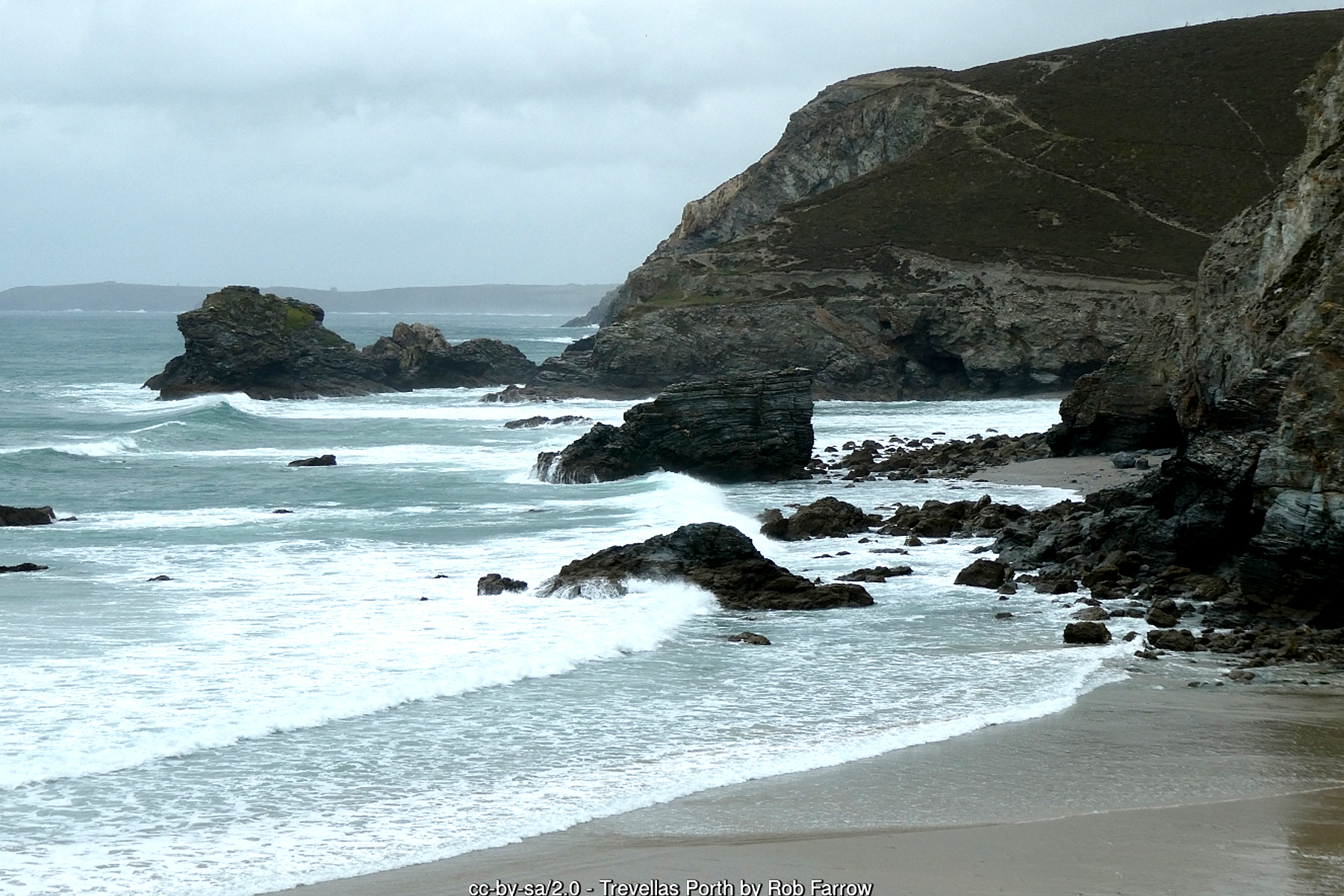
The valley above the beach is part of the St Agnes Mining District, one of the ten areas that together make up the Cornwall and West Devon Mining Landscape World Heritage Site, and its industrial history goes back much further than the ruins visible today suggest. The name Trevellas is first recorded in 1302, as the manor of the Trevellas family, and the valley was known locally for centuries as "Blue Hills" after the bluish, mineral-stained slate exposed in its sides. Tin was originally recovered here by streaming - washing loose alluvial ore out of the valley gravels - long before deep shaft mining began, and from the late seventeenth century onward the same stream that still crosses the beach was harnessed to power stamps and other tin-processing machinery. By the nineteenth century the lower valley had been transformed into a working industrial site, with ore-dressing floors, waterwheels and eventually steam engines crowded into a coombe that today looks almost entirely wild.
The Blue Hills sett itself was formally established in 1810, bringing together several older, smaller workings - including a mine known as Wheal Betsy - under one company, though some tin extraction here is thought to have continued on and off since at least the 1780s. The mine closed in 1819, reopened in 1858, and was worked underground jointly with the neighbouring Penhalls mine from 1879 before the two separated again in 1893; Blue Hills finally closed for good in 1897, when Cornish tin could no longer compete with cheaper ore coming from Australia and Malaya. What survives in the valley today includes a roofless slate engine house that once held a 60-inch pumping engine installed in 1869, its associated chimney stack, and the more fragmentary remains of a horizontal whim and stamps further up the coombe, along with traces of the waterwheel that once drove the stamps closer to the beach. Penhalls Mine's own history in turn connects the valley to Wheal Kitty, a substantial mine on the road between St Agnes and Trevellas whose restored engine house, built around a 65-inch beam engine, once pumped a shaft nearly 950 feet deep before the mine finally closed in 1930 - together the old workings of Trevellas Coombe, Penhalls and Wheal Kitty give a good sense of just how industrialised this now-quiet corner of the coast once was.
Remarkably, tin processing in the valley never entirely stopped. Blue Hills Tin Streams, a little way up the coombe from the beach, is widely described as the last working tin streaming operation left in Cornwall, still crushing, washing and smelting small quantities of tin using traditional methods and open to visitors during the main season. It is a genuine working link to an industry that, at its Victorian peak, filled this valley with sheds, machinery and noise, and it sits only a short, easy walk up the track from the cove itself - a natural stop for anyone combining a visit to the beach with a look at the mining landscape above it.
Getting down to Trevellas Porth is part of its appeal, and part of its difficulty. The lane into the valley from the St Agnes side drops steeply through a series of bends, including one notably sharp hairpin, before reaching a small car park close to the beach with room for only a limited number of vehicles - it can fill quickly on a fine day, particularly in summer. A larger car park sits on the clifftop above the valley, from where a rough, unsurfaced track with wide sea views leads down to join the coast path and the beach, a walk of roughly ten to fifteen minutes each way. The onward path down to the sand itself crosses rock and uneven ground and is not suitable for wheelchairs or buggies. The South West Coast Path runs along the top of the valley, linking Trevellas Porth on foot to Trevaunance Cove to the south - a steep climb past the Driftwood Spars pub in St Agnes - and onward towards Perranporth to the north, and the walk from Trevaunance Cove up through the mining remains of Trevellas Coombe is a well-known short circular route in its own right.
There are no facilities of any kind at the beach - no toilets, shop, cafe or bins - so visitors need to bring what they need and take everything away again; the nearest toilets, cafes and shops are at Trevaunance Cove, about a mile away by road or path, or in St Agnes and Perranporth themselves. There is no lifeguard cover at Trevellas Porth at any time of year, and signage at the cove warns of strong undercurrents, so it is not treated as a recommended swimming beach; it is better known among snorkellers, rock-poolers and local anglers making the most of calmer conditions than among swimmers. Dogs are welcome at Trevellas Porth all year round, with none of the seasonal summer restrictions that apply on the larger, more commercial beaches nearby, though the cove is small and rocky rather than a wide-open space for a dog to run.
Beyond the mining history, Trevellas Coombe is also worth a mention for its wooded upper reaches, a rare pocket of valley woodland on an otherwise largely open, cliff-top stretch of coast, and for the Bronze Age burial mound recorded nearby that hints at a much older human presence in the area than even its tin workings. The painter John Opie, later known as "the Cornish Wonder" and celebrated as a portraitist in Georgian London, was born in Trevellas in 1761 - an unexpected footnote for so small and industrial a valley. Today, with its engine house ruins overgrown and its tin streaming works still quietly turning nearby, Trevellas Porth is best approached less as a conventional beach day out than as a short, atmospheric detour: a cove for those interested in mining heritage, a quiet corner for coast path walkers, and a genuine contrast to the busier sands of Perranporth just along the coast.
Visitor Information
Parking
A small car park close to the beach, down a steep valley lane with a sharp hairpin bend - limited spaces, fills quickly in fine weather. An alternative, larger car park on the clifftop above leads down via a rough track and the coast path (10-15 minutes' walk each way).
Facilities
None on site - no toilets, shop or cafe, and no lifeguard cover at any time of year. Nearest facilities are at Trevaunance Cove, about a mile away, or in St Agnes and Perranporth.
Disabled Access
Not wheelchair accessible - the approach from either car park is steep, and the final path to the beach crosses rock and uneven ground. No dedicated Blue Badge provision; parking at the small beachside car park is informal and limited.
Things to Do Nearby
- Trevaunance Cove, St Agnes's main beach with a pub, cafes and the remains of its historic mineral harbour, a short walk or drive south
- Perranporth, a large sandy surf beach a few miles up the coast
- Blue Hills Tin Streams, a working tin processing operation a short walk up Trevellas Coombe, widely regarded as the last of its kind in Cornwall
- South West Coast Path Guide - the section linking Trevaunance Cove, Trevellas Coombe and Perranporth passes directly above the cove and its old mine workings
- St Agnes & Trevaunance Cove Town Guide
Places to Stay
Frequently Asked Questions
Page last updated: 8 September 2026.