Perranporth Beach
Cornwall's Great Dune-Backed Surf Beach
Perranporth, Cornwall, TR6 0EY
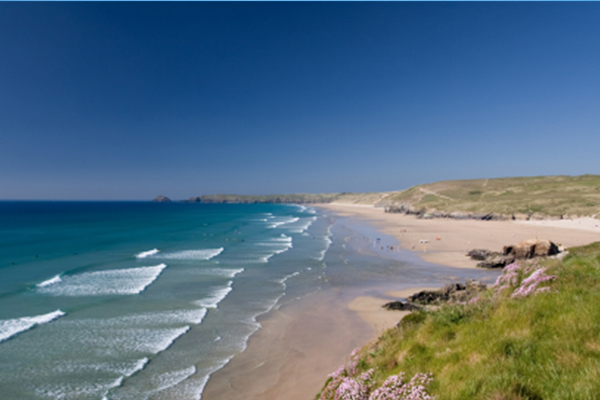
Perranporth is one of the great beaches of Cornwall's north coast, a wide, west-facing sweep of golden sand running from the village northeast for the best part of two miles towards Ligger Point, where it merges into the even longer strand of Perran Sands. At low tide the beach opens out to a huge expanse of firm, flat sand backed by Penhale Sands, the largest sand dune system in Cornwall, and hemmed in to the south by the cliffs of Droskyn Point and Cligga Head. It is this combination - space, scale, reliable Atlantic surf and a genuinely wild dune hinterland behind an otherwise busy, well-equipped resort beach - that has made Perranporth one of the most popular beaches in the county for surfers, families and walkers alike.
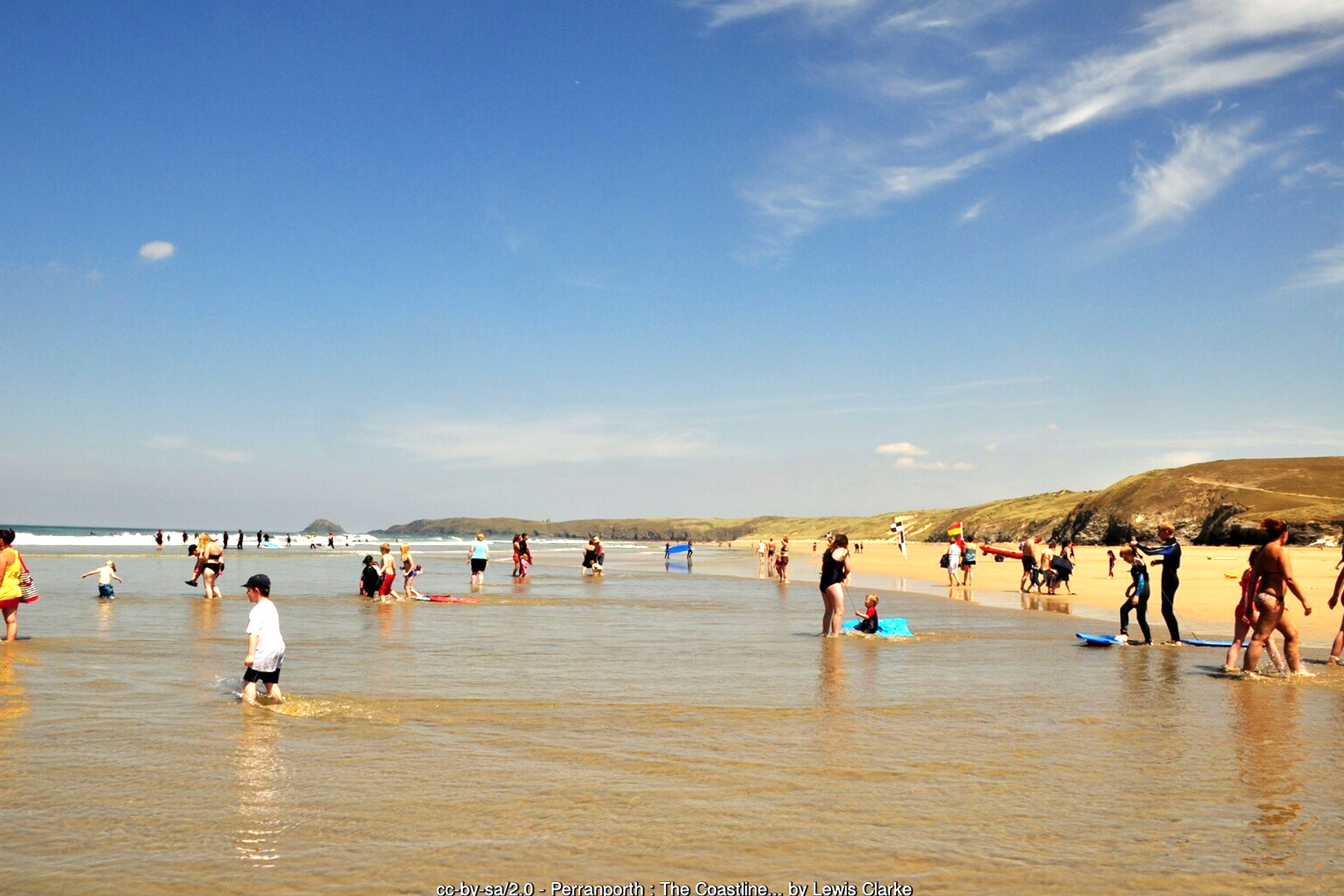
The village grew up at the mouth of a small stream cutting through the dunes, its name deriving from Cornish for "cove of Piran" - a reference to St Piran, patron saint of Cornwall and of tin miners, who according to tradition landed nearby and founded a hermitage in the sands in the sixth or seventh century. Like much of this stretch of coast, Perranporth's economy was originally built on tin and, later, tourism as the railway and then the motor car opened the north coast to summer visitors through the twentieth century. Mining left its mark directly on the beach: at the southern end, natural rock arches and stacks sit alongside old tin-mining adits driven into the cliff face, and in the nineteenth century iron ore was worked from the foreshore itself, hauled up the cliff by a steam-powered "puffer" engine. The wreck of the barque Voorspoed, driven ashore here in a storm in March 1901, is one of several shipwrecks recorded along this exposed section of coast.
Behind the beach, Penhale Sands (also known as Perran Sands) forms a dune system of well over a thousand hectares, reaching more than a mile inland in places and, in places, over 45 metres deep in wind-blown sand - by most measures the most extensive dune system in Cornwall. It has been a Site of Special Scientific Interest since 1953 and a Special Area of Conservation since 2004, protected for a rare community of lime-loving plants that thrives on the calcium-rich sand (itself made largely of broken shell fragments), including the nationally scarce Cornish gentian and Babington's leek. The dunes support an exceptional range of invertebrates - dozens of butterfly and moth species, including Cornwall's largest colony of the silver-studded blue butterfly - and are one of the best places in the county for this kind of dune wildlife, best appreciated by keeping to the marked paths rather than trampling the fragile, slow-growing dune grassland.
Part of Penhale Sands has a very different, more recent history. Penhale Camp was established as a military training ground in 1939 and saw tragedy early in the Second World War when a German bombing raid in 1940 killed twenty-two British soldiers stationed there; the camp was later used by United States Army combat engineers in 1943 as part of the build-up to the D-Day landings, and several Nissen huts from that period still stand. The Ministry of Defence continued to use the site for training into the twenty-first century, closing the camp in 2010, and MOD byelaws still apply to parts of the dunes, so it is worth heeding any local signage while exploring away from the beach itself.
The most historically important site hidden within these dunes is St Piran's Oratory, reputed to be one of the oldest Christian buildings in Britain and traditionally identified as the very hermitage founded by St Piran himself. Buried for centuries by shifting sand, it was rediscovered and excavated in 1835, with further excavation in 1843, but the exposed remains proved impossible to protect from the elements and the encroaching dune, and the oratory was deliberately reburied for its own preservation in 1980. It was carefully excavated once more in 2014, and the low walls of the little chapel can now be seen again, a short but genuinely evocative walk into the dunes from the beach. St Piran's Day is marked every 5 March with a procession across the sands to the oratory, a tradition that has grown into one of the best-attended folk celebrations of Cornish identity anywhere in the county.
Back on the beach itself, Chapel Rock is Perranporth's best-known landmark - a large outcrop standing roughly in the centre of the sand that forms a natural tidal pool on its seaward side. For a few hours either side of low tide it is a popular, sheltered spot for families and younger children to paddle and swim, and generations of locals and visitors have also used the rock as a cliff-jumping spot into the pool below. This is worth treating with real caution: water depth over the pool changes constantly with the tide and shifting sand, submerged rocks are not always visible from above, and currents can run hard on the ebb tide close to the rock - so anyone jumping should check the depth and conditions first, never jump alone, and be aware that Chapel Rock is completely cut off from the rest of the beach as the tide comes in.
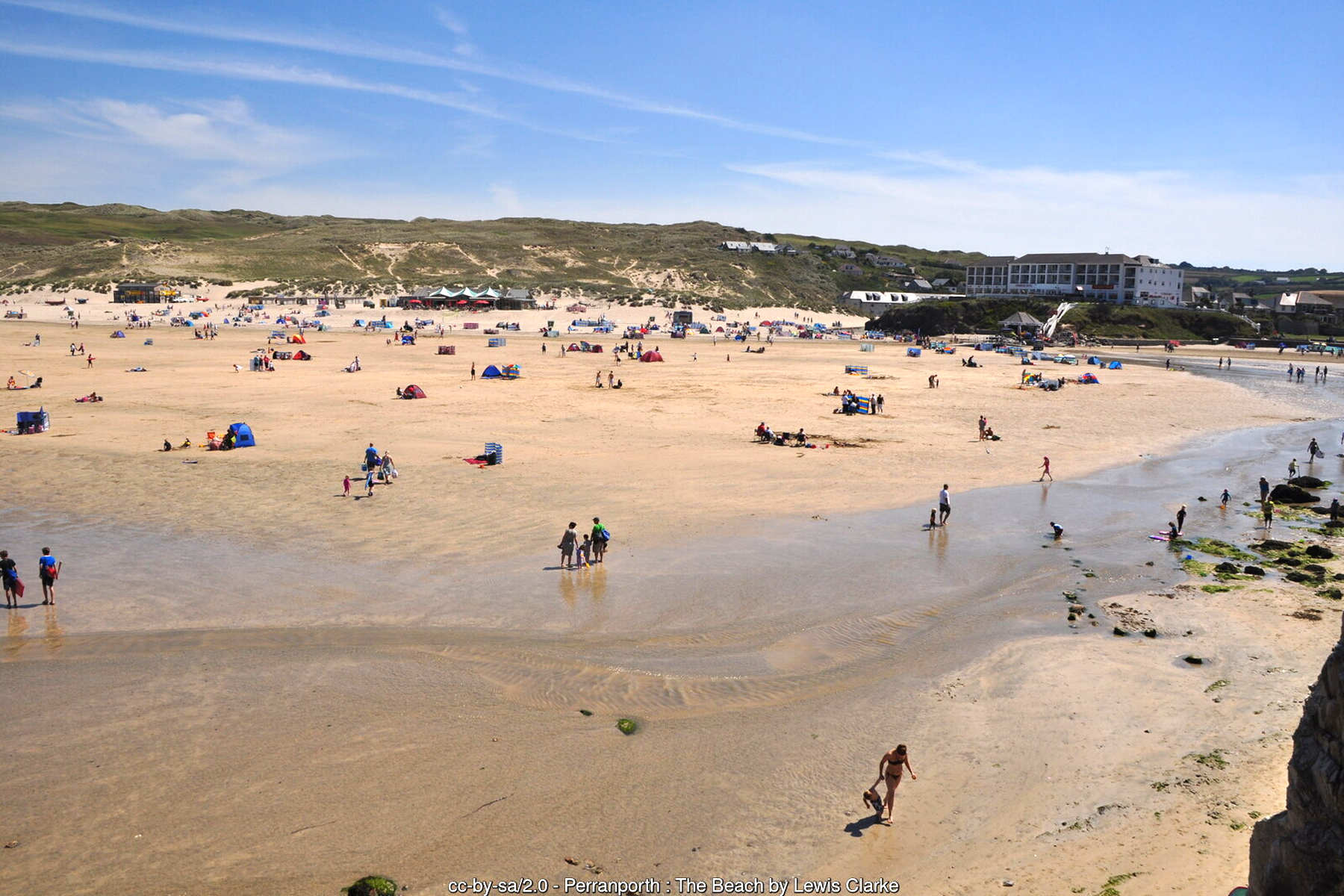
A couple of hundred yards from Chapel Rock stands the Watering Hole, a beach bar built directly on the sand that markets itself as the only pub in the UK actually sited on a beach, and one of Perranporth's best-loved fixtures, known for live music as much as for its position. To the south, the cliffs rise to Droskyn Point, a headland with a former youth hostel and superb coastal views back along the length of the beach and dunes; the South West Coast Path continues from here past the old mine workings of Cligga Head, where cliffs reach around 300 feet and the abandoned tin, tungsten and arsenic workings add another layer of industrial history to the walk. An eighteen-hole links golf course, Perranporth Golf Club, occupies part of the dune system inland of the beach, laid out among the same dune ridges that make the wider Penhale Sands so distinctive.
Perranporth has a long-standing reputation as an excellent all-round surf beach, with a beach break that produces consistent, long rides and suits a wide range of ability levels, from complete beginners taking a first lesson to more experienced surfers looking for a reliably good wave on the right swell and tide. Its scale means it rarely feels as crowded as some of Cornwall's smaller, more famous surf spots even at the height of summer, and several surf schools and hire outlets operate from the beach and village. The size of the beach and the strength of the Atlantic swell do, however, mean rip currents can develop, particularly around Chapel Rock and the rockier margins of the bay - RNLI lifeguards patrol through the main season and are worth heeding, especially on bigger swells.
Away from the main summer season, Perranporth rewards a quieter visit - a big spring low tide exposes the full width of the beach and its rockpools, the dunes are at their most colourful with wildflowers in early summer, and a clear winter's day gives some of the best long-distance coastal views on this part of the north coast, out past Ligger Point towards Holywell Bay and Kelsey Head to the north and towards St Agnes Head to the south. The beach's popularity and the narrow lanes leading down into the village mean summer weekends can be busy on the roads and in the car parks, so an early start or a walk down from one of the surrounding villages is often the easier option in July and August.
Visitor Information
Parking
Several pay-and-display car parks serve the beach, including Droskyn car park at the top of Cliff Road, Wheal Leisure car park on the seafront, and a seasonal long-stay overflow car park at Chyanhale in Ponsmere Valley. All can fill quickly on busy summer days.
Facilities
Public toilets, the Watering Hole beach bar plus other cafes and a beach shop, surf hire and surf schools, a first aid point and a lost-child point in season. RNLI lifeguards patrol daily from 3 April to 1 November, 10am to 6pm.
Disabled Access
The promenade and main approach give reasonably level access onto a large expanse of firm, flat sand, and a beach wheelchair can be booked locally for use on the beach itself. Confirm current Blue Badge parking provision with Cornwall Council before you travel.
Things to Do Nearby
- Holywell Bay, a sandy, dune-backed beach a few miles north sharing the same Penhale Sands dune system
- Trevaunance Cove, the harbour beach at St Agnes a short drive south
- St Piran's Oratory, the reburied and re-excavated early Christian chapel hidden in the dunes behind the beach
- Perranporth Surf Guide - surf schools, hire and conditions for this beach
- Perranporth Village Guide - the wider village, its history and holiday information
Places to Stay
Frequently Asked Questions
Page last updated: 8 September 2026.