Holywell Bay
Dunes, Sea Caves and Atlantic Surf on the National Trust's Kelsey Head Coast
Holywell Bay, near Cubert, Cornwall, TR8 5PP
Holywell Bay is one of the largest and most dramatic beaches on Cornwall's north coast, a broad sweep of golden sand tucked between the headland of Kelsey Head to the south and Penhale Point to the north, roughly midway between Perranporth and Newquay near the village of Cubert. Most of the coastline here, including the towering dune system behind the beach and the headlands at either end, is owned and managed by the National Trust as part of its Holywell and Kelsey Head holding, which forms part of the wider Kelsey Head, Holywell Dunes and Penhale Sands Site of Special Scientific Interest. It is a genuinely family-friendly beach, with rock pools, a shallow freshwater stream running down the sand and one of the biggest dune systems in Britain to explore, but it is also a serious, exposed Atlantic surf beach, and the combination of the two is central to its appeal.
Surfing is one of the main reasons people come to Holywell Bay. The beach faces almost due west into the open Atlantic with nothing offshore to soften an incoming swell, and it holds a reliable, powerful break that suits everything from complete beginners in the whitewater to more experienced surfers and bodyboarders looking for a proper wave. Several surf schools operate from the beach through the season, and the long-established Holywell Bay Surf Life Saving Club trains and competes here, part of the wider Surf Life Saving GB movement that grew out of Cornwall's beach culture. That same exposure to Atlantic swell, though, makes conditions changeable and sometimes powerful, and rip currents are a documented hazard here, particularly around the stream outflow and the rocky ground toward the northern end of the beach - RNLI lifeguards have carried out multiple rip-current rescues at Holywell Bay in past seasons, including group rescues of several swimmers and bodyboarders at once. RNLI lifeguards patrol daily from mid-May to the last weekend of September, and the advice, as everywhere on this coast, is to swim and surf between the red and yellow flags whenever they are flying and to never swim alone.
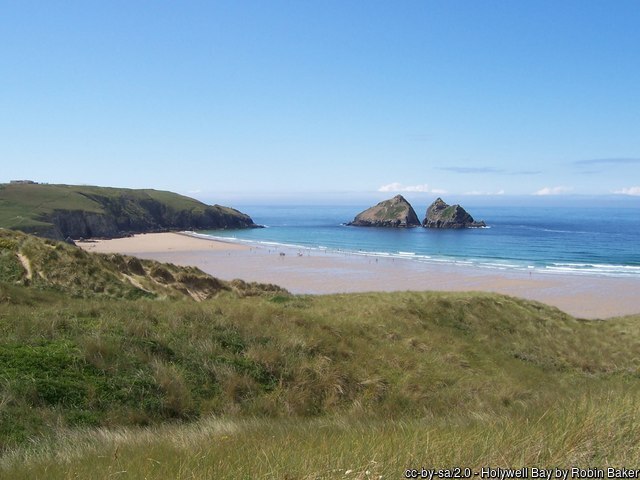
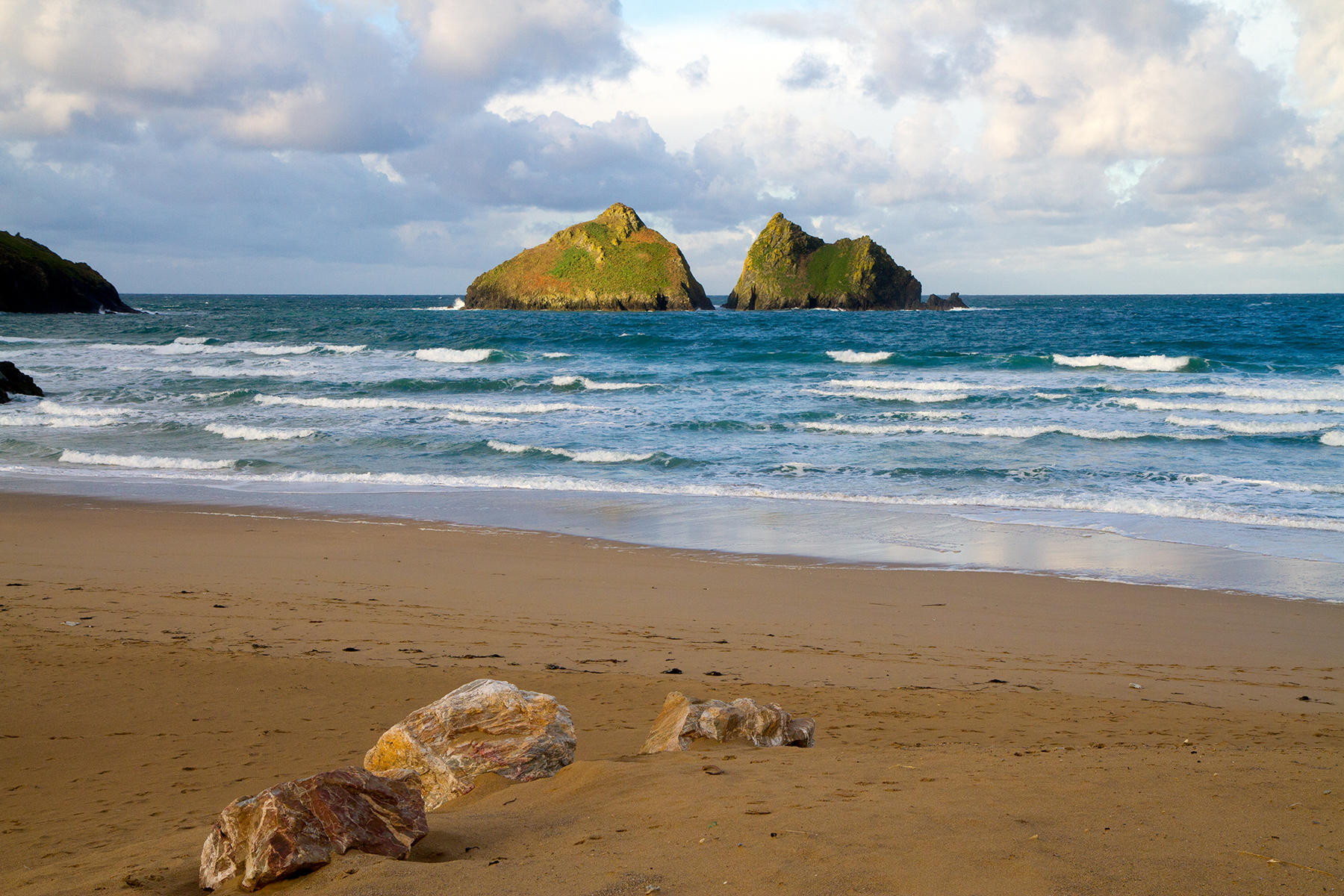
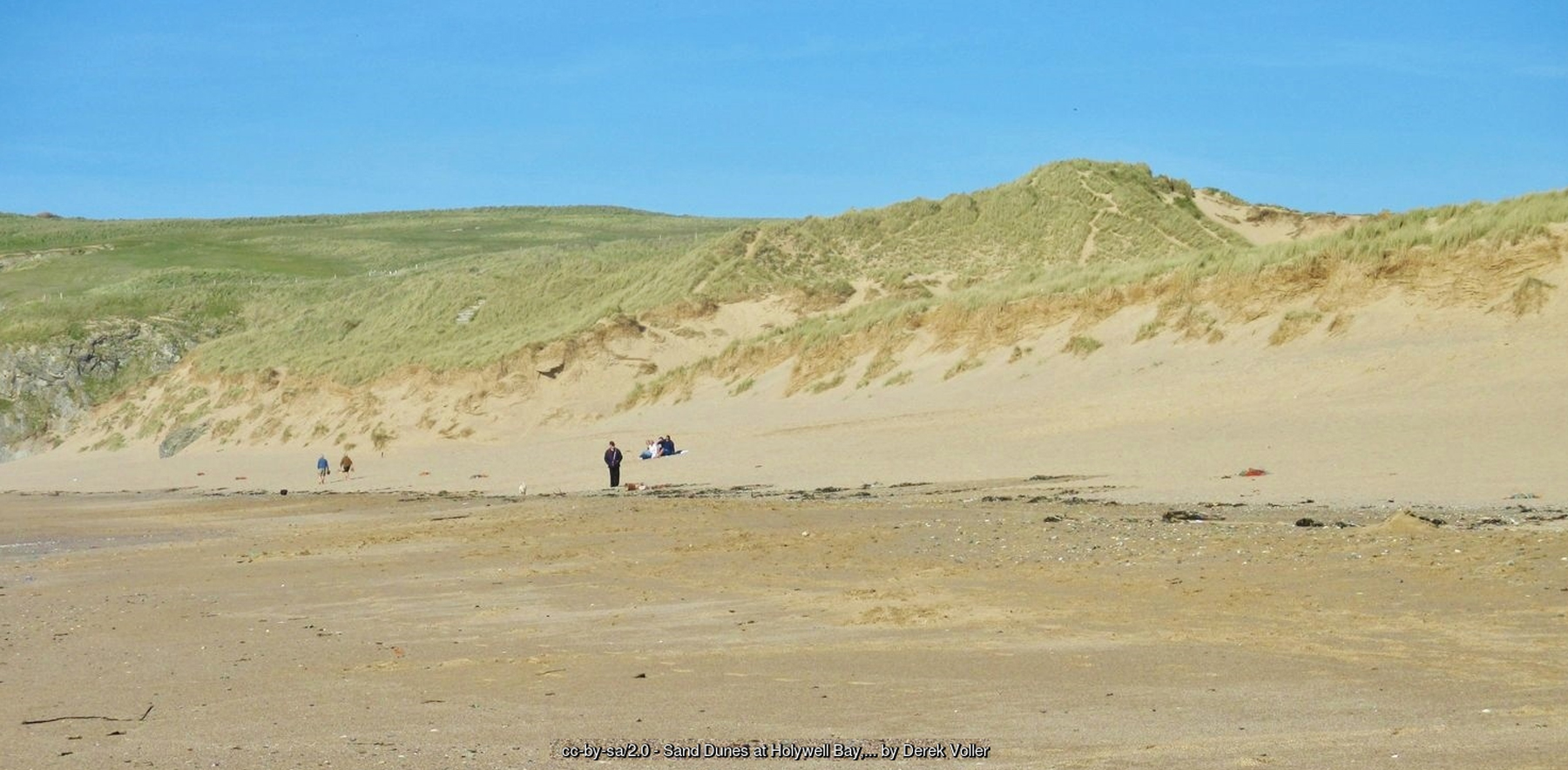
The dunes behind the beach are the real physical spectacle at Holywell Bay. Rising in places to more than 20 metres, they form part of a vast dune system - Penhale Sands - that runs for around five miles down the coast from Perranporth to Crantock, one of the largest and most important sand dune complexes in Britain. Close to the beach the dunes are mobile and largely bare, shaped constantly by wind and salt spray, while further inland they stabilise into fixed dunes and dune grassland bound together by marram grass, sea holly and evening primrose, with damp dune slacks supporting a very different range of plants in between. This mix of mobile and fixed dune habitats, along with the calcareous grassland of neighbouring Cubert Common - itself a registered ancient common - underpins the whole area's SSSI status and supports a wealth of invertebrates and ground-nesting or cliff-nesting seabirds that are easy to overlook among the more obvious appeal of the beach itself.
At the southern end of the bay, Kelsey Head rises as a steep, grass-topped headland with the well-preserved earthworks of an Iron Age cliff castle along its top - a defended promontory fort roughly 170 by 160 metres across, with earth and stone ramparts, a smaller annexe and an outer ditch, and evidence of even earlier Mesolithic and Neolithic activity found nearby in the form of worked flint. Just off Penhale Point at the northern end of the beach sit a pair of jagged offshore rocks known locally by several names - Carter's Rocks, Gull Rocks and, because of their shape, Fishtail Rocks - which are also in National Trust ownership and provide a nesting platform for gulls and other seabirds; seals are regularly seen hauled out or fishing in the water around Kelsey Head. Both headlands are strung along the South West Coast Path, which links Holywell Bay north to Porth Joke, Crantock and Newquay, and south around Perran Beach to Perranporth, making the beach a natural halfway point on some of the most scenic coastal walking in this part of Cornwall.
The beach's name comes from an ancient holy well hidden inside a sea cave at its northern end, reachable only for a couple of hours either side of low tide. Inside, a natural spring trickles down through a small, strikingly colourful mineral-stained grotto into a series of terraced rock pools, and worn stone steps cut into the rock mark an entrance that has drawn visitors for centuries - the water was traditionally believed to be sacred, with pilgrims said to have visited seeking cures for various ailments, possibly under the dedication of St Cubert, whose name is preserved in the neighbouring parish. A second, very different holy well associated with Holywell survives inland near the Holywell Bay Golf Club and Trevornick, with a small medieval stone surround built up around it like a roofless chapel. Visitors should note that the sea cave itself suffered a serious rockfall on 30 August 2026, when several hundred tonnes of cliff material collapsed and completely smothered its entrance; the National Trust has asked visitors to stay well back from the affected area on the beach and on the clifftop paths above, as the cliff remains unstable, so the cave should be treated as closed and inaccessible until further notice.
At low tide, the wreck of a ship can also be made out embedded in the sand toward the northern end of the beach, generally believed to be the remains of the SS Francia, a roughly 700-ton steam coaster that came to grief here in 1917 while carrying a cargo of coal out of Newquay - though accounts differ on the exact circumstances, with some records suggesting the vessel actually foundered several miles offshore rather than at the beach itself. Either way, the timbers and metalwork exposed by shifting sand are a genuine point of interest for a falling-tide walk, best combined with a look at the rock pools that appear around the same stretch of foreshore.
Tide has a big influence on what Holywell Bay offers on any given visit. At low water the sand opens right out into a huge, flat expanse running from Kelsey Head almost up to Penhale Point, exposing the wreck timbers, the best of the rock pools and, when the low tide window allows, the entrance to the holy well cave; as the sea comes back in, the beach narrows quickly and the stream that crosses the sand widens into a small, shallow river that families often use as a natural paddling pool away from the main surf. The south end, tucked in under Kelsey Head, tends to be a little more sheltered than the open, north-facing stretch near Penhale Point, which is worth knowing on days when the wind is up. A rising swell after Atlantic storms can make Holywell hold decent surf even when smaller, more enclosed beaches nearby have gone flat, which is part of why it keeps its reputation among local surfers through the autumn and winter months as well as in summer.
Holywell Bay's scenery has also made it a popular filming location. Its beach hut once stood in for a military bunker on the coast of Korea for the opening sequence of the James Bond film Die Another Day, and the beach and dunes have since appeared in BBC's Poldark, in Agatha Christie's And Then There Were None, and more recently as the beach beneath fictional "High Tide Castle" in HBO's House of the Dragon, where several key scenes for Princess Rhaenyra and House Velaryon were filmed among the dunes and along the sand in the show's fifth and seventh episodes, with Carter's Rocks visible in the background of several shots.
Visitor Information
Parking
National Trust pay-and-display car park (TR8 5PP), open 7am-11pm - around £2.50 up to an hour, £5 up to four hours and £9 for the full day; free for National Trust members.
Facilities
Toilets, a beach cafe/bar (Gull Rocks Bar & Coffee House), surf school and equipment hire. RNLI lifeguards patrol daily from mid-May to late September.
Disabled Access
An accessible toilet with baby changing is available, though the dunes and much of the beach itself are uneven, sandy terrain with limited wheelchair access. Blue Badge parking bays are available near the beach entrance.
Things to Do Nearby
- Perranporth, a few miles south along the coast, with its own long sandy beach, dunes and the Watering Hole beach bar
- Porth Joke, a small, unspoilt cove just around Kelsey Head towards Crantock
- National Trust Holywell & Kelsey Head - the walks, wildlife and history behind the dunes and headlands
- Holywell Town Guide - the village, holiday parks and local amenities
- Surfing Cornwall Guide - surf schools and other breaks nearby
Places to Stay
Frequently Asked Questions
Page last updated: 8 September 2026.