Chapel Porth Beach
Cornwall's Beach That Disappears at High Tide
Chapel Porth, near St Agnes, Cornwall, TR5 0NS
Chapel Porth is one of the most dramatic beaches on Cornwall's north coast, a National Trust property tucked into a narrow, steep-sided valley between St Agnes and Porthtowan. High cliffs press in on both sides, the mouth of the cove opens straight onto the Atlantic, and the clifftop above is crowned by one of Cornwall's most photographed sights: the ruined engine house of Wheal Coates, perched on the very edge of the rock. Few beaches in the county pack so much into so small a space - a genuinely wild stretch of sand and rock, a working reminder of Cornwall's mining past, and a beach café whose ice cream has a small, devoted following of its own.
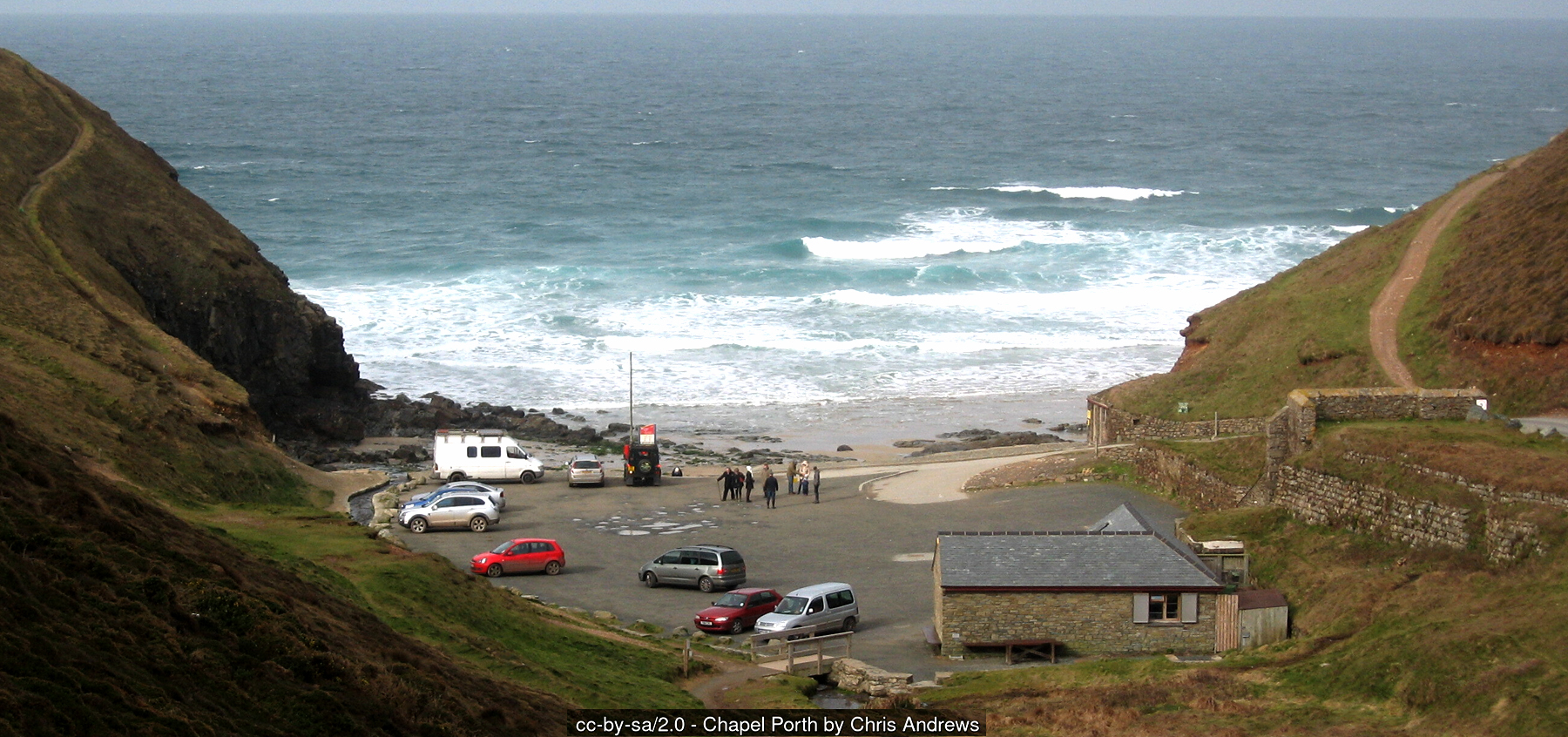
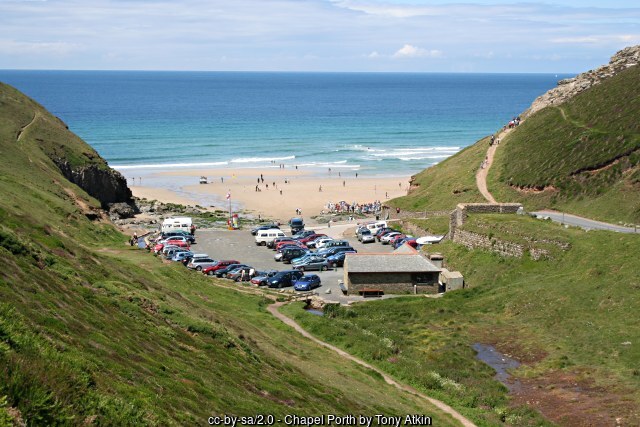
The single most important thing to know before visiting Chapel Porth is that the tide dictates almost everything about the beach. At low water, the sea retreats to reveal a broad, level expanse of golden sand backed by rock pools and low cliffs, easily wide enough for games, picnics and a proper walk along the shore. As the tide rises, that sand disappears with unusual speed - within a couple of hours the beach narrows to a cramped strip of stones hard against the cliff base, and on the highest tides of the month Chapel Porth can become completely covered, with no dry beach left at all. Visitors who plan around the tide table get the best of it; visitors who don't can find themselves cut off, or with nowhere left to sit. It is worth checking tide times before setting out, and building in enough time to get back across the sand before the sea claims it.
A National Trust pay-and-display car park sits right beside the beach, level and surfaced in compacted gravel, using the JustPark app and payment machines (free for National Trust members) - though it fills quickly on a warm day in the school holidays. RNLI lifeguards patrol on a seasonal basis, broadly from late May to September; outside that season, and outside the flagged area, there is no supervision. Dogs are welcome for most of the year, with a seasonal restriction between 1 July and 31 August, 10am to 6pm, when they are not permitted on the beach itself. And just above the car park sits the reason a good number of visitors make the trip at all: a beachside café, run under National Trust concession, famous well beyond Cornwall for its "hedgehog" - a wafer cone piled with local ice cream, a generous dollop of clotted cream, and a coating of crushed hazelnuts. It has been a fixture at Chapel Porth for years and the queue for one on a sunny afternoon is practically a local institution in its own right.
Geologically, Chapel Porth sits within the same Devonian slate and greenstone sequence that runs along much of this stretch of coast, cut through by a steep, narrow valley that historically carried mine workings, water and ore down to the sea. That valley shape is why the beach feels so enclosed compared with its open, sweeping neighbour Porthtowan a mile or so to the south - the cliffs here rise close and high on both sides, funnelling the swell in and, in stormy weather, throwing spray a long way up the valley. At low tide, rocks and small caves along the northern side reward an hour of exploring, and the sand itself is a rich, dark gold rather than the pale, bleached tone found on some other north-coast beaches, a result of the mineral-bearing rock the sea has been grinding down for millennia.
The clifftops above Chapel Porth are part of the St Agnes mining district, one of the richest and most intensively worked corners of the Cornwall and West Devon Mining Landscape World Heritage Site. Wheal Coates, the mine whose ruins overlook the beach, worked tin and some copper across several phases from the early 1800s, with its most productive years falling in the 1870s and 1880s before a final, short-lived attempt to rework it in the early 1910s. Its single most recognisable structure, the Towanroath Shaft engine house, was built in 1872 to house a pumping engine that kept the 600-foot Towanroath shaft beneath it free of water - without which the mine simply could not have been worked, since much of Cornwall's underground ore lies below the water table. The engine house was left to the elements after the mine finally closed, and was stabilised by the National Trust in 1986 to stop further decay; it is now Grade II listed and one of the most-photographed mining ruins anywhere in Cornwall, its chimney silhouetted against the sea on countless postcards, calendars and Instagram feeds. A network of shaft openings, capped with conical safety grilles, and other ruined mine buildings dot the heathland around it, a genuinely evocative landscape to wander even for visitors with no particular interest in mining history.
Chapel Porth has its own quieter, sadder story too. On the night of 18 November 1928, the Liverpool coaster SS Eltham, a 687-ton vessel under Captain Ellis Foulkes returning empty to Swansea after delivering coal to Rouen, was driven ashore here in a north-westerly gale and broke in two on the beach. All eleven of her crew were lost; evidence afterwards suggested they had taken to the lifeboats too far from shore, and currents carried wreckage and bodies some distance up the coast in the days that followed. Most of the wreck has long since broken up and washed away, but at very low tide one battered piece - the ship's boiler - can still occasionally be seen embedded in the sand, a quiet, easily missed memorial to a night that cost eleven lives.
Above the beach, the coast path threads along heather- and gorse-covered clifftops that turn a rich purple and gold through late summer, part of the wider St Agnes Heritage Coast. The short, well-trodden path up from Chapel Porth to Wheal Coates - a climb of well under a mile, though a steep one - is among the most popular walks in this part of Cornwall, rewarding the effort with the close-up view of the Towanroath engine house and, on a clear day, sea views stretching towards St Ives Bay in one direction and beyond Portreath in the other. St Agnes Beacon, a prominent hill a little further inland, is visible from much of the route and makes a natural extension for anyone wanting a longer walk. The heathland supports stonechats, linnets and skylarks, while fulmars and other seabirds nest on the cliff ledges either side of the cove; the rock pools at low tide are a reliable spot for anemones, small crabs and blennies, and a genuine draw for families exploring beyond the sand itself.
The beach also has a long-standing reputation with surfers, who rate its beach-break waves among the more reliable options on this stretch of coast when conditions align, particularly around mid tide before the sand narrows too far. As with any exposed Atlantic beach hemmed in by rock, rip currents can develop close to the cliffs and around the rocky margins, especially on a dropping tide, so sticking to the lifeguarded area in season, or taking local advice outside it, is worth the caution. The beach's narrow, valley-mouth setting means conditions can change quickly as the tide turns, which is part of why local knowledge and a glance at the tide table matter more here than at most Cornish beaches.
Chapel Porth is owned and managed by the National Trust as part of its wider St Agnes Heritage Coast holdings, and the car park is staffed by National Trust staff during peak season and on busy weekends. No overnight camping or sleeping in vehicles is permitted. The narrow road down into the valley is steep with a couple of passing places, and reaching the sand itself involves crossing cobbles, large rocks and pebbles below the car park - there is no easy, level route down, which is worth knowing for anyone with mobility considerations or in charge of a pushchair. For everyone else, that slightly awkward approach is part of what has kept Chapel Porth feeling wilder and less developed than many of Cornwall's better-known beaches, despite its popularity.
Timing a visit well pays off more here than almost anywhere else in Cornwall: arrive on a falling tide for the best chance of a full beach and a couple of hours of rock-pooling and sand before the sea reclaims it, and pair the trip with the walk up to Wheal Coates while the light is good. Combined with its mining heritage, its shipwreck history and its unmistakable hedgehog ice cream, Chapel Porth earns its reputation as one of the most distinctive - and most photographed - beaches on Cornwall's whole north coast.
Visitor Information
Parking
National Trust pay-and-display car park right beside the beach, using the JustPark app and payment machines - free for National Trust members. Level, compacted gravel surface. Fills quickly in summer - arrive early.
Facilities
Toilets and a beachside café (National Trust concession, famous for its "hedgehog" ice cream) near the car park. RNLI lifeguards patrol on a seasonal basis, broadly late May to September.
Disabled Access
The car park itself is level, with accessible toilets and designated bays near the rear. The route down to the sand is a different matter - a steep, narrow road followed by cobbles, large rocks and pebbles - making the beach itself very difficult for wheelchairs or pushchairs. Blue Badge holders can use the designated bays by the car park, but there is no Blue Badge access down to the cove.
Things to Do Nearby
- Wheal Coates & the Towanroath Shaft Engine House, a short, steep coast path walk above the beach - one of Cornwall's most photographed mining ruins
- Trevaunance Cove, St Agnes's own harbour beach, a short drive or coast path walk north
- Porthtowan Beach, a wider, more open beach a mile or so south, and a 2026 Blue Flag holder
- St Agnes Town Guide - the village itself, its shops, pubs and mining heritage trails
Places to Stay
Frequently Asked Questions
Page last updated: 8 September 2026.