Portreath
Cornwall's Great Mining Port, Now a Sandy North-Coast Surf Beach
Portreath, Cornwall, TR16 Seaside Award 2026
Portreath sits in a steep, narrow valley on Cornwall's north coast a few miles north-west of Redruth, where a broad stretch of golden sand opens out between dark, folded cliffs on either side of a small stone harbour. A stream cuts down the beach on its way to the sea, firm sand dominates from mid to low tide, and a steeper bank of shingle builds up against the harbour wall and promenade as the tide floods in. It is a genuinely dual-character beach: a solid family and swimming strand at low water, and a well-regarded surf spot at most states of tide, with "The Vortex" - a punchy, hollow reef break that wraps around the harbour wall on the right swell - drawing bodyboarders and surfers from across West Cornwall. For 2026, Portreath holds a Seaside Award, one of only five Cornish beaches to do so this year, recognising its water quality, safety and facilities, though it does not currently hold Blue Flag status, which this year went to a separate list of ten Cornish beaches.
Beyond the beach, Portreath is an excellent starting point for exploring the surrounding north Cornish coastline. The South West Coast Path runs through the area, with elevated sections offering fine views back across the bay, along the rugged cliffs and out towards the Atlantic. The village also has strong links with Cornwall's historic mining industry, having once been an important harbour for exporting copper and other minerals from the nearby mining districts around Camborne and Redruth. Today, the old harbour, beach and surrounding valley provide an appealing combination of natural scenery and industrial heritage, while the nearby coastal paths, coves and headlands offer opportunities for walking, wildlife watching and enjoying some of the spectacular scenery for which Cornwall's north coast is renowned.
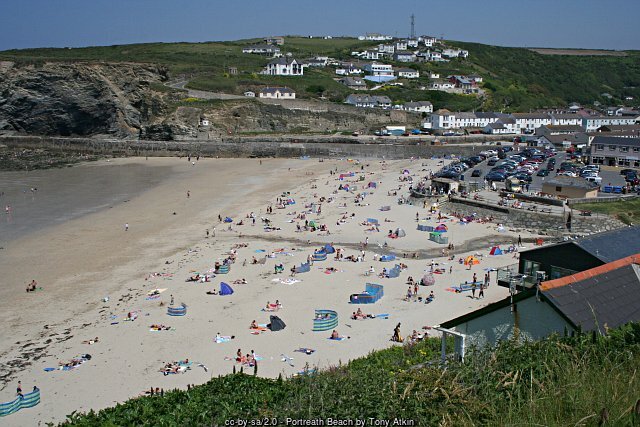
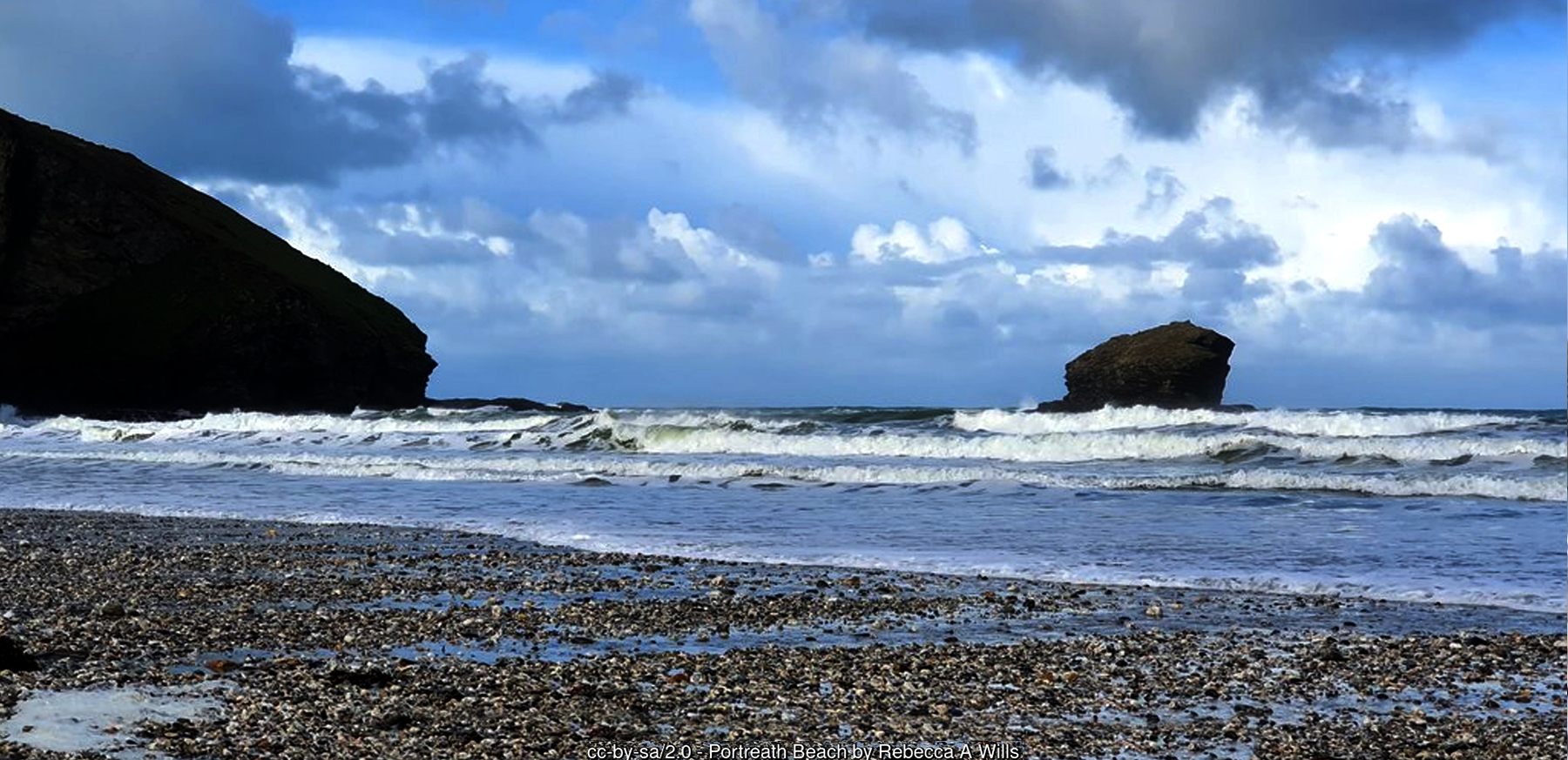
What makes Portreath unusual among Cornwall's beaches is quite how important a working place it once was. The name itself is thought to derive from the Cornish for "sandy cove," and for centuries it was little more than a small fishing and farming hamlet tucked into its sheltered valley.
An early quay was built here in 1713 by a local landowner, Samuel Nott, but it was destroyed by the sea within a few decades - a reminder of just how exposed this stretch of coast is to Atlantic storms. Portreath's real transformation began after 1760, when a proper breakwater pier was constructed to give ships reliable shelter for the first time, kick-starting the harbour's growth into the industrial port that would come to define the village. An Outer Basin followed in 1801 and the pier itself was extended to close to its present length in 1824; an Inner Basin was added in 1846, and a further dock - known locally as the New Dock, by the "Little Beach" west of the main harbour - was built in the 1860s to keep pace with demand.
That demand came from Cornwall's booming inland mining district around Redruth, Camborne, Scorrier and St Day, and by 1827 Portreath was being described as Cornwall's single most important port. Its business was a two-way trade: copper ore dug from the mines was shipped out to the smelters of South Wales, while coal - needed in huge quantities to fire the steam engines that pumped and hauled at the mines - was shipped back in.
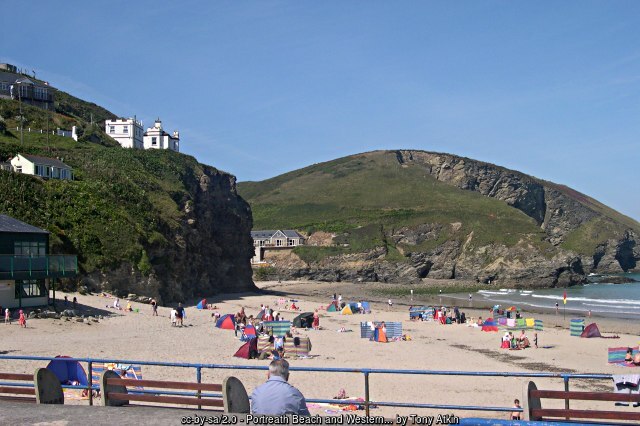
At its mid-19th-century peak, around 1840, as many as 700 ships a year worked in and out of the harbour, carrying something like 100,000 tons of copper ore annually - an extraordinary volume of traffic for such a small, enclosed inlet. The 1st Baron de Dunstanville, Francis Basset, whose family did more than anyone to develop Portreath, had also fortified the port decades earlier, in 1782, against the threat of French and Spanish naval attack during the American War of Independence: four 12-pounder cannon were mounted in a battery above the beach, on the site where Battery House stands today, with two more guns positioned above the harbour itself. In a rather gentler contrast, the same Basset family also had bathing pools cut into the rocks below for his daughter Frances, reflecting the fashionable Georgian enthusiasm for sea bathing.
Getting ore to the harbour in bulk was the great logistical problem of the age, and Portreath's answer was one of Cornwall's genuine transport landmarks. Before any fixed track existed, ore was hauled down to the port by long trains of pack mules - it has been estimated that as many as 15,000 mules were in use across west Cornwall's copper trade at any one time, with around a thousand mule-loads needed to fill a single 150-ton ship. Francis Basset and his partners solved this by building the Portreath Tramroad, a horse-drawn plateway using L-shaped cast-iron plates laid on stone sleeper blocks to a gauge of around four feet - the first railway of any kind built in Cornwall. The first rail was laid on 25 October 1809, and the line, running inland to the mining district around Scorrier, St Day, Poldice, Wheal Unity and Wheal Gorland, was fully open to traffic within a few years, later extended as far as Crofthandy. It cost around £20,000 to build, a considerable sum at the time, and its owners' policy of reserving it for their own mines' use prompted jealous rivals to develop the competing port at Devoran and, in 1824-25, the Redruth and Chasewater Railway. A second line, the Hayle Railway's Portreath branch, opened in 1837 and included a dramatic feat of engineering: an inclined plane cut through solid rock at a slope of roughly 1 in 10, worked by a stationary steam engine at the top that hauled loaded wagons up while lowering empty ones down on the same cable. It remained in use until 1936. The older tramroad itself fell into decline as steam railways took over, closing in the 1860s, with its iron plates eventually lifted and sold for scrap around 1882.
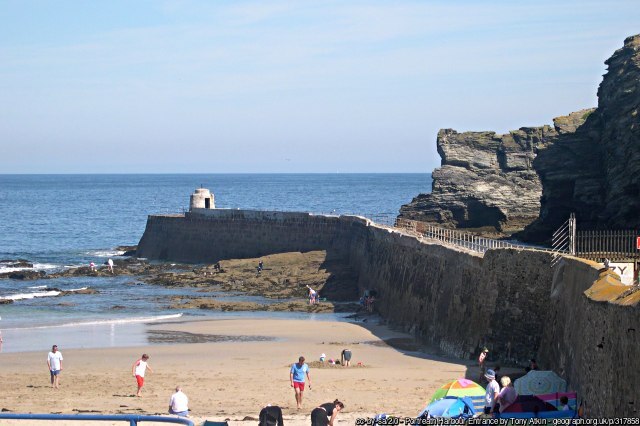
Cornwall's copper industry, undercut by cheaper foreign ore, collapsed by the 1880s, and Portreath's fortunes declined with it, though the harbour carried on a reduced coal and coastal trade into the 20th century before commercial shipping finally ceased around 1960. The coast here has claimed its share of vessels over the centuries: on 25 January 1895 the steamship Escurial was wrecked in heavy weather just off Portreath with the loss of around ten men, one of the worst individual tragedies remembered on this part of the coast and a stark reminder of how quickly this exposed shoreline can turn dangerous. The 20th century brought a very different kind of activity to the clifftop above the beach: an airfield opened here in 1941, playing a role in wartime Coastal Command operations and as a staging point for aircraft crossing the Atlantic, and the same site later housed the Nancekuke Chemical Defence Establishment, a defence research facility whose history remains a subject of local interest. Today the clifftop is home to RRH Portreath, a working radar station whose distinctive spherical "golf ball" radome is a familiar landmark visible from the beach and from the coast path for miles around.
Little of the industrial harbour's original scale survives visibly today - much of the basin has silted or been built over, and the working piers are a fraction of their 19th-century footprint - but the outer breakwater still shelters small boats, and the walk around the harbour wall remains one of the best ways to get a sense of the place's working past before dropping onto the sand. Geologically the cliffs on both sides of the beach are formed from the dark, folded killas (slate and shale) typical of this coast, weathered into the coves, stacks and gullies that shelter the beach from the worst of the prevailing wind and swell. A tidal pool on the northern side of the beach offers calmer, more sheltered swimming for families when the main beach is livelier, and the rocks exposed at low tide around the harbour mouth are worth a look for crabs, anemones and small fish typical of this rocky, moderately exposed stretch of coast.
Portreath's surf has a strong local following. Beyond the harbour-wall Vortex, the open beach itself throws up decent, punchy beach-break waves that work through a good range of tide and swell, making it popular with both improving surfers and more experienced riders, while the shelter of the valley keeps onshore wind effects a little more manageable than on some of the more exposed beaches further along this coast. The village's own surf life-saving club, one of the longest-established in Cornwall, is based right on the beach and has trained generations of local lifeguards and competitive surf lifesavers. Walkers are equally well served: the South West Coast Path runs through the village in both directions, heading east towards Porthtowan across rolling, mining-scarred cliff tops rich in engine-house ruins and industrial archaeology, and north-west past the dramatic North Cliffs towards Hell's Mouth and Godrevy, with its lighthouse and grey seal colony. Inland, Tehidy Country Park - once the Basset family's own estate and now Cornwall's largest country park - offers miles of woodland and lakeside paths, several of them following the routes of the old mineral tramways that once served the mines this harbour was built to supply, tying the modern leisure landscape directly back to Portreath's industrial story.
The best of Portreath is generally found outside the busiest midsummer weeks: a spring or early autumn visit at low-to-mid tide gives the most sand, the calmest water in the tidal pool, and the clearest sense of the old harbour without the crowds that fine July and August days bring. Whenever you visit, treat the stream crossing the beach and the harbour wall itself with some caution with young children, keep an eye on the tide - the beach narrows quickly as the water rises against the promenade - and check conditions before surfing near the harbour wall, where the Vortex can pack a good deal more power than the gentler open beach break suggests.
Visitor Information
Parking
A privately owned pay-and-display car park sits directly behind the beach, with some further roadside parking in the village. It fills quickly on warm days and throughout the summer holidays, so arrive early.
Facilities
Public toilets, a first aid post and lost child point at the beach, plus cafes, a bakery, pubs and shops in the village. RNLI lifeguards patrol seasonally, roughly mid-May to late September, alongside Portreath's own long-running surf life-saving club.
Disabled Access
A ramp at the harbour end of the car park gives level access down to the beach, and the car park itself has designated disabled bays. Sand chairs can be borrowed from the Portreath Surf Life Saving Club; there is no dedicated Blue Badge scheme beyond the car park's standard disabled bays.
Things to Do Nearby
- Basset's Cove - a quieter, cliff-backed cove reached along the coast path towards Tehidy
- Porthtowan - a larger surf beach a short drive or coast-path walk to the east
- Portreath Village Guide - a fuller guide to the village, its shops and its history
- Tehidy Country Park - the former Basset family estate, now Cornwall's largest country park, with woodland and lakeside walks along old mineral tramways
- South West Coast Path Guide - walking routes along this stretch of coast, including on to Porthtowan and Godrevy
Places to Stay
Frequently Asked Questions
Page last updated: 8 September 2026.