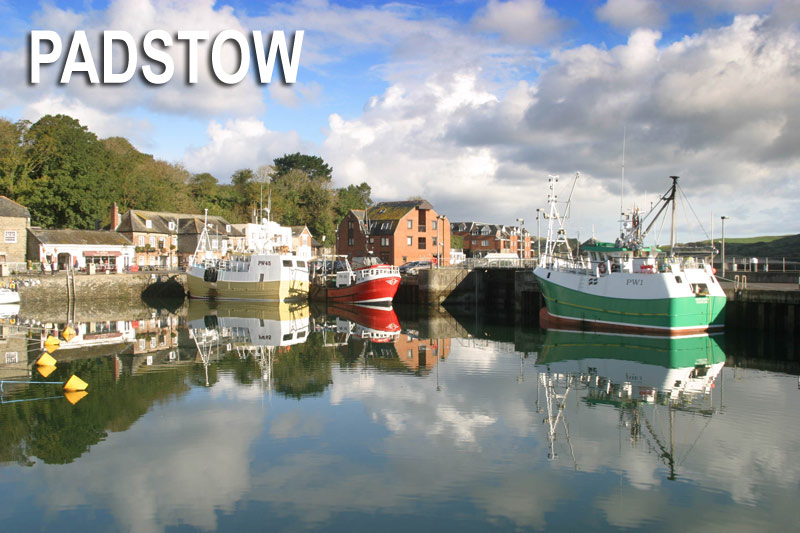
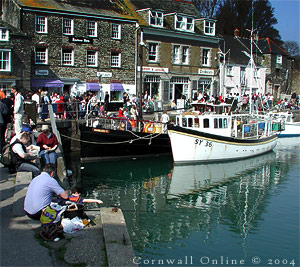
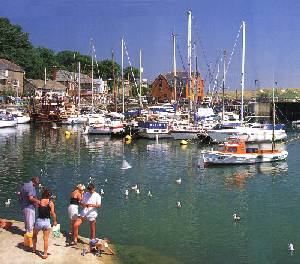
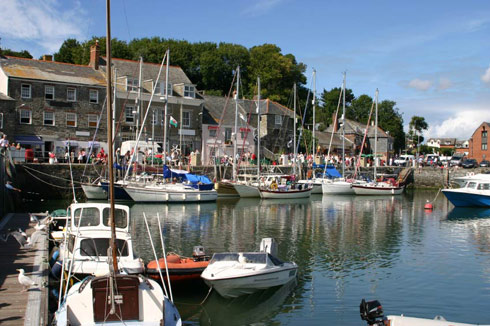
Try to set aside some of your holiday to share our heritage. Visit our dear little museum which is not a huge tomb of a place. but a small room set aside to house some our modest historic treasures. Come to church. sit quietly awhile and reflect upon the history of Padstow. Somehow the church in a small seafaring town reflects life's chequered pattern so much more. Spare a moment of thought for the wives and mothers of yesteryear who prayed for the sate return of their absent menfolk. Of the joy that would be released at the end of a long voyage safely concluded. Of the deep numb grief of women folk who waited day after day! week after week, for a long overdue ship. You will be warmly welcomed at services here. The Methodist Chapel in the middle of the town and the modern Catholic Church hold out equally welcoming arms. Padstow History Padstow in North Cornwall, has a long and ancient history dating back to well before the birth of Christ, for around 2500 BC people travelling from Brittany to Ireland used the Fowey/Camel valleys on their journeys. During recent years this ancient path, known as The Saints Way, has been re-opened, making it possible for walkers to trace the footsteps of those early travelers. It is believed that this track continued to be used during Roman times, as some evidence of Roman settlement has been found in the area. Shortly after 2000BC the Beaker folk settled around the coast of North Cornwall, and remains of their ancient burial chambers can still be seen at Harlyn Bay. One of these cyst burials is currently on display at the Plymouth Museum. Much later, during the 1st century BC, Venitii settlers arrived from Brittany, building forts on the coastal headlands. and it is likely that Padstow was a centre of population at that time. However it was with the arrival of St. Petroc in the 6th century AD that Padstow really began to develop. He spent 30 years in Padstow, during which time he founded a monastery here. and remains of old Celtic crosses all still to be found in the area. The monastery and church were destroyed by the Danes in 981 AD and the monastery was transferred to Bodmin, when Padstow came under the control of the Priory of Bodmin. A second church was built to replace the one destroyed by the Danes, of which only the base of the tower now remains, and the present church was built between 1420 and 1450. In medaeval times, Padstow was granted the right of Sanctuary by King Athelstan, which enabled criminals to remain safe from arrest, and this continued until the time of the Reformation. At that time trading continued with Brittany and Ireland and a Guild of St. Petroc was set up by traders in Padstow. Their headquarters was thought possibly to have been in Abbey House, which can be seen over-looking the harbour on North Quay and which is now a private residence.
Padstow's importance as a port developed from earliest times and in 1565 Sir John Hawkins took shelter here while returning from the West Indies, as did Sir Martin Frobisher while returning from his search for the North West Passage to China in 1577. At that time Padstow was well used as a fishing port, and during the 17th century, when mining in Cornwall was expanding, shipments of copper ore were made to Bristol and slates were exported, many of them from the Camel quarry. By the 19th century a number of ship-building yards had been established, and the Padstow Museum houses a collection of tools from that time. At that time the fishing industry was at its height, when pilchards were landed and cured here, and cured fish of many types, as well as wheat, barley, oats, cheese and minerals were being exported. A considerable variety of goods was also imported
from Ireland, France, Wales, Scandinavia and Russia. The first
lifeboat was stationed at Padstow prior to 1827 when improvements
began to be made to the port in an effort to make it safer. By
1899 the railway arrived, which helped the port and also marked
the beginning of the tourist industry. Sadly this century has
seen a decline in the fishing industry, which was further affected
when the railway closed, but over recent years this seems to be
recovering and there are also signs of a small return to commercial
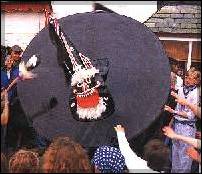
shipping. Padstow has retained some of its ancient traditions,
the most notable being its May Day Festival to mark the coming
of summer, which originated in an ancient fertility rite. At Christmas
the traditional Padstow carols are sung in the streets of the
town. These are unique to Padstow and date back at least to the
18th century
|
PADSTOW HOLIDAY RENTAL
 Puffins Wing Selfcatering
Tel: 01841 520684. Visit England/Quality in Tourism 4 Star Self-catering Holiday Rental in Trevone with Sea Views- sleeps 2. Fri Changeover, Prices from £750 to £980  Treyarnon Bay Farm Cottages
Tel: 01841 520653. Self-catering Holiday Cottage Rental in Treyarnon Bay sleeps Over 10 people - suitable for Large Groups, Prices from £290 to £1290 |
|||||||||||||||||||||||||||||



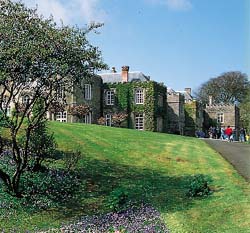 During
the Reformation the church's control of Padstow ceased when the
ownership of the land was transferred to the Prideaux family Prideaux
Place, built on the site of the former Barton of the Monks of
Bodmin, was completed in the 16th century and has one of the oldest
deer parks in the country. This house is still occupied by descendants
of the Prideaux family, and is open to the public on some afternoons.
Sir Walter Raleigh lived in Padstow when he was Warden of Cornwall,
and his Court House on Riverside was the central office for the
collection of dues and taxes. Although his Courthouse and cottage
still remain, they are now private residences and are not open
to the public.
During
the Reformation the church's control of Padstow ceased when the
ownership of the land was transferred to the Prideaux family Prideaux
Place, built on the site of the former Barton of the Monks of
Bodmin, was completed in the 16th century and has one of the oldest
deer parks in the country. This house is still occupied by descendants
of the Prideaux family, and is open to the public on some afternoons.
Sir Walter Raleigh lived in Padstow when he was Warden of Cornwall,
and his Court House on Riverside was the central office for the
collection of dues and taxes. Although his Courthouse and cottage
still remain, they are now private residences and are not open
to the public. 


 |
|
Promoting
your business on Cornwall Online |
|
Cornwall
Online is a trading name of ITS WEB DESIGN - COL DIRECT
Cornwall Online Website by ITS WEB DESIGN - COL DIRECT. Tel 01579 557343 Please ensure that you confirm all details with the Advertiser before Booking We recommend that you take out Holiday Insurance on ALL Bookings |