Charlestown
A Georgian Harbour Village of Tall Ships and China Clay History
Charlestown Harbour, Charlestown, near St Austell, Cornwall, PL25 3NJ
Charlestown is one of the most historically complete and visually striking Georgian harbours anywhere in Britain, a small, perfectly preserved port village built almost entirely from scratch by the local landowner and entrepreneur Charles Rashleigh between 1791 and 1801. Before Rashleigh's development, this stretch of the St Austell Bay coastline was little more than a small fishing hamlet known as West Polmear, with no real harbour to speak of. Rashleigh transformed it into a purpose-built industrial port, planning not just the harbour itself but the whole village that grew up around it, and the settlement took its modern name, Charlestown, from him. It remains, to this day, one of the clearest and most intact examples anywhere in the country of a harbour and village conceived and built as a single, coherent piece of Georgian industrial planning.
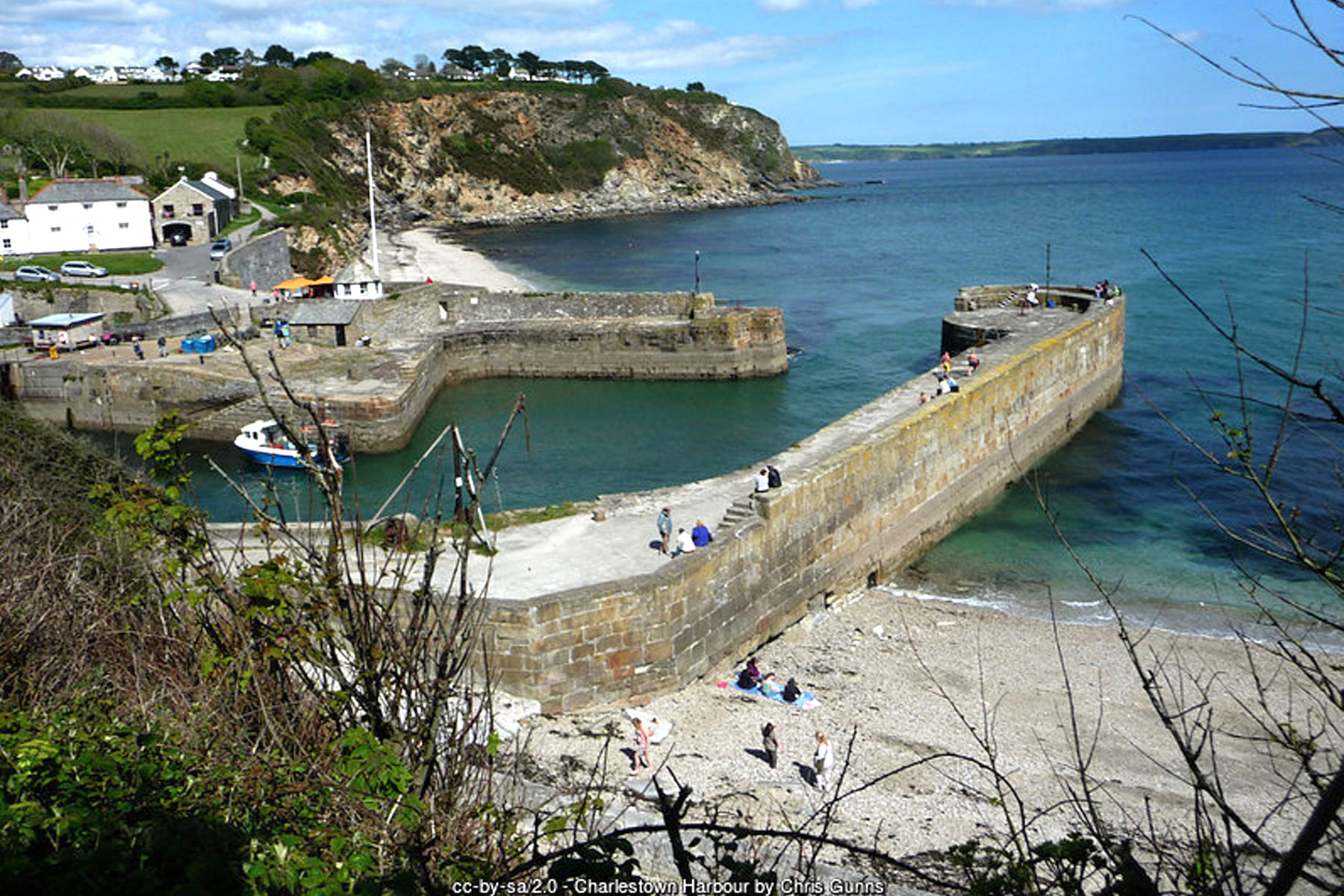
The harbour's original purpose was to serve the mining industry of the St Austell district, and it first made its name exporting copper from the mines inland. As the copper trade declined, Charlestown found a new and even more enduring role at the heart of Cornwall's china clay industry, becoming central to the export of the fine white clay - often called Cornwall's "white gold" - that made this whole stretch of coast so industrially important through the nineteenth and twentieth centuries. Remarkably, commercial china clay shipments continued to leave from Charlestown right up until as recently as 2000, giving the harbour a genuinely long working life stretching from the age of sail almost into the twenty-first century.
One reason Charlestown has survived in such an unusually complete and unspoiled state is, in a sense, an accident of its own engineering. Because the harbour's lock gates and inner basin were built relatively small, only smaller sailing vessels could ever use it, and the port was never able to expand to accommodate the larger, more modern ships that came to dominate maritime trade through the twentieth century. Rather than being progressively rebuilt and modernised, as so many larger Cornish and British ports were, Charlestown's small scale effectively froze its historic character in place, preserving the Georgian stonework, the narrow quays and the compact working harbour that visitors see today.
That well-preserved Georgian setting, complete with stone quaysides, a working lock gate, and often several genuine square-rigged tall ships moored in the harbour, has made Charlestown one of Britain's most in-demand film locations for period drama. Its authentic period atmosphere means film crews need to do relatively little dressing to turn the harbour into a convincing eighteenth or nineteenth-century seaport, and it has featured prominently in the BBC's Poldark, as well as in Hornblower, Mansfield Park and The Onedin Line, among a long list of other period productions over the years. Charlestown remains a working filming location today, and it is not unusual for visitors to find the harbour dressed for a shoot, tall ships and all, on any given visit.
The harbourside is also home to a well-known shipwreck and maritime heritage museum, a longstanding fixture of Charlestown's visitor appeal that has introduced generations of holidaymakers to the area's diving and salvage history alongside the harbour's own story. Combined with the genuine tall ships that regularly call at Charlestown, the museum has long reinforced the village's identity as a place with a real, tangible connection to Cornwall's maritime past rather than simply a pretty backdrop.
It is worth pausing on Charles Rashleigh himself, since so much of what makes Charlestown distinctive traces directly back to his decisions in the 1790s. A member of the influential Rashleigh family, long associated with nearby Fowey and the wider St Austell district, Charles Rashleigh had the resources and the ambition to fund an entirely new harbour from scratch at a modest fishing hamlet with no natural advantages of its own, choosing to engineer a safe, defensible port where none had existed rather than simply expand an existing one. That decision to build outward from nothing, laying out both the harbour and the village around it as a single planned scheme, is precisely what gives Charlestown its unusually coherent, unified Georgian character today, in contrast to the more organic, centuries-layered growth seen at most other Cornish harbour villages.
The beach itself sits beside the harbour, a small strip of sand and shingle that gives visitors an unusual "working port" beach experience rather than the conventional wide, open sandy bay found at somewhere like neighbouring Carlyon Bay. A visit to Charlestown's beach is as much about wandering the historic quayside, watching the harbour's working rhythms and admiring the tall ships moored alongside, as it is about sand between your toes, and many visitors treat the beach as one part of a broader stroll around the whole harbour rather than a destination in its own right. At low tide there is more sand and shingle to explore around the harbour mouth, while the sheltered inner basin, protected by the lock gate, keeps its water regardless of the state of the tide outside.
Charlestown's popularity as a day-trip destination, driven in large part by its fame as a filming location and by the sheer photogenic appeal of its Georgian harbour, means it can get genuinely busy in the summer months, and pay car parking near the harbour fills accordingly. A good range of harbourside cafés, pubs and shops serve visitors around the quay, giving Charlestown a fuller day-out feel than its compact size might suggest, though there is no RNLI lifeguard patrol here, so swimmers should take the same sensible precautions they would at any unpatrolled beach, with particular care around the harbour entrance and lock gate where boat traffic and changing water levels are a factor. Dogs are generally welcome around Charlestown, with the usual seasonal restrictions that apply at many Cornish beaches in the busiest summer weeks, and it is worth checking current local signage on arrival since the details can vary from year to year.
Away from the water's edge, Charlestown itself is a designated conservation area, and the streets rising back from the harbour are lined with the same terraces of Georgian stone cottages and former china clay warehouses that made the village function as a working port in Rashleigh's day. Many of those old warehouse and net-loft buildings have since found new life as cafés, gift shops and holiday accommodation, giving Charlestown a busy, lived-in feel that sits comfortably alongside its role as one of Cornwall's best-known visitor attractions, rather than the museum-piece stillness that a purely preserved village might have. It is a compact place, easily explored on foot in an hour or two, but the sheer density of history packed into such a small footprint of stone quaysides and narrow streets means most visitors find themselves lingering far longer than they expect.
Set within the wider sweep of St Austell Bay, Charlestown sits between the open sands of Carlyon Bay to the west and the smaller beach at Duporth to the east, making it a natural stop on a longer coastal walk or drive taking in several of the bay's beaches in a single day. The South West Coast Path passes directly above the harbour, offering good views back down over the quay and its tall ships as well as out across the bay towards the Gribbin Head daymark near Fowey. Few other villages on this stretch of coast, or indeed in Cornwall as a whole, combine such a complete and authentic slice of Georgian industrial history with an actively working harbour still visited by real tall ships, and it is that combination, more than the size of its beach, that makes Charlestown one of the most distinctive stops in St Austell Bay.
Visitor Information
Parking
Pay car parks serve the harbour area, with charges applying throughout the day. Charlestown is a popular day-trip destination and can be busy in summer, so arriving earlier in the day is worthwhile.
Facilities
Harbourside cafés, pubs and shops line the quay, along with a well-known shipwreck and maritime heritage museum. There is no RNLI lifeguard patrol at Charlestown.
Disabled Access
The harbourside itself is largely level, paved quayside, making it easy to explore by wheelchair or pushchair, though the small beach below is sand and shingle, which limits onward access to the sand. No dedicated Blue Badge bays are confirmed at the nearby car parks - check current signage on arrival.
Things to Do Nearby
- Carlyon Bay, the wide sandy stretch of Crinnis, Shorthorn and Polgaver beaches a short distance west
- Duporth, the next beach east around St Austell Bay
- The Eden Project, a few miles inland at Bodelva, one of Cornwall's best-known visitor attractions
- Charlestown's shipwreck and maritime heritage museum on the harbourside itself, a longstanding local fixture
Places to Stay
Charlestown has its own range of holiday accommodation close to the harbour and beach:
Frequently Asked Questions
Page last updated: 17 September 2026