New Polzeath
The Quieter North End of Polzeath's Sandy Bay
New Polzeath, near Wadebridge, Cornwall
New Polzeath sits at the northern end of Polzeath's broad sweep of golden sand, a small hamlet perched above the beach rather than a separate stretch of coastline. At low tide its sand runs on, uninterrupted, into the main Polzeath beach a few hundred metres to the south, so the honest way to think of the two is as one long bay with two names rather than two distinct beaches with a hard line drawn between them. What does genuinely set New Polzeath apart is everything above the tideline: its own quieter hamlet, its own small car park, and direct coast path access north toward Pentireglaze Haven and the National Trust land around Pentire Point, in a spot that sees noticeably fewer visitors than the main beach even in the height of summer.
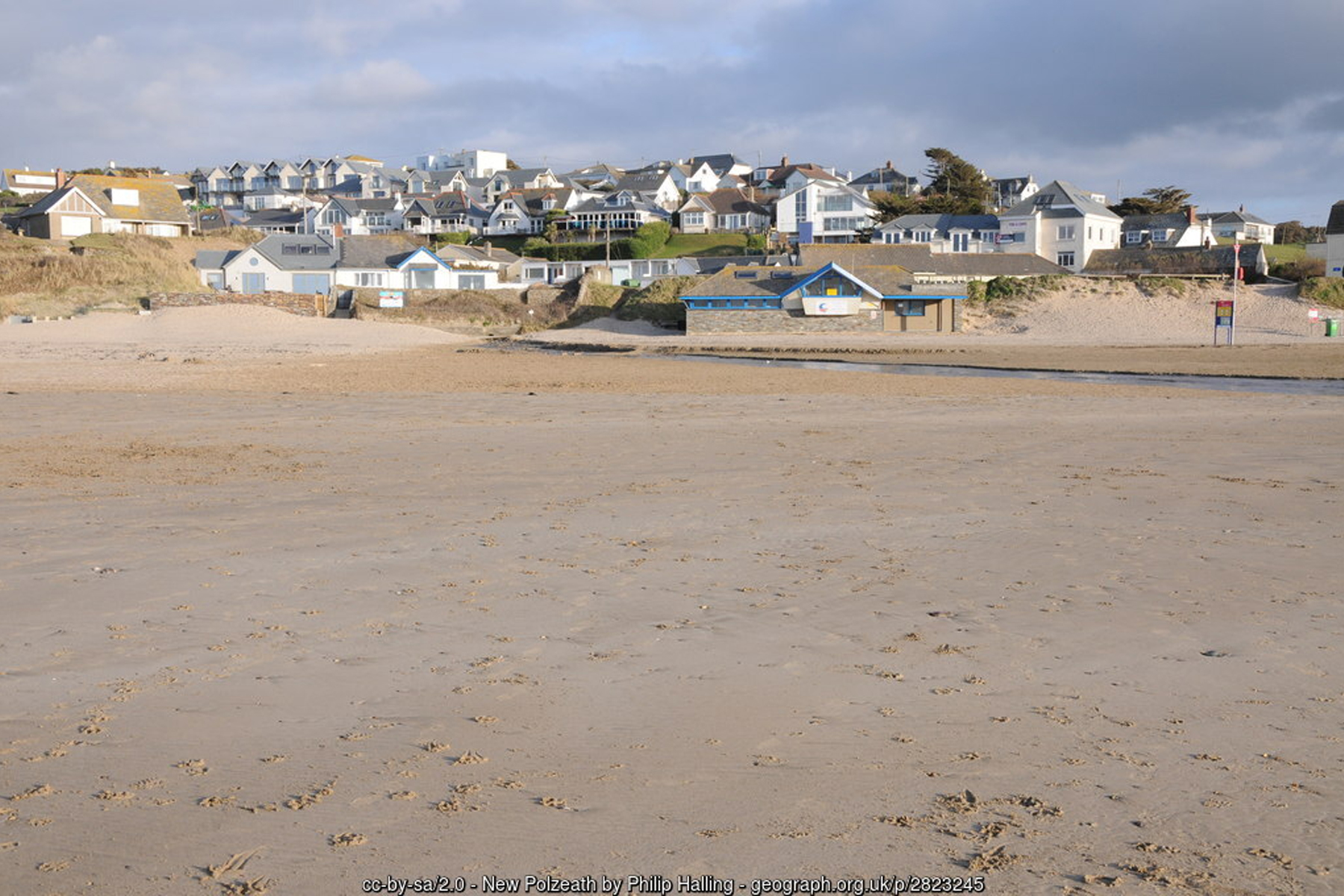
The hamlet itself grew up in the late Victorian period, some way removed from the older fishing and farming settlement of Polzeath down the hill. Its main street, Atlantic Terrace, dates to 1898, and the rows of houses and holiday homes built along and behind it since have given New Polzeath a character of its own - a quiet, largely residential fringe to a beach that can feel very different once the road drops down into Polzeath proper. Development has stayed relatively contained, in large part because the National Trust owns much of the land to the west and north, protecting the headland and coast path from further building and keeping the walk out toward Pentireglaze and Pentire Point open and undeveloped. The hamlet's older Cornish name, Trebenntir, survives in local records even though "New Polzeath" is what appears on maps and signposts today.
One of the more curious things about the place is how the two settlements relate to each other on the ground. A coast path of only a few hundred yards connects New Polzeath to Polzeath along the top of the beach, and at low tide it's just as easy to walk straight across the sand between the two. By road, though, the two are the best part of two miles apart, since the lanes serving New Polzeath loop well inland before dropping back down to the coast - a reminder that this stretch of Cornwall was shaped for people arriving on foot or by boat long before it was shaped for cars. Visitors staying in New Polzeath quickly learn to treat the coast path, not the road, as the real route into the village below.
New Polzeath has its own small share of literary and social history, out of proportion to its size. A plaque in the hamlet marks the spot where the poet Laurence Binyon is said to have composed "For the Fallen" in 1914, the poem whose fourth stanza - "They shall grow not old, as we that are left grow old..." - is read at Remembrance services across Britain every year. Rather less happily, Cardinal Bernard Griffin, then Archbishop of Westminster, died of a heart attack while holidaying in New Polzeath in August 1956. Betjeman country begins properly a little further south around Daymer Bay and St Enodoc, but New Polzeath's own place in that literary landscape - a quiet corner favoured by visitors escaping to write, or simply to rest - fits the same pattern.
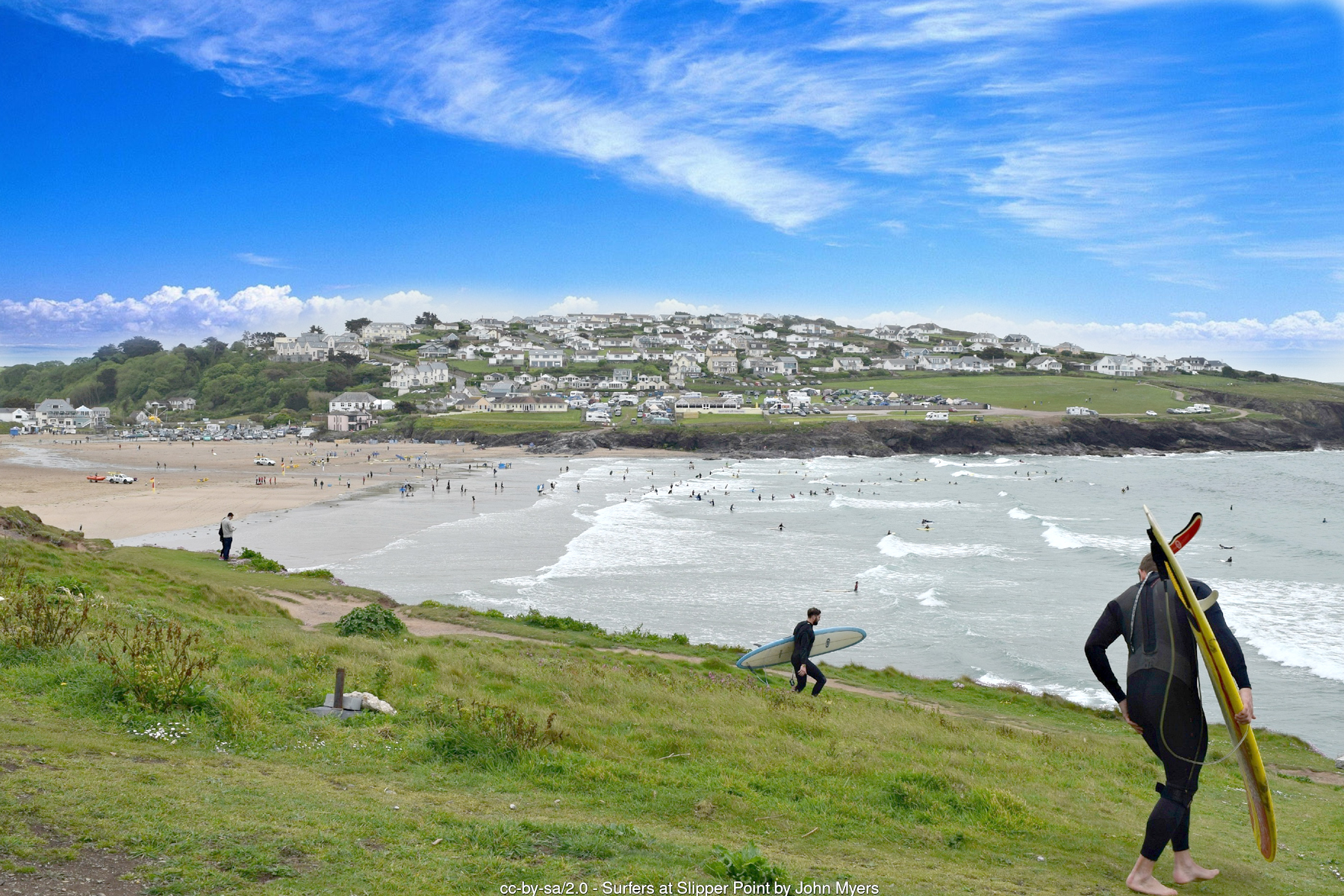
As for the beach itself, the surf and sand at New Polzeath are, in practice, the surf and sand of Polzeath bay as a whole. The bay faces west into open Atlantic swell that arrives long, consistent and relatively slow-breaking by Cornish standards, which is a large part of why Polzeath has built its reputation as one of the county's best beginner and intermediate surf beaches, with several surf schools operating from the main beach. The New Polzeath end shares that swell, but it sits outside the zone patrolled by RNLI lifeguards during the summer season, who are based down at the main beach - so less experienced swimmers and surfers are generally better off making the short walk south to where the flags and patrols are, rather than treating New Polzeath's own sand as a supervised swimming beach. The tide is worth taking seriously here too: as at Polzeath generally, a rising sea can cut off low-lying sections of sand quickly, and the coast path up to New Polzeath is sometimes used as an escape route by walkers caught out by an incoming tide along the beach below.
What New Polzeath does offer, reliably, is a quieter version of the same view. Its own car park at the northern end of the hamlet is consistently reported as a calmer alternative to Polzeath's main car park once the school holidays are in full swing, and the short stretch of sand and rock in front of it - along with the coast path leading north - tends to draw a steadier trickle of walkers and dog owners rather than the beach crowds that build up around the surf schools and cafes further south. It's the kind of spot locals gravitate to precisely because it isn't the destination beach, even though the sand under their feet is technically the same bay.
New Polzeath also carries a small but genuine mining history that most visitors walk straight past without realising. An old lead and silver mine worked the ground around nearby Pentireglaze between roughly 1850 and 1875, raising close to a thousand tons of lead ore and around nineteen thousand ounces of silver from two separate lodes before it closed. One shaft and its spoil dump sat, and still survive in overgrown form, right at the north-eastern edge of New Polzeath village itself, while the mine's engine house - built to pump water from the workings - stood nearby until it was demolished around 1957. It's an easy detail to miss on a beach holiday, but it's a reminder that this quiet holiday hamlet sits on ground that was industrial, not simply scenic, within living memory of some of its older residents.
Heading north from New Polzeath on foot, the coast path drops toward Pentireglaze Haven, a small, sheltered cove reachable either along the clifftop path or across the sand at low tide, with rock pools exposed as the tide falls that are worth a slow, careful look for anemones, crabs and small fish. Beyond Pentireglaze the path climbs out onto National Trust land covering Pentire Point and, further out, The Rumps - a dramatic double-humped headland carrying the remains of an Iron Age promontory fort built sometime between 400 BC and 100 AD, still visible as banked earthworks cutting across the neck of the headland. Geologically this section of coast is much older than the sand and slate around the main bay: the Pentire headland is built from pillow lava, rounded blobs of basalt that solidified as ancient volcanic flows met the sea bed, among the oldest rock exposed anywhere on this stretch of the Cornish coast. The Trust manages the clifftop grassland here as part of its wider Cornish Coastal Meadows project, and the headland and its offshore rocks support breeding seabirds - including, in season, puffins, gannets and kittiwakes - while seals and dolphins are seen in the water beyond the point from time to time.
The best time to appreciate New Polzeath's own stretch of the bay is on a falling or low tide, when the full width of sand connecting it to the main beach is exposed and the rock pools around Pentireglaze are at their best; by high water, much of the sand narrows sharply and the two ends of the bay are effectively cut off from each other except by the clifftop path. Combined with its position on the doorstep of some of the finest coast path walking in north Cornwall, that makes New Polzeath a genuinely good base for a quieter stay - close enough to Polzeath's shops, cafes and surf schools to use them without difficulty, but removed enough to offer a calmer stretch of sand and a proper sense of the wilder coastline that continues north beyond it.
Visitor Information
Parking
A pay-and-display car park at New Polzeath itself, at the northern end of the hamlet - generally quieter than the main car park down at Polzeath beach.
Facilities
Public toilets at New Polzeath. Shops, cafes and surf schools are a short walk or drive away at the main Polzeath beach. RNLI lifeguards patrol the main beach in season, not the New Polzeath end.
Disabled Access
Not confirmed - no dedicated beach wheelchair or ramped access is documented at New Polzeath itself, unlike the facilities available at the main Polzeath beach nearby. Check with Cornwall Council for current Blue Badge parking provision before you travel.
Things to Do Nearby
- Pentireglaze Beach, a small cove a short walk north via the coast path
- Polzeath, the main beach, shops and surf schools a few hundred yards south
- Lundy Bay, further north along the coast path beyond Pentireglaze
- Pentire Point and The Rumps (National Trust) - an Iron Age promontory fort and seabird colonies on the headland beyond Pentireglaze
Places to Stay
Frequently Asked Questions
Page last updated: 8 September 2026.