Greenaway Beach
A Quiet, Tide-Dependent Cove Between Polzeath and Daymer Bay
Greenaway Beach, Trebetherick, near Polzeath, Cornwall
Greenaway Beach - named after the grassy stretch of coast path of the same name - is a small, quiet cove tucked around Trebetherick Point on the Camel Estuary side of the Polzeath peninsula, roughly midway between Polzeath and Daymer Bay. It has none of the crowds or the surf of Polzeath's main beach half a mile or so to the north: facing into the sheltered mouth of the Camel Estuary rather than the open Atlantic, Greenaway is a beach of sand, shingle and a broad slate rock platform, and one that really only comes into its own for a few hours either side of low water. At high tide it narrows to little more than a shingly strip against the cliff; as the tide falls, a wide platform of rock pools, ledges and patches of sand is gradually uncovered, and it is this lower-tide version of the beach that most visitors come to see.
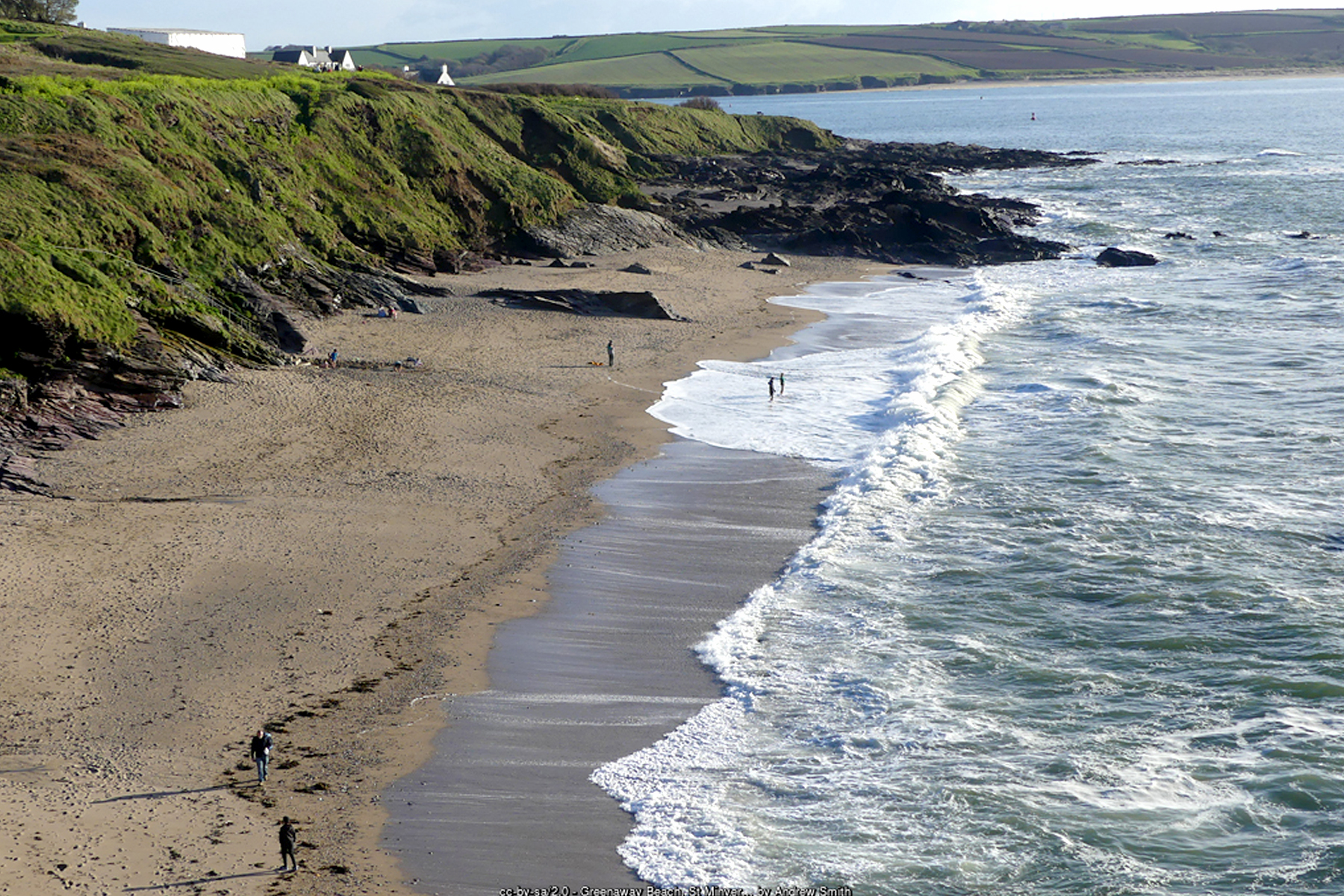
There is no road down to Greenaway and no car park at the beach itself, which is a large part of why it stays so much quieter than its neighbours. The most straightforward approach is from Daymer Bay: park in the pay-and-display car park there, then follow Daymer Lane and a path and steps down past Tregreen to the beach, a walk of around ten minutes. From Polzeath, it is a longer approach of twenty to twenty-five minutes on foot, following the coast path around Trebetherick Point along the route known locally as "The Greenaway" - a grassy, gently undulating stretch that most visitors would call one of the more scenic short walks on this part of the coast, particularly in spring and early summer when the path is lined with wildflowers. Either way in, the final stretch down to the beach involves steps and an uneven, sometimes slippery path, so this is not a beach for pushchairs or for anyone who struggles with steep or uneven ground.
Because so much of Greenaway depends on the tide, checking tide times before setting out matters more here than at most Cornish beaches. At low water there is a genuine expanse of rock platform and sand to explore; as the tide turns and rises, that same platform disappears quickly, and the narrow strip left at the top of the beach is not somewhere to linger. There is no lifeguard cover at Greenaway - it is a small, lightly used cove, and visitors should treat it as entirely unsupervised, timing a visit around the tide rather than assuming the beach will remain accessible for as long as they might like to stay.
The rocks that frame Greenaway are slate, folded and fissured in the way so much of this stretch of the Camel Estuary shoreline is, and the headland above the beach, Trebetherick Point, is designated a Site of Special Scientific Interest. The beach and its slate ledges also have a literary connection: John Betjeman, who spent childhood summers at Trebetherick and is buried a short walk away at St Enodoc Church, named this exact spot in his poem "Trebetherick," recalling stormy days on this coast with the line "we struggled round to Greenaway," and describing the local rock in the same poem as "feathery slate," black after rain, with "golden sand" turning brown again as a squall passed through. It is a fitting description of the beach as it still looks today.
At low tide, the rock platform at Greenaway is good for rock pooling - crabbing and shell hunting among the ledges and pools are the main draw for families making the walk down, and local anglers also fish off the rocks here at low water. Several sources describe the visible remains of a wrecked vessel at the beach's far end; this most likely relates to the yacht Courageous II, which ran aground near Greenaway Point in April 2013. All four crew were rescued safely, though a quantity of diesel escaped from the wreck and an oil slick was reported reaching Polzeath and Daymer beaches over the following days. From the coast path above the beach, views open out over the mouth of the Camel Estuary, where seals are occasionally seen, and dolphins are spotted from time to time further out.
Greenaway is not a beach for water sports. Its narrow, tide-dependent strip of sand and rocky fringes make it unsuitable for surfing, kitesurfing or windsurfing, and the well-known local kitesurfing and windsurfing scene is based instead across the water at Daymer Bay, where broader, flatter sands and more sheltered estuary water suit those sports far better - not at Greenaway itself, whatever some general guides to the area might suggest. What Greenaway does offer is a quieter alternative to its bigger neighbours: dogs are allowed here all year round, unlike Polzeath's main beach, which bans them between 15 May and 30 September, making Greenaway a popular fallback for dog walkers throughout the summer season.
There are no facilities of any kind at Greenaway - no toilets, cafe or shop - and the nearest of any of those is back in Polzeath or over in Rock. It forms part of a well-regarded short circular walk between Polzeath and St Enodoc Church, and features on the longer Rock-to-Polzeath route that takes in the dunes and golf links around Daymer Bay as well. For most visitors, Greenaway rewards a slow approach timed around a falling tide - a short, scenic walk in, an hour or two of rock pools and quiet sand, and a walk back before the water returns.
Visitor Information
Parking
No car park at the beach itself. Nearest option is the pay-and-display car park at Daymer Bay, around a ten-minute walk via Daymer Lane and a path and steps past Tregreen, or a twenty-to-twenty-five-minute walk from Polzeath around Trebetherick Point.
Facilities
None at Greenaway Beach itself - no toilets, cafe or shop. Nearest facilities are in Polzeath or Rock, a short drive or a longer coast path walk away.
Disabled Access
Not suitable for wheelchairs or pushchairs - both approaches involve steps and an uneven cliff or coast path. No dedicated Blue Badge parking at the beach; the nearest car park, at Daymer Bay, is some distance away with no step-free route down.
Things to Do Nearby
- Polzeath Beach, around twenty to twenty-five minutes on foot around Trebetherick Point, with surf, shops and full facilities
- Daymer Bay, a short walk in the other direction, with a car park, dunes, and the local kitesurfing and windsurfing scene
- St Enodoc Church, a short walk further along the coast path, once buried in sand and now the burial place of the poet Sir John Betjeman
Places to Stay
Frequently Asked Questions
Page last updated: 8 September 2026.