Daymer Bay
A Sheltered Estuary Beach Beside St Enodoc Church
Daymer Bay, near Rock and Polzeath, Cornwall, PL27 6SA
Daymer Bay is a wide, west-facing beach of fine golden sand tucked inside the mouth of the Camel Estuary, roughly midway between Rock and Polzeath on Cornwall's north coast. Unlike the exposed, Atlantic-facing beaches nearby, Daymer Bay sits within the shelter of the estuary itself, giving it calmer water and a gentler, more gradually shelving shore that has long made it one of the most popular family beaches in the area. Behind the sand, a system of low dunes rises towards Brea Hill, and half-hidden among them stands St Enodoc Church - a building with one of the more remarkable survival stories of any parish church in Cornwall, and the final resting place of the poet Sir John Betjeman.
At around half a mile in length, Daymer Bay is bounded to the north by Trebetherick Point and to the south by the grassy dune headland of Brea Hill, which separates it from the Camel's main channel and, beyond that, the town of Rock. The beach faces broadly west and north-west across the estuary towards Padstow and Stepper Point on the far shore, giving it attractive, open views up and down the Camel without the full force of the Atlantic swell that reaches beaches like Polzeath and New Polzeath just over the headland. That relative shelter, combined with a beach that slopes gently rather than dropping away quickly, is the main reason Daymer Bay is so often recommended for young children and for anyone who wants calmer water than the surf beaches nearby - though the estuary's currents and the state of the tide should still be treated with respect.
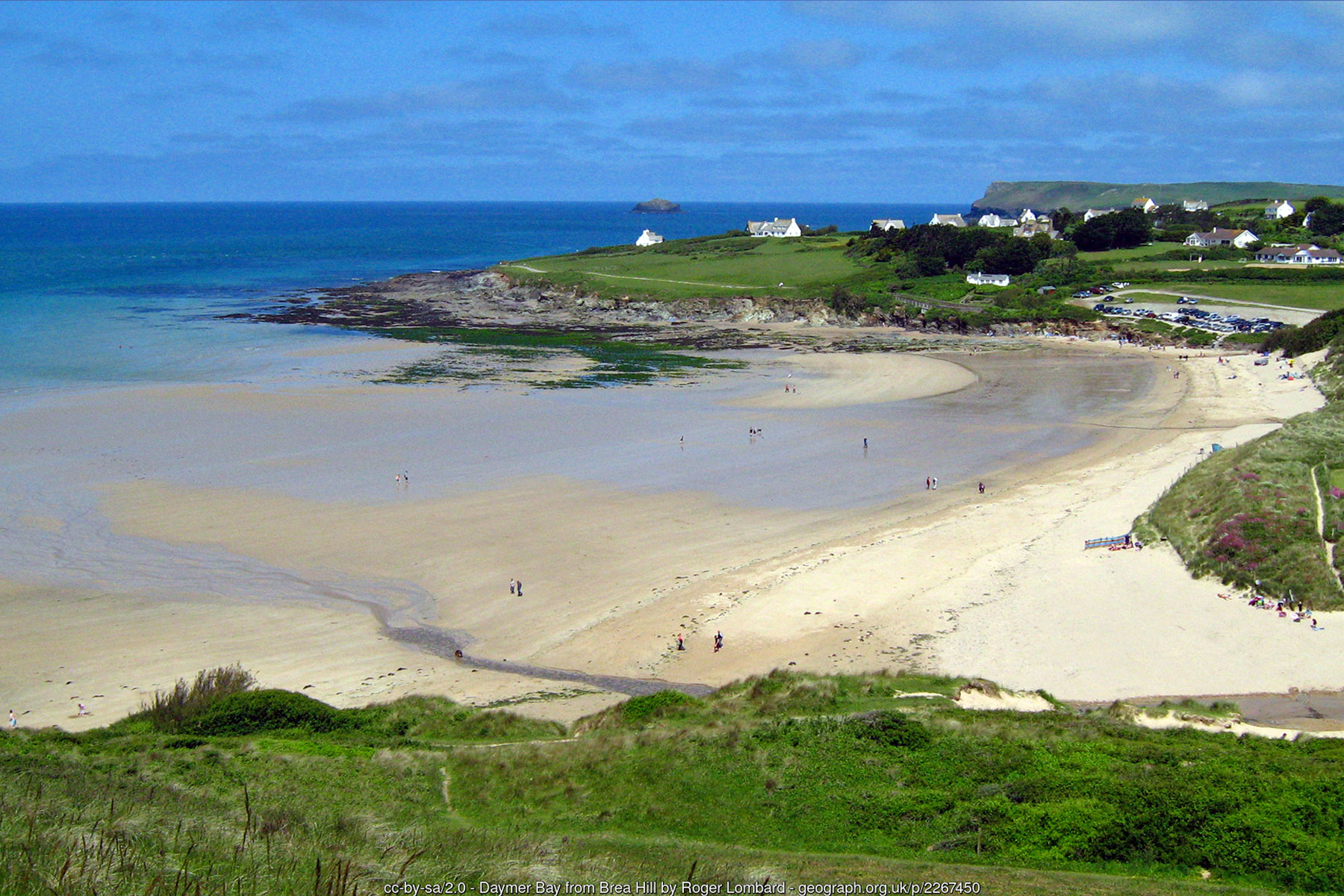
Tides make a considerable difference to how Daymer Bay looks and feels. At low water the sand stretches out a long way and, in dry conditions, the beach links up with the sands towards Rock, tempting many visitors into a long, easy walk along the shore - but the crossing floods well before full high tide, so anyone walking towards Rock needs to keep an eye on the time and turn back in good time rather than relying on being able to complete the route. As the tide rises, the beach narrows quickly against the dunes, and the currents in the main body of the estuary channel picking up pace are a genuine hazard for stronger swimmers who venture beyond the shallows, even though the water immediately off the beach itself is usually calm. Daymer Bay has no RNLI lifeguard patrol, unlike Polzeath along the coast, so it pays to keep to the shallower water close to the beach, especially with children, and to check tide times before planning a walk. Low tide also exposes a scattering of rock pools along the beach's northern edge, worthwhile for an hour of exploring with children, and - visible only on the very lowest tides - the eroded stumps and roots of an ancient submerged forest thought to be around four thousand years old, a rare and tangible trace of a time when sea levels here were markedly lower and this part of the estuary was dry, wooded land.
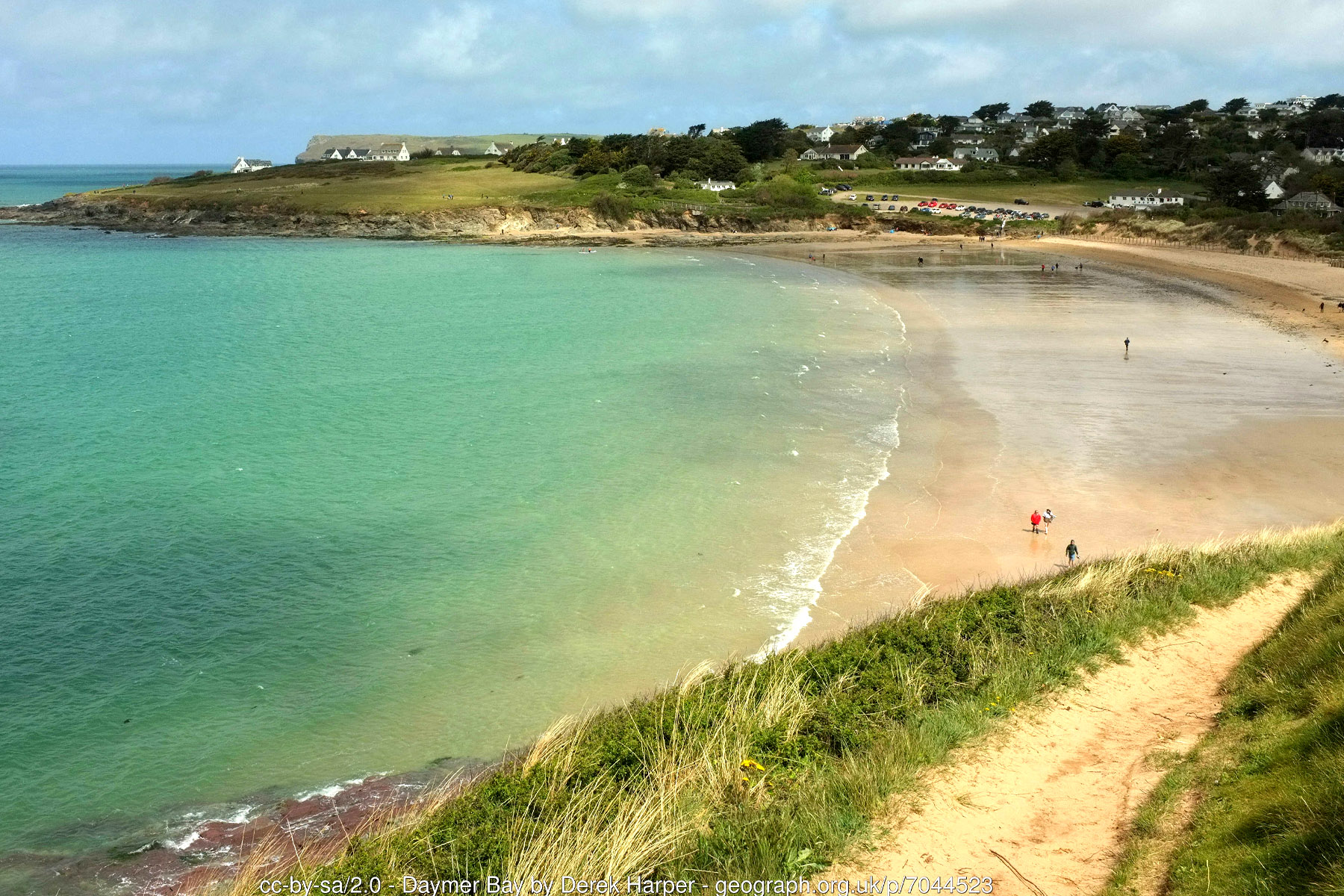
The dunes backing the beach and the headland of Trebetherick Point to the north fall within protected conservation areas recognising the ecological value of this stretch of the Camel Estuary, and the sands and mudflats further up the estuary towards Rock and Padstow are an important feeding ground for wading birds and other estuary wildlife for much of the year, particularly outside the summer season. The Camel Estuary as a whole is one of the better birdwatching spots in north Cornwall, with curlew, oystercatcher, shelduck and little egret among the species regularly seen working the tideline, especially as the tide uncovers the mudflats further towards Wadebridge.
Behind the dunes, and reached by a short, well-trodden path from the beach, St Enodoc Church is one of the more atmospheric sights in this part of Cornwall. The church traces its origins to a hermitage associated with the sixth-century Welsh saint Enodoc (also recorded as Wenedoc), with the present building dating back at least to the twelfth century and carrying thirteenth and fifteenth century additions, along with a distinctive broach spire. For several centuries the church waged a losing battle against the shifting dunes that surround it: by the sixteenth century it was known locally as "Sinking Neddy" for the way sand was steadily engulfing it, and by the eighteenth century it had become almost entirely buried, to the point that parishioners are said to have had to be lowered through a hole in the roof once a year to hold the minimum service needed to preserve the parish's rights and tithes. The church was finally dug out, cleaned and restored in 1863-64 under the architect J. P. St Aubyn, after which the surrounding dunes were stabilised so that the building would not be overwhelmed again - a restoration Betjeman himself later wrote about with characteristically mixed feelings, admiring the building's atmosphere while regretting some of the changes the Victorian works made to its interior.
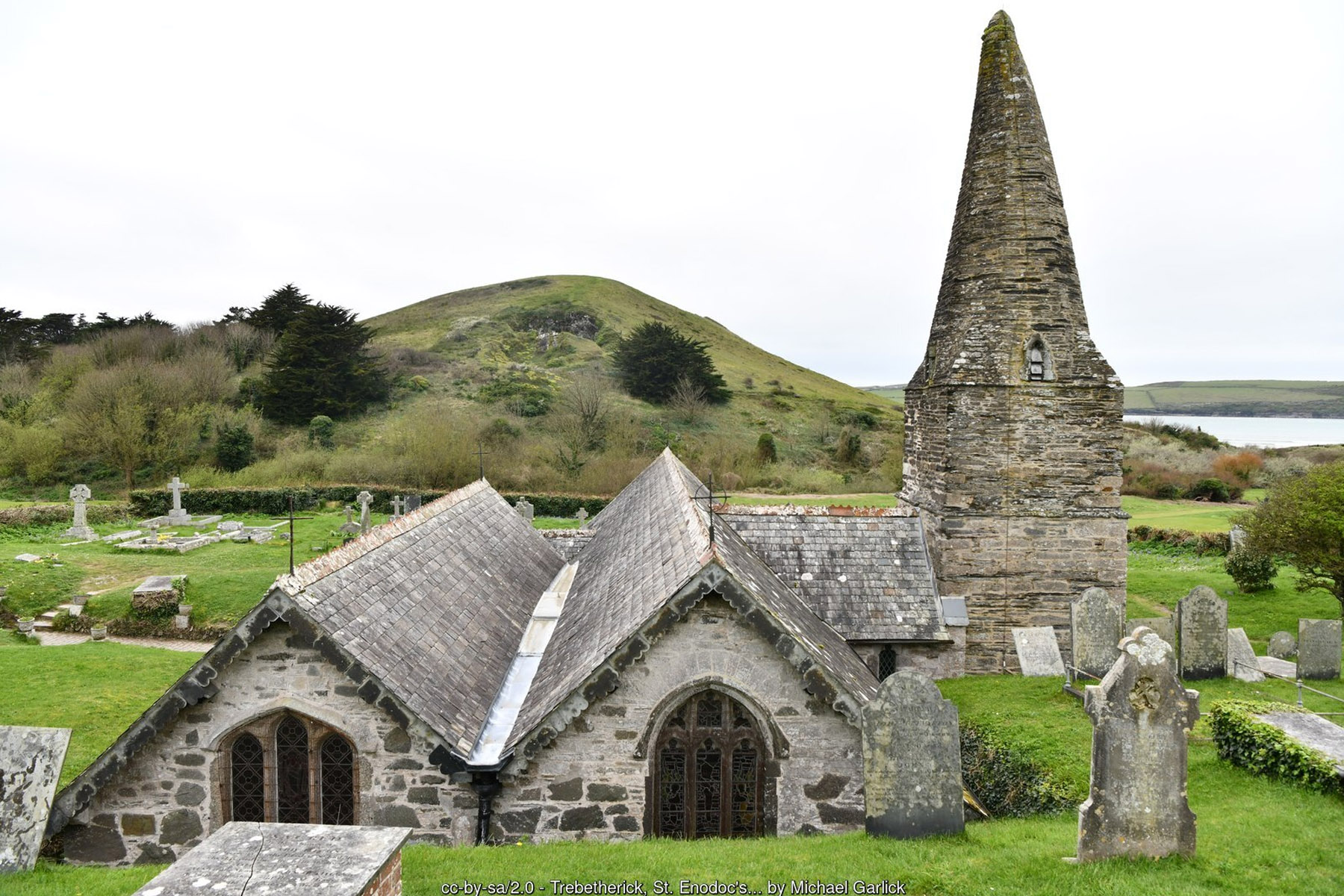
John Betjeman's connection to Daymer Bay and St Enodoc runs deep. His family took holidays at nearby Trebetherick throughout his childhood, and the church, the beach and the surrounding dunes and links feature repeatedly in his poetry - his poem "Trebetherick" opens with the well-known line "Blessed be St Enodoc, blessed be the wave", recalling summers spent on this stretch of coast, while "Sunday Afternoon Service in St Enodoc Church, Cornwall" describes the building's "smooth, slate floor" and "rounded wooden roof" in close, affectionate detail. Betjeman, who became Poet Laureate in 1972, asked to be buried at St Enodoc, and his grave lies close to the church's lychgate, in the same dune-backed churchyard he wrote about for most of his life - a modest, unassuming spot that draws a steady trickle of visitors each year, most of them walking up from Daymer Bay itself.
St Enodoc Church shares its dune-and-links landscape with St Enodoc Golf Club, one of England's most highly regarded links courses and a fixture of most serious rankings of the best courses in the country. Golf was first played informally around the church and Daymer Bay by a group of Oxford undergraduates in the late 1880s, and the club was formally established in 1890; the present Church Course was substantially laid out by the noted golf architect James Braid in 1907, with further changes made after the clubhouse moved in 1937. The course is built directly across the dune system behind the beach, and the church itself sits within the grounds - the tenth hole is played close by it - giving the whole area a distinctive, layered sense of history: an ancient place of worship, a churchyard holding one of England's best-loved twentieth-century poets, and a golf course regarded by many enthusiasts as among the finest natural links anywhere, all within a few hundred yards of the sand at Daymer Bay.
Daymer Bay's own beach facilities are modest but sufficient for a day out: a car park sits directly behind the beach, a seasonal kiosk in the car park area sells drinks and snacks, and there are public toilets nearby. Dogs are welcome on Daymer Bay all year round, with no seasonal restriction, which makes it a popular choice for dog owners visiting this part of the Camel Estuary. The beach's gentle slope and relatively short walk from the car park onto flat sand also make it one of the easier beaches in the area to reach for anyone with limited mobility, though as with any natural beach the surface becomes softer and less even further from the car park and toward the dunes.
For a longer day out, Daymer Bay connects naturally to the wider Camel Estuary. Rock, a mile or so south around Brea Hill, has its own sandy beach, sailing and watersports facilities, shops and a passenger ferry across the estuary to Padstow - a popular short excursion that takes in views of the notorious Doom Bar sandbank at the estuary mouth, long blamed by local legend for numerous shipwrecks over the centuries. The South West Coast Path runs along the top of the dunes past St Enodoc, linking Daymer Bay north to Polzeath and New Polzeath and south towards Rock, and the Camel Trail - a level, traffic-free cycling and walking route along the old railway line - follows the estuary shore further inland towards Wadebridge, Padstow and Bodmin. Taken together, Daymer Bay's combination of sheltered, family-friendly sand, one of Cornwall's most storied small churches, and a golf course of genuine international standing gives it a quieter, more layered appeal than its more famous neighbour Polzeath, just over the headland.
Visitor Information
Parking
A car park directly behind the beach, charged and monitored by ANPR camera according to length of stay - pay by app, phone or machine, and allow a little extra time so as not to overstay.
Facilities
Public toilets (small charge) and a seasonal kiosk selling drinks and snacks in the car park. No RNLI lifeguard patrol - the nearest lifeguarded beach is Polzeath.
Disabled Access
A short, fairly level walk from the car park reaches flat sand, making this one of the easier beaches nearby to access, though the surface softens further from the car park. Disabled toilet facilities are available; check locally for dedicated Blue Badge parking bays.
Things to Do Nearby
- Greenaway Beach, a short walk north over the headland
- Rock, a mile or so south around Brea Hill, with sailing, watersports and the passenger ferry to Padstow
- St Enodoc Church and St Enodoc Golf Club, reached on foot through the dunes behind the beach - final resting place of Sir John Betjeman
- Rock, Daymer Bay & Trebetherick Tourism Guide - the wider Camel Estuary area
Places to Stay
Frequently Asked Questions
Page last updated: 8 September 2026.