Bodmin Moor
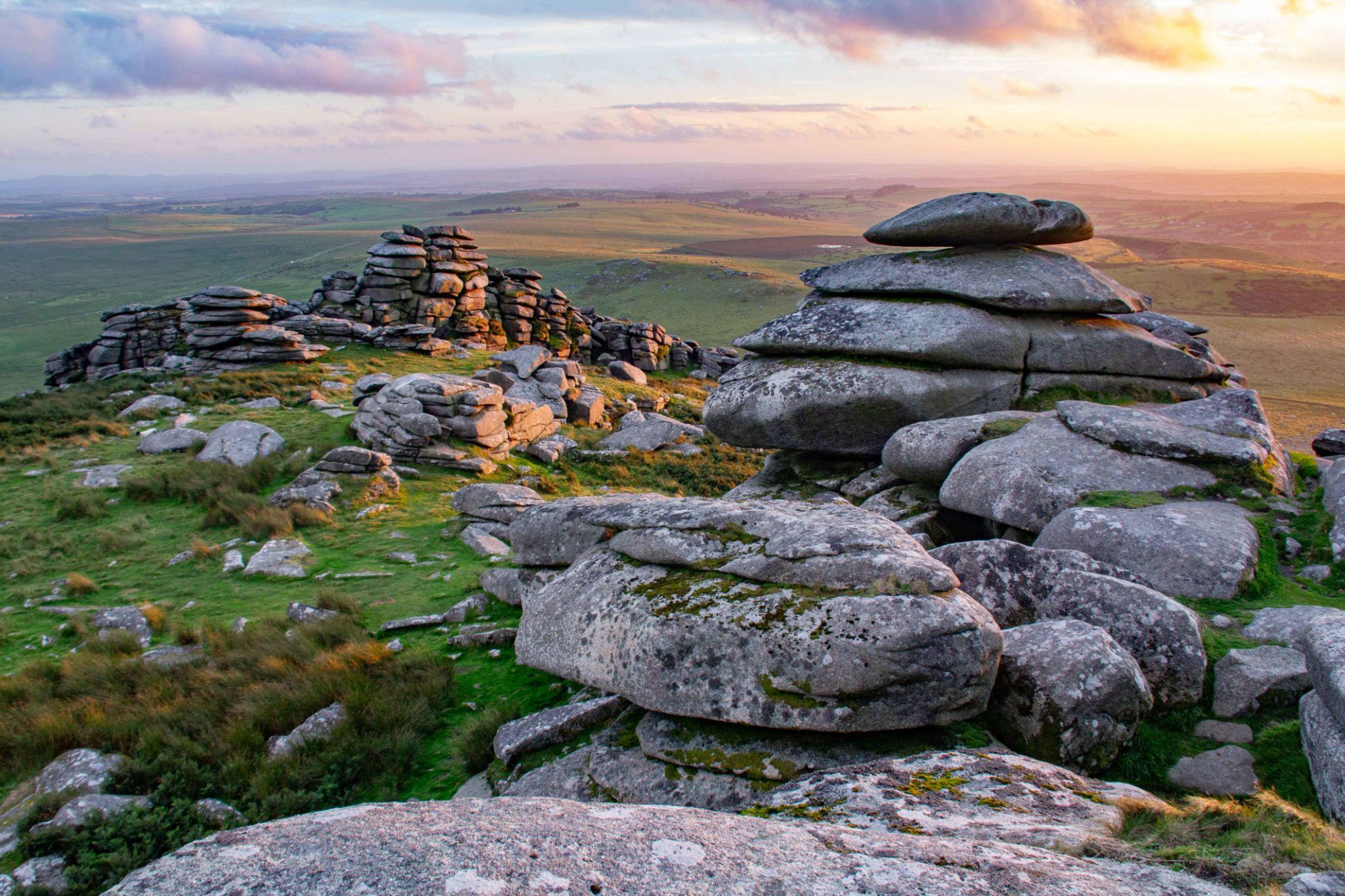
Explore granite uplands, tors and exposed bedrock. The Cheesewring near Minions is a striking example of granite weathering.
Look for: granite, tors and the relationship between geology and upland scenery.
The ancient forces that folded Cornwall's rocks, raised a mountain belt and helped create the granite and mineral deposits that define much of the county today.
Between about 385 and 280 million years ago, powerful tectonic forces transformed the rocks of what is now south-west England. The resulting geological structures, followed by granite intrusion and mineralisation, laid the foundations for Cornwall's distinctive landscape and mining heritage.
Mainly Late Devonian to Carboniferous mountain building, with related granite intrusion continuing into the Permian.
Part of the wider collision that helped assemble the supercontinent Pangaea.
Older sedimentary and volcanic rocks were folded, faulted and locally metamorphosed.
Granite-related fluids helped form important deposits of tin, copper and other metals.
An orogeny is a period of mountain building caused by movements of the Earth's lithospheric plates. The Variscan Orogeny was a major episode of deformation that affected large parts of Europe during the late Palaeozoic Era.
As ancient continental landmasses – Gondwana to the south and Laurussia to the north – moved towards one another, the Rheic Ocean and smaller ocean basins between them narrowed and eventually closed. The resulting convergence, subduction and continental collision generated immense pressures within the Earth's crust.
The Variscan mountain belt extended across parts of what are now Iberia, France, Germany, southern Ireland and south-west Britain. Cornwall occupies part of its northern region, where rocks record complex episodes of deformation, heating, magmatism and mineral formation.
The mountains that once existed here have long since been eroded. Today's cliffs, moorlands, tors and mining districts reveal parts of their deep geological roots.
The Variscan Orogeny explains much of Cornwall's folded bedrock, while later granite intrusions and associated hydrothermal activity help explain the county's metal-rich mineral veins and extensive china clay deposits.
The modern Cornish landscape is the result of several connected geological processes rather than a single event.
Much of the material that would become Cornwall's bedrock accumulated in marine basins. Mud, sand and other sediments settled on the seabed, while volcanic activity occurred in parts of the region.
Over time, these sediments were buried and compacted. They would later become important components of Cornwall's slate, sandstone and other rocks.
Deformation began in the south around 385 million years ago, when slices of ocean floor such as the Lizard were pushed onto the continental margin. Convergence between the continental plates then intensified, with the main phases of northward compression around 340–320 and 295–280 million years ago. The closure of oceanic basins and associated tectonic movements placed the rocks under considerable compression.
Existing rock layers were folded, fractured and pushed along major faults and thrusts – producing, for example, the chevron folds of the Bude coast and the tilted Meadfoot Beds of south-east Cornwall. These processes helped establish the broad east–west structural grain seen across much of Cornwall.
Heat and melting deep within the crust produced granitic magma. Large bodies of granite were emplaced at depth during the later stages of the Variscan geological episode and into the Permian.
Collectively, these granites form the Cornubian Batholith, which extends beneath south-west England from the Isles of Scilly towards Dartmoor – exposed at Bodmin Moor, St Austell and Land’s End.
Hot fluids associated with the granite intrusions moved through fractures and permeable zones in the surrounding rocks. As these fluids cooled and reacted with the bedrock, they deposited minerals and altered the surrounding rocks.
These processes helped create economically important tin, copper, tungsten and other mineral deposits. Later alteration of granite also contributed to the formation of Cornwall's china clay deposits.
Uplift and erosion gradually removed enormous thicknesses of overlying rock. The deeply eroded roots of the ancient mountain belt became exposed at the surface.
Today's granite moors, rocky tors, folded coastal cliffs and mineralised landscapes provide evidence of this long geological history.
The term killas is used locally for much of Cornwall's slate-like country rock, particularly the Devonian and Carboniferous sedimentary rocks affected by regional deformation and metamorphism.
Before the Variscan mountain-building episode, many of these rocks began as mud, sand and other sediments deposited in marine environments. Compression folded the original layers and produced extensive faulting.
Heat and pressure changed the texture and mineral composition of the rocks. Near granite intrusions, additional heating caused contact metamorphism, locally producing hard, fine-grained rocks such as hornfels.
The resulting killas forms much of the bedrock surrounding Cornwall's granite masses. Its resistance to weathering, together with the influence of geological structures, helps determine the shape of cliffs, valleys and coastal headlands.
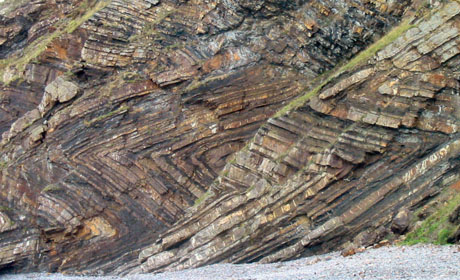
One of the most important consequences of the Variscan geological episode was the emplacement of the Cornubian Batholith, a vast complex of granite bodies lying beneath Cornwall and Devon.
Granite forms when silica-rich magma cools slowly underground, allowing crystals to grow. Much of Cornwall's granite is coarse-grained, with visible quartz, feldspar and mica.
The batholith is exposed at the surface in several separate granite masses. These include Bodmin Moor, the St Austell area, Carnmenellis, Land's End and smaller western and southern outcrops.
These granite bodies are not simply isolated blocks scattered across Cornwall. Geological evidence indicates that they form part of a larger intrusive system extending beneath the region.
The granite masses have influenced local relief, drainage, soils and vegetation. Their distinctive weathering patterns have also produced the dramatic tors and rock formations found on the moors.
The connection between granite and mineralisation is central to understanding Cornwall's industrial history. The principal mountain-building phase deformed the country rocks, while later magmatic and hydrothermal processes helped concentrate valuable metals.
As granite magma crystallised, hot fluids carrying dissolved chemical elements moved through fractures and other pathways. Changes in temperature, pressure and fluid chemistry caused minerals to precipitate within veins and altered zones.
Tin, principally found in the mineral cassiterite, became one of Cornwall's most important resources. Tin deposits occur in veins and in altered rocks associated with granite intrusions.
Copper ores were mined extensively in Cornwall, particularly during the eighteenth and nineteenth centuries. Many deposits occupy mineralised fractures within the country rocks.
In the St Austell area, alteration of granite transformed feldspar into kaolinite-rich material. This produced the extensive china clay deposits and white spoil heaps characteristic of the area.
The Variscan Orogeny, granite emplacement and mineralisation are closely related, but they were not a single instantaneous event. Granite intrusion and mineral-forming processes continued through different stages, extending into the Permian. The detailed timing and origin of individual deposits vary across Cornwall.
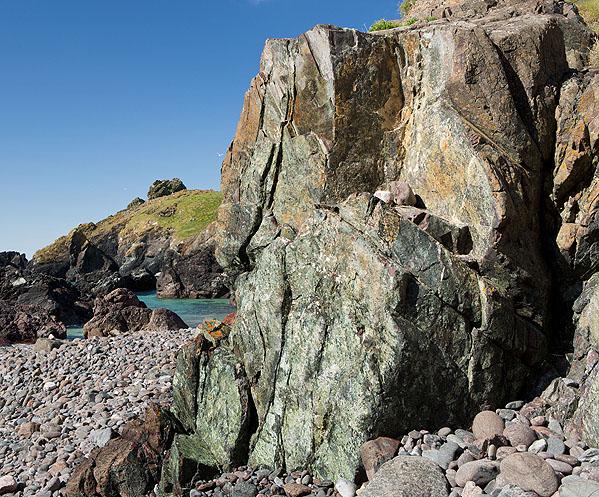
The Lizard Peninsula has a geological character quite different from much of the rest of Cornwall. Its complex includes unusual rocks interpreted as remnants of ancient oceanic crust and upper mantle, collectively known as an ophiolite.
These rocks are associated with the former Rheic Ocean, which lay between ancient continental landmasses before being progressively consumed during plate convergence.
During the geological events associated with the Variscan system, fragments of oceanic rocks were transported and emplaced onto continental crust. The precise history of the Lizard Complex is complicated and remains a subject of scientific research.
The Lizard is therefore an important place for understanding the processes that accompanied the closure of ancient oceans and the assembly of the Variscan mountain belt.
These locations provide opportunities to see granite, deformed bedrock, mineralised landscapes and the geological variety created by Cornwall's ancient past.
Explore granite uplands, tors and exposed bedrock. The Cheesewring near Minions is a striking example of granite weathering.
Look for: granite, tors and the relationship between geology and upland scenery.
The extensive pits and pale spoil heaps illustrate the industrial importance of granite alteration and kaolin-rich deposits.
Look for: altered granite and the distinctive landscape of the china clay industry.
The coastal mining landscape reveals mineralised rocks, granite-related geology and the remains of Cornwall's mining heritage.
Look for: mineral veins, mine remains and the relationship between geology and historic industry.
Granite outcrops and rugged coastal scenery reveal the western part of the Cornubian Batholith and the effects of prolonged erosion.
Look for: granite cliffs, weathered rock and mineralised districts.
Discover unusual green serpentine rocks and complex geological relationships that record the history of ancient oceanic crust.
Look for: serpentinite, metamorphic rocks and the region's unusual geological diversity.
Coastal cliffs and rock platforms provide opportunities to examine folded sedimentary rocks and the structural effects of ancient compression.
Look for: folded strata, fractures and changes in rock orientation.
Coastal exposures and mine sites can be dangerous. Observe rocks from safe public viewpoints, check access restrictions and tides, and do not enter abandoned mine workings.
Cornwall's geological character is the product of a long sequence of events: marine sedimentation, volcanic activity, plate convergence, folding, faulting, granite emplacement, mineralisation and millions of years of erosion.
The Variscan Orogeny provides the wider tectonic explanation for much of this history. It transformed earlier rocks and formed part of a mountain belt whose deeper structure is now exposed in south-west England.
Later granite intrusions and associated mineral deposits helped make Cornwall one of the world's historically important tin and copper mining regions. Granite alteration also contributed to the development of the St Austell china clay industry.
The cliffs, moors, tors, quarries and mining remains visible today are therefore more than scenic features. They are evidence of the enormous geological forces that shaped this part of Britain hundreds of millions of years ago.
The Variscan Orogeny was a long period of mountain building, caused by continental plates converging as the ocean between them closed. It affected much of western and central Europe in the Late Palaeozoic and helped assemble the supercontinent Pangaea. Cornwall lies near its northern edge.
In south-west England deformation began in the south around 385 million years ago, in the Devonian. The main phases of northward compression followed at roughly 340–320 and 295–280 million years ago, and the mountain belt then collapsed in the Late Carboniferous to Early Permian, when the Cornish granites were intruded.
The main ocean consumed was the Rheic Ocean, which lay between the continents of Gondwana to the south and Laurussia to the north. The rocks of the Lizard are interpreted as a fragment of ocean floor caught up in this closure.
No. The mountains were eroded away long ago. What we see today are their deep roots – folded slates and sandstones, thrust faults, and the granite that crystallised several kilometres beneath the mountain belt.
The chevron folds at Millook Haven and along the Bude coast are among the best examples in Britain. Steeply tilted and folded Devonian rocks can also be seen at Talland Bay and around Looe in south-east Cornwall.
Late in the orogeny the thickened crust melted, producing the granites of the Cornubian Batholith. As the granites cooled, hot fluids deposited tin, copper and other metals in veins, creating the lodes that Cornish miners worked for centuries.
The following sources provide additional information on the Variscan Orogeny, south-west England's geology and the development of Cornwall's granite and mineral deposits.
Discover the other rock formations and landscapes in our Cornwall geology guides.