The Cornubian Batholith

The immense granite complex beneath Cornwall and Devon that helped shape the moorlands, mineral deposits, dramatic tors and historic mining landscapes of south-west England.

From Dartmoor in the east to the Isles of Scilly in the west, the Cornubian Batholith records an important chapter in the geological history of Britain.

Back to Geology of Cornwall

By Martin Frost · Updated 14 October 2026

Ancient origins

Granites intruded over about 25 million years, roughly 300–275 million years ago.

Regional scale

Over 250 km long and up to about 10 km thick beneath Cornwall, Devon and the sea floor.

Mineral wealth

Closely associated with important tin, copper, tungsten and other mineral deposits.

Distinctive scenery

Granite tors, exposed rock, upland moors and historic quarries.

What is the Cornubian Batholith?

A batholith is a very large body of intrusive igneous rock formed when magma cools and crystallises deep within the Earth's crust. The Cornubian Batholith is a major granite complex beneath south-west England.

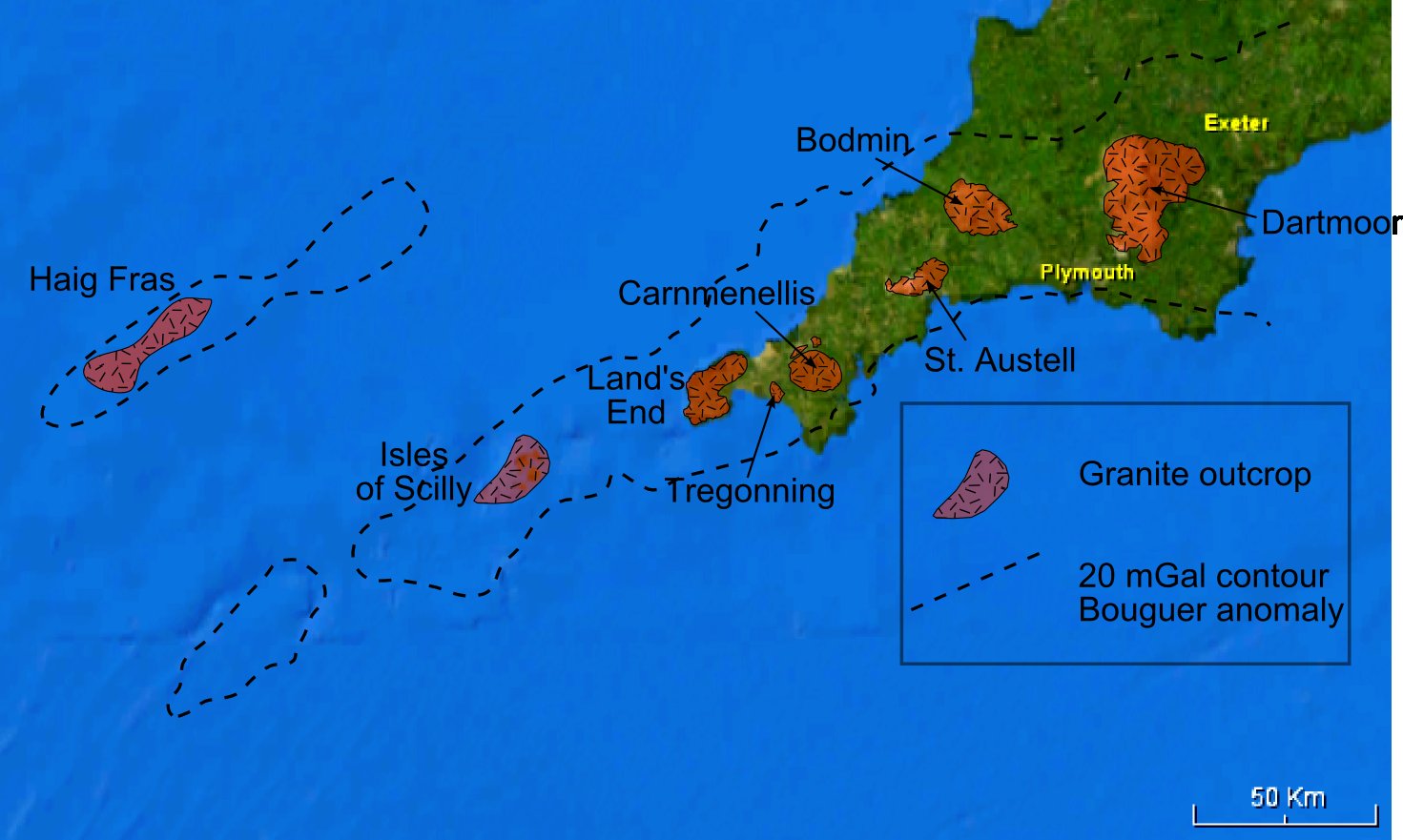
Its exposed granite masses occur discontinuously from Dartmoor in Devon, across Cornwall and westwards to the Isles of Scilly. Gravity surveys show that the granite extends beneath areas where it is not exposed, forming one connected body more than 250 km long, 20–40 km wide and up to about 10 km thick. A related granite, Haig Fras, lies on the sea bed about 95 km north-west of the Isles of Scilly.

The separate granite outcrops are therefore understood as parts of a much larger geological system rather than unrelated bodies of rock. They represent portions of an intrusive complex that has been exposed by millions of years of uplift and erosion.

The batholith is particularly important because its development was associated with the late stages of the Variscan mountain-building episode. Granite intrusion followed the main phases of regional deformation, although the tectonic processes and magmatism were related.

Map showing the extent of the Cornubian Batholith and associated gravity anomaly in south-west England
The granite outcrops of the Cornubian Batholith, with the dashed line marking the gravity low that shows the buried granite connecting them. Map by Mikenorton, Wikimedia Commons, CC BY-SA 3.0 (converted to JPEG). Image source and licence .

How the granite formed

The batholith developed during a period of major geological change, as the ancient rocks of south-west Britain were deformed, heated and intruded by magma.

1. The Variscan mountain-building episode

During the late Palaeozoic Era, movements of tectonic plates brought continental landmasses together. The associated convergence, subduction and collision deformed rocks across a wide region of Europe, including south-west Britain.

2. Heating and melting deep within the crust

During the later stages of this tectonic history, conditions deep within the crust allowed silica-rich granitic magmas to form. The precise sources of the magma and the processes that generated it have been the subject of geological research.

3. Granite intrusions, around 300–275 million years ago

The magma moved upwards and crystallised underground, forming granite bodies at depth. Different granite masses were emplaced over a period of about 25 million years, with variations in their mineralogy and chemical composition – Carnmenellis and Bodmin Moor among the earliest, the main Land’s End granite among the latest.

4. Cooling, fracturing and mineralisation

As the granites cooled, hot fluids circulated through fractures in the granite and surrounding country rocks. These fluids helped concentrate metals and formed mineral veins and zones of alteration.

5. Uplift and erosion

Over immense periods of time, erosion removed overlying rocks and exposed portions of the granite complex. The result is the patchwork of granite outcrops, moorland tors, cliffs and mineralised districts visible today.

The principal granite areas

Although they belong to the same broad intrusive complex, the individual granite masses have their own geological characteristics and landscapes.

Dartmoor Granite

The easternmost major exposed granite mass of the batholith lies beneath Dartmoor. Its weathering has produced the familiar granite tors and boulder-strewn hilltops of the national park.

Landscape: Haytor, Hound Tor, granite moorland and historic quarries.
Bodmin Moor

Bodmin Moor is underlain by granite that forms elevated ground and distinctive rocky summits. Weathering has produced large granite blocks and tors.

Landscape: Rough Tor, Brown Willy and the Cheesewring.

St Austell Granite

The St Austell granite is especially important for its extensive china clay deposits, formed by alteration of feldspar-rich granite.

Landscape: China clay pits, white spoil heaps and industrial heritage.

Carnmenellis

The granite of the Carnmenellis area forms part of central Cornwall's upland landscape. Its geology is associated with the region's wider mineralised districts.

Landscape: Granite uplands, old quarries and mining country.

Land's End Peninsula

The western granite masses create much of Penwith's rugged character, with rocky headlands, exposed granite and dramatic coastal scenery.

Landscape: Granite cliffs, tors and historic mining districts.

Isles of Scilly

The Isles of Scilly are the westernmost part of the granite complex on land; the related Haig Fras granite lies further out on the sea bed. Their granite bedrock has helped shape the islands' rocky shores and distinctive coastal scenery.

Landscape: Granite headlands, rocky shore platforms and island scenery.

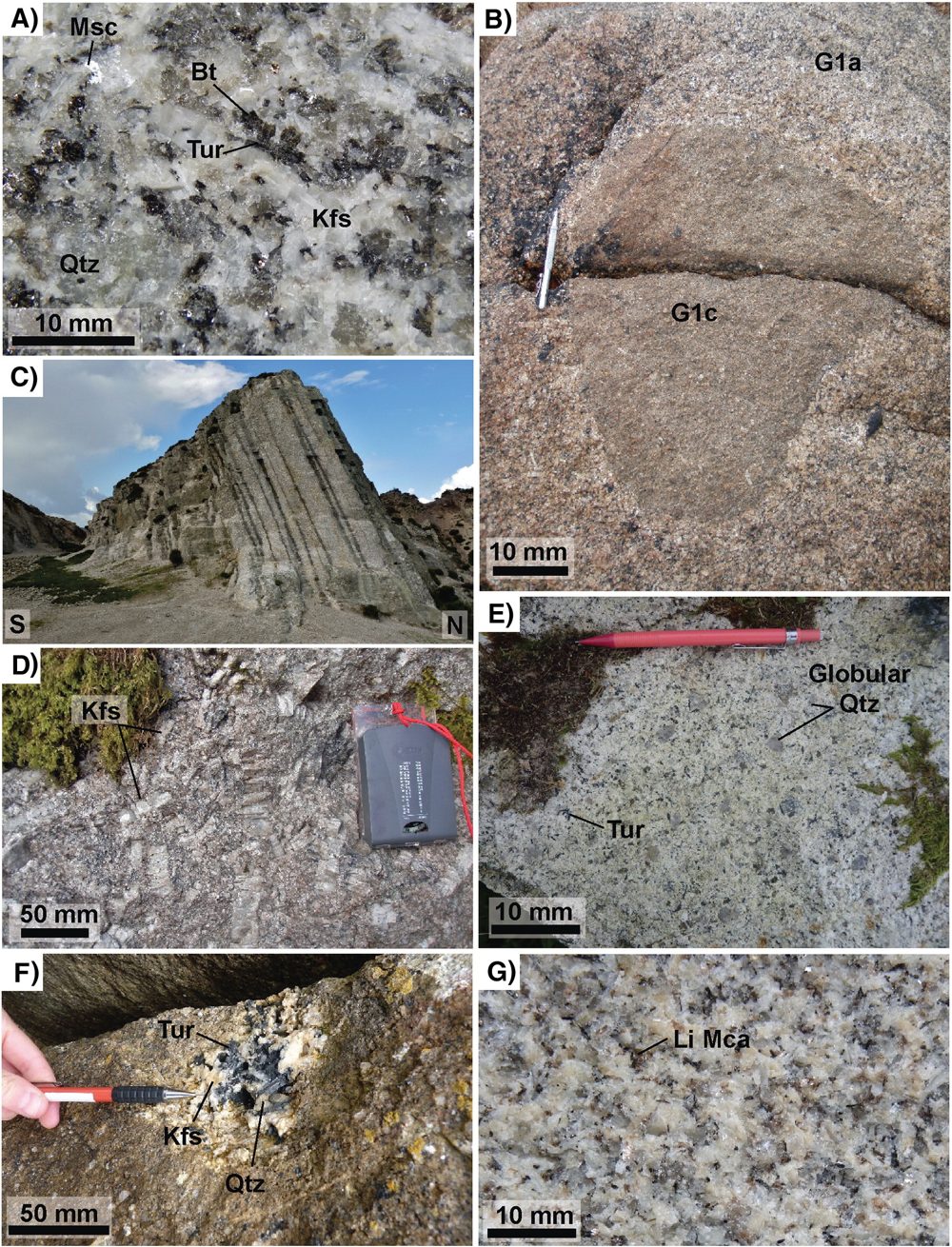
Scientific field photographs showing different granite textures from the Cornubian Batholith, including Dartmoor and Cornish granite
Granite textures from different parts of the Cornubian Batholith, including Dartmoor. Photograph plate by Beth Simons, Jens C.Ø. Andersen, Robin K. Shail and Frances E. Jenner, CC BY 4.0 (resized). Image source and licence .

Granite is not all the same

Granite is an intrusive igneous rock, but its appearance and composition can vary considerably. The granites of the Cornubian Batholith contain different proportions of quartz, feldspar, mica and accessory minerals.

Some varieties contain large crystals of potassium feldspar, known as phenocrysts, within a coarser-grained matrix. Other varieties are associated with minerals such as tourmaline, topaz and lithium-bearing mica.

These differences reflect changes in the composition and evolution of the magma, as well as the processes that occurred during and after crystallisation.

For geologists, comparing granite samples from Dartmoor, Carnmenellis, Land's End and other locations helps reveal the complex history of the batholith.

The batholith and Cornwall's mineral wealth

The Cornubian Batholith is closely associated with the mineral resources that made Cornwall internationally famous for mining. The granite itself is important, but so too are the hot fluids and chemical changes associated with its formation and cooling.

Tin

Tin occurs mainly in the mineral cassiterite. Granite-related fluids concentrated tin in veins and altered rocks, supporting a mining industry that developed over many centuries.

Copper and other metals

Cornwall's mineralised veins contain copper and a range of other metals, including tungsten, arsenic, zinc and, in some districts, lead. Individual deposits differ in age and geological setting.

China clay

In the St Austell district, chemical alteration transformed feldspar in the granite into kaolinite-rich china clay. This process created a major industrial resource and a distinctive landscape.

Why the country rock matters

Mineral deposits occur not only within granite but also in the surrounding rocks. Fluids moving away from intrusions reacted with the country rock and deposited minerals in fractures and altered zones. The geology of each mining district reflects this interaction.

Dartmoor: granite at the surface

Dartmoor provides one of the best-known examples of the relationship between granite and landscape in south-west England. Its upland plateau, rugged tors and exposed boulder fields are closely linked to the properties and weathering of the granite.

Tors such as Haytor and Hound Tor consist of resistant granite blocks exposed by prolonged weathering and erosion. The details of tor formation vary from place to place, involving fractures within the rock, chemical weathering and the removal of surrounding material.

Granite has also influenced Dartmoor's soils, drainage and land use. The relatively acidic, nutrient-poor soils over much of the upland have helped shape its characteristic moorland vegetation.

The same granite has been quarried for building stone and other uses. Old quarries, abandoned workings and granite structures are further evidence of the relationship between geology and human activity.

Exploring Dartmoor

The tors are useful places to observe granite in the landscape. Follow public paths, check access and weather conditions, and take care around steep rock faces and disused quarries.

Cornwall: granite, moorland and coast

Across Cornwall, granite outcrops create some of the county's most distinctive landscapes. Bodmin Moor rises above the surrounding country, while western Cornwall has rugged granite headlands and cliffs.

The granite masses also help explain the distribution of mineralised districts. The historic mining areas of the Camborne–Redruth region, St Agnes and western Cornwall are associated with a complex network of mineral veins and altered rocks.

In the St Austell area, granite alteration produced china clay deposits that became central to the local economy. The large excavations and pale spoil heaps are now prominent features of the landscape.

Granite also forms part of Cornwall's built heritage. Churches, farm buildings, walls, bridges and monuments demonstrate how local stone has been used for construction over many centuries.

Why the Cornubian Batholith matters

Understanding Earth's history

The batholith provides evidence of magma generation, intrusion and crystallisation during the late stages of the Variscan geological episode.

Explaining the landscape

Granite influences the shape of moorlands, tors, cliffs, drainage patterns and the distribution of soils across parts of Cornwall and Devon.

Explaining mineral deposits

Granite-related fluids and alteration processes helped form economically important deposits of tin, copper and other minerals.

Connecting geology with heritage

Quarries, mine remains, historic buildings and mining landscapes reveal how geology influenced the economic and cultural history of the region.

Cornubian Batholith FAQ

It is a huge body of granite lying beneath south-west England. It reaches the surface in a chain of separate granite masses – Dartmoor, Bodmin Moor, St Austell, Carnmenellis, Land’s End and the Isles of Scilly – which gravity surveys show are joined together underground.

The granites were intruded over about 25 million years, roughly 300 to 275 million years ago, at the end of the Carboniferous and in the Early Permian. Carnmenellis, Bodmin Moor and the Isles of Scilly are among the older masses; the main Land’s End granite is one of the youngest.

Gravity data suggest a connected granite body more than 250 km long, 20–40 km wide and up to about 10 km thick, extending from Dartmoor out under the sea beyond the Isles of Scilly. A separate but related granite, Haig Fras, lies on the sea bed about 95 km north-west of Scilly.

The granites formed late in the Variscan Orogeny. Continental collision had thickened the crust; as the mountain belt began to relax, the deep crust melted and the granite magma rose and crystallised several kilometres below the surface.

As the granites cooled, hot fluids carried tin, copper, tungsten, arsenic, lead and zinc into fractures in the granite and the surrounding rocks, forming the lodes worked by Cornish and Devon miners. Altered granite also produced the china clay of St Austell and Lee Moor on Dartmoor.

No. The granites vary in texture and mineralogy – from coarse granite with large feldspar crystals to finer, tourmaline-, topaz- or lithium-mica-bearing varieties. These differences reflect how the magmas formed and evolved, and are an active area of research, including for lithium.

Further reading

Page views: 4 ·  2026 views: 5 ·  Last updated: 14 October 2026