Cornwall's geological landscape
Mid Cornwall and St Austell
The St Austell Granite has been altered in places to china clay. North of the town, huge excavations, pale sands and towering white spoil heaps create one of Cornwall's most distinctive man-made landscapes.
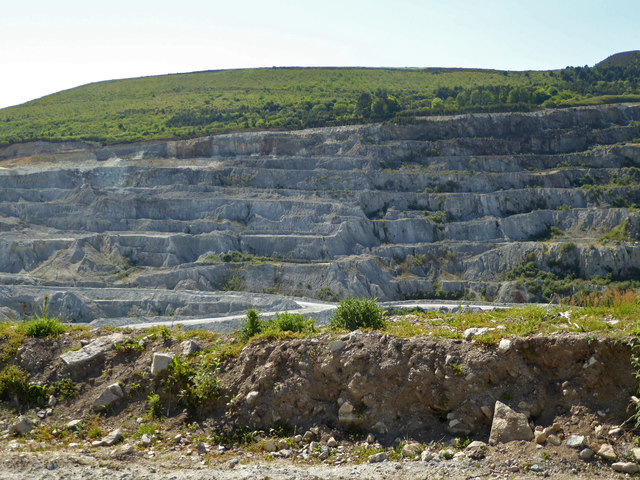
A landscape built around granite
Around St Austell and the villages to its north, the geology has helped create a landscape unlike almost anywhere else in Cornwall. The area is underlain by the St Austell Granite, a large body of igneous rock formed when molten material cooled slowly beneath the Earth's surface.
Granite is made up mainly of minerals including quartz and feldspar, with mica and other minerals also present. It is the feldspar-rich parts of the granite that are particularly important to the story of china clay.
After the granite formed, some of its original minerals were altered. Feldspar was transformed into kaolinite, the fine white clay mineral known commercially as china clay or kaolin. The process is called kaolinisation. Hot fluids circulating through the cooling granite are the traditional explanation, although some geologists think that deep weathering much later, under warm climates, also played a part – the exact origin is still debated.
The alteration did not affect every part of the granite equally. Some areas became deeply decomposed and suitable for clay extraction, while other areas retained harder granite or were worked for different mineral products.
Why is the clay white?
Kaolinite is a pale clay mineral. When feldspar-rich granite is altered and the resulting material is processed to remove impurities, the fine white china clay can be separated from coarser quartz sand, mica and other minerals.
From granite to china clay
The transformation of granite into china clay is a geological process that took place over long periods. Chemically active water – hot fluids from below and, possibly, groundwater from above – changed the minerals within the rock, replacing feldspar with clay minerals and leaving quartz and mica behind.
The altered granite could be relatively soft and friable compared with unaltered granite. This made the deposits workable on a large scale, although extracting and refining the clay still required extensive engineering, water management and processing.
The Plymouth chemist William Cookworthy first identified Cornish china clay at Tregonning Hill in west Cornwall in 1745, and in 1768 made the first true hard-paste porcelain in Britain. The far larger deposits of the St Austell granite soon took over, and the area became one of the world's most important china clay districts. The industry developed from relatively small workings into large operations that reshaped hillsides and created extensive pits, processing sites, transport routes and waste tips.
A simple geological sequence
- Molten rock cooled underground to form granite.
- Hot fluids – and possibly later deep weathering – altered feldspar in parts of the granite.
- Kaolinite-rich material formed within the altered rock.
- Mining and processing separated china clay from other material.
- Excavation and waste deposits created the landscape visible today.
The white tips and vast pits
The most striking feature of Clay Country is the contrast between the white and pale grey tips, deep excavations, green countryside and wooded valleys. The tips are not natural hills: they are accumulated materials left by mining and processing.
China clay extraction produces more than the finished clay itself. Quartz-rich sands, mica and other waste materials need to be separated from the fine kaolin. Depending on the deposit and the process used, these materials have been stored in tips, placed in worked-out areas or used for other purposes.
The scale of the workings is visible from roads and viewpoints around the clay district. The white slopes and geometric excavations reveal where the underlying granite has been altered and where generations of industrial activity have changed the shape of the land.
The St Austell Granite
St Austell granite at a glance
- Rock: granite – quartz, feldspar and mica
- Age: about 282 million years (Early Permian)
- Part of: the Cornubian Batholith, with Dartmoor, Bodmin Moor and Land’s End
- Also known as: the Hensbarrow granite, after its highest point, Hensbarrow Beacon
- Product: china clay (kaolin), plus china stone used in porcelain
The St Austell Granite forms part of the wider family of Cornish granites. These intrusions were emplaced deep underground during the later stages of geological mountain-building in south-west Britain – the St Austell mass about 282 million years ago.
Granite is normally a hard, crystalline rock. However, the chemical alteration of feldspar within parts of the St Austell intrusion created extensive deposits of china clay.
The result is a patchwork of different ground conditions: relatively fresh granite in some places, strongly altered granite in others, and mineral-rich deposits that have been exploited for industrial purposes.
This variation explains why the clay workings are concentrated in particular areas rather than spread uniformly across all the granite.
How china clay forms
China clay is the commercial name for kaolin, a material dominated by the mineral kaolinite. In the St Austell district, the clay formed through the alteration of feldspar in granite.
Feldspar is a major constituent of granite. When hot fluids interact with feldspar, the original mineral can break down and new minerals, including kaolinite, can form. The fluids also transport dissolved chemical components through fractures and pores in the rock.
This process is a form of hydrothermal alteration. It changes the original granite and may leave it softer and easier to excavate. The resulting material is not pure clay: it contains other minerals that must be separated during processing.
Feldspar
An abundant mineral in granite and the principal source of the kaolinite formed during alteration.
Kaolinite
The fine, pale clay mineral that gives china clay its characteristic colour and commercial value.
Quartz and mica
Other minerals remain in the altered material and are separated or managed during processing.
The white spoil heaps of Clay Country
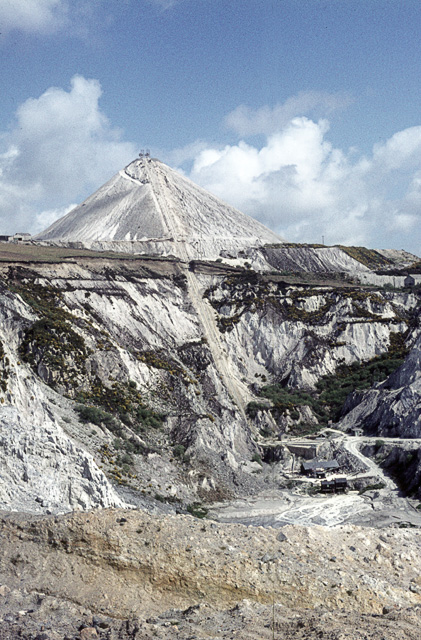
The white tips – often nicknamed the “Cornish Alps” – have become an emblem of the St Austell area. For every tonne of china clay produced, several tonnes of waste, mostly quartz sand, are left behind. Their bright surfaces contrast sharply with the dark green vegetation of the surrounding countryside.
Their shape and colour reflect the material deposited and the way it was handled. Some tips form high, angular slopes, while other worked areas have been reprofiled and revegetated.
The clay industry has left a landscape that is both industrial and continually changing. Active workings, old tips, restored ground and new habitats may occur close together.
Restoration can involve reshaping slopes, managing drainage, establishing vegetation and creating opportunities for wildlife and recreation. The results vary according to the site and its intended future use.
A human-made landscape with a geological origin
The tips and pits are products of industry, but their location and scale are closely tied to the distribution of altered granite beneath the surface. The geology determined where the clay could be extracted; mining created the landscape seen above ground.
From extraction to finished china clay
The china clay industry grew rapidly as demand increased for porcelain, ceramics and other products. St Austell became closely associated with the industry, which provided employment and shaped the growth of nearby villages and transport networks.
In traditional processing, clay-bearing material was broken down and mixed with water. The fine clay particles could then be separated from coarser material through washing, settling and other stages of refining. Modern operations use industrial processes adapted to the deposit and the required product.
China clay has uses beyond pottery. Depending on its grade and processing, it is used in products such as paper, ceramics, coatings and other industrial applications.
The industry also produces sand, mica and other residual materials. Some can be used in other applications, while the remainder needs to be managed through approved storage, restoration and planning arrangements.
A major local industry
China clay transformed employment, settlements, transport and the economy around St Austell.
More than white clay
Processing separates the clay from other minerals and produces materials that may have additional uses.
Wheal Martyn and the history of china clay
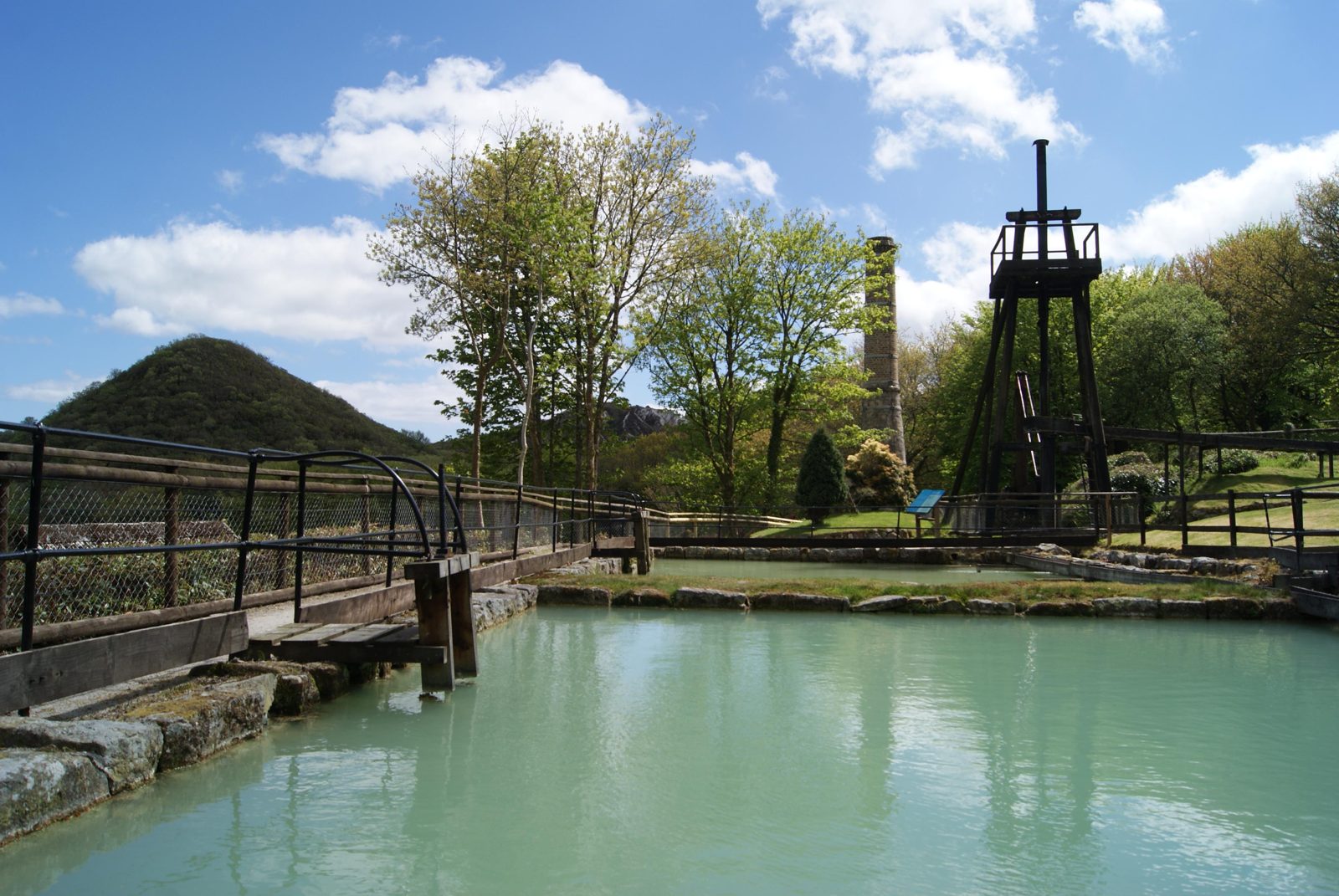
Wheal Martyn, at Carthew about two miles north of St Austell, preserves two Victorian china clay works – Wheal Martyn and Gomm – on a 26-acre site, including a 35 ft waterwheel built at Charlestown Foundry in the 1880s. Its historic works help explain how clay was processed before the introduction of many modern methods, and a viewpoint looks over a modern working pit next door.
The museum and its surroundings illustrate the practical stages of the industry, from handling clay slurry to settling, drying and preparing the finished material. Historic structures also help tell the story of the workers and communities whose lives were shaped by the industry.
Wheal Martyn provides a useful starting point for understanding the relationship between the geology, the extraction process and the striking landscape beyond the museum grounds.
Wheal Martyn on Cornwall Online · Visit St Austell: Wheal Martyn
Exploring Clay Country
The Clay Trails provide a way to experience parts of the landscape created by china clay extraction. Routes pass through a mixture of former industrial land, countryside, wooded valleys and villages. They reveal how the industrial landscape is being reused and incorporated into the wider countryside.
Surfaces, gradients and facilities vary between routes, so check current information before setting out, especially if you need a step-free or accessible route. Some nearby industrial areas remain operational and are not open for unrestricted access.
Cornwall Council: Coast and Clay Trails
The best-known new use of an old clay working is the Eden Project, whose biomes were built in the worked-out Bodelva clay pit and opened in 2001.
The contrast between white tips and green restored ground is particularly revealing. It shows how the same landscape can reflect the geology beneath it, the demands of industry and decisions about how former workings are managed.
Mid Cornwall & St Austell Geology FAQ
China clay, or kaolin, is a fine white clay made mostly of the mineral kaolinite. In Cornwall it formed where the feldspar crystals in granite were altered to kaolinite. It is used in porcelain and ceramics, and also in paper, paints, coatings and many other products.
Parts of the St Austell granite were altered so that their feldspar broke down to kaolinite, leaving the quartz and mica behind. The traditional explanation is that hot fluids circulating through the cooling granite did the work; some geologists argue that deep weathering much later, under warm climates, also played a part. The exact balance is still debated.
The St Austell granite is one of the granite masses of the Cornubian Batholith, which underlies Devon and Cornwall. It crystallised about 282 million years ago, in the Early Permian.
For every tonne of china clay extracted, several tonnes of waste are produced – mostly quartz sand, with mica and rock. This pale material was tipped into the conical heaps and long ridges nicknamed the ‘Cornish Alps’. Many are now reshaped and grassed over.
The Plymouth chemist William Cookworthy found fine clay at Tregonning Hill in west Cornwall in 1745 and went on to make the first true hard-paste porcelain in Britain in 1768. The much larger deposits in the St Austell granite soon became the centre of the industry.
Yes. China clay is still extracted and processed in the St Austell area today, alongside old pits and tips that have been restored, flooded or put to new uses.
Yes. The Eden Project’s biomes were built in a worked-out china clay pit at Bodelva, near St Austell, and opened in 2001. It is one of the best-known examples of a former clay working given a new life.
Wheal Martyn at Carthew, two miles north of St Austell, preserves two Victorian china clay works with a 35 ft waterwheel, settling tanks and drys, with a viewpoint over a modern working pit. The Clay Trails let you walk or cycle through the former clay landscape.
Further reading and geological resources
Cornwall Council
Planning information on china clay extraction, restoration and the future management of the St Austell clay district.
St Austell China Clay Restoration and Tipping StrategyWheal Martyn China Clay Museum
Discover the people, machinery and processing methods associated with Cornwall's china clay heritage.
Wheal Martyn informationThe Coast and Clay Trails
Find official information about walking, cycling and horse-riding routes through Mid Cornwall.
View the trail informationBritish Geological Survey
Explore geological maps and learn more about the rocks beneath Cornwall.
Open the BGS Geology Viewer