The Big Build
Restoring an Industrial Wasteland
Bodelva, St Austell, Cornwall, PL24 2SG | Tel: 01726 811911
Restoring an Industrial Wasteland
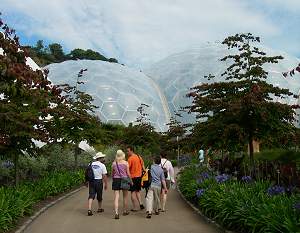
Eden features two spectacular giant Biomes and The Core education centre, all set within a developing outdoor landscape of gardens, built in an abandoned clay pit on the outskirts of St Austell. The original pit was around 60m deep - a gaping eyesore left behind by decades of mineral extraction for the local china clay industry.
Although the site already covered an area equivalent to 35 football pitches, contractors still had to remove a further 1.8 million tonnes of material, a task that took 12 trucks and 8 bulldozers six months to complete. Drainage was a major early challenge too - some 43 million gallons of water had to be managed in the first three months alone - before the pit's sides could be stabilised and work could begin on the world's largest greenhouse.
Creating the World's Largest Geodesic Conservatory
The Eden Project holds the record for the largest geodesic lean-to conservatories in the world. The Humid Tropics Biome alone measures 240m long, 110m wide and 55m high, and during construction the project also required the world's largest freestanding scaffold.
A world-class team came together in 1995 with the challenge of creating an architectural showcase to match Eden's horticultural ambitions - an international centre for exploring human dependence on the plant world. The plan involved transforming a 50m deep, 15-hectare china clay pit overlooking St Austell Bay into a dramatic landscaped destination, housing thousands of plants from three climatic zones: a temperate outdoor landscape, plus humid tropical and warm temperate zones inside two giant conservatories.
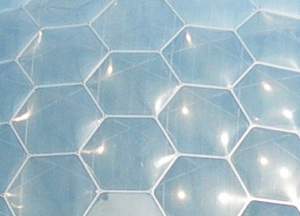
Beyond the Biomes themselves, the site needed to accommodate a Visitor Centre, classrooms, an exhibition gallery, conference facilities, an amphitheatre, and catering and retail space stocking plant-based products from around the world. The Biomes are built from 625 hexagonal window panels, the largest measuring 11m across - too large and heavy for glass, which would have overloaded the frame and created a serious safety risk.
ETFE - "Cling Film with Attitude"
The solution was ETFE (ethylenetetrafluoroethylene), nicknamed "cling film with attitude" on site. Each hexagonal panel is made from three layers of transparent ETFE foil, inflated into 2m-deep pillows that clad the exterior of the structure. ETFE brings exactly the qualities the project needed: it's transparent, weighs less than 1% of an equivalent pane of glass, is safer in use, and has non-stick, self-cleaning properties. The finished geodesic domes weigh barely more than the air they enclose.

The Big Build in Numbers
- Original clay pit depth: around 50-60 metres
- Site area: equivalent to 35 football pitches
- Material removed: 1.8 million tonnes, over 6 months
- Water managed in first 3 months: 43 million gallons
- Humid Tropics Biome: 240m long, 110m wide, 55m high
- Hexagonal window panels: 625, largest measuring 11m across
- Cladding material: ETFE foil, in 2m-deep inflated pillows