Upton Towans
Dune-Backed Beach and Wildlife Reserve on the Site of a Victorian Dynamite Works
Upton Towans, Hayle, Cornwall, TR27 5AX Cornwall Wildlife Trust Reserve
Upton Towans is one of the quieter sections of the long, sandy sweep of St Ives Bay, sitting roughly midway along the three-mile run of dune-backed beach between the mouth of the River Hayle and Gwithian, with Mexico Towans immediately to its south and Gwithian's own beach to the north. Backed by one of the largest and most botanically important dune systems in Cornwall, Upton Towans is a beach best known today for two very different things: as a Cornwall Wildlife Trust nature reserve of real conservation value, and as the site of a large Victorian and Edwardian explosives works that once employed hundreds, and at its wartime peak close to two thousand, workers among these same sand hills. Little of that history is obvious from the beach itself, which looks much like any other stretch of this coast - open, sandy and exposed to the Atlantic swell - but the dunes immediately behind it are scattered with the concrete remains of a factory that manufactured dynamite, nitric acid and cordite for over thirty years.
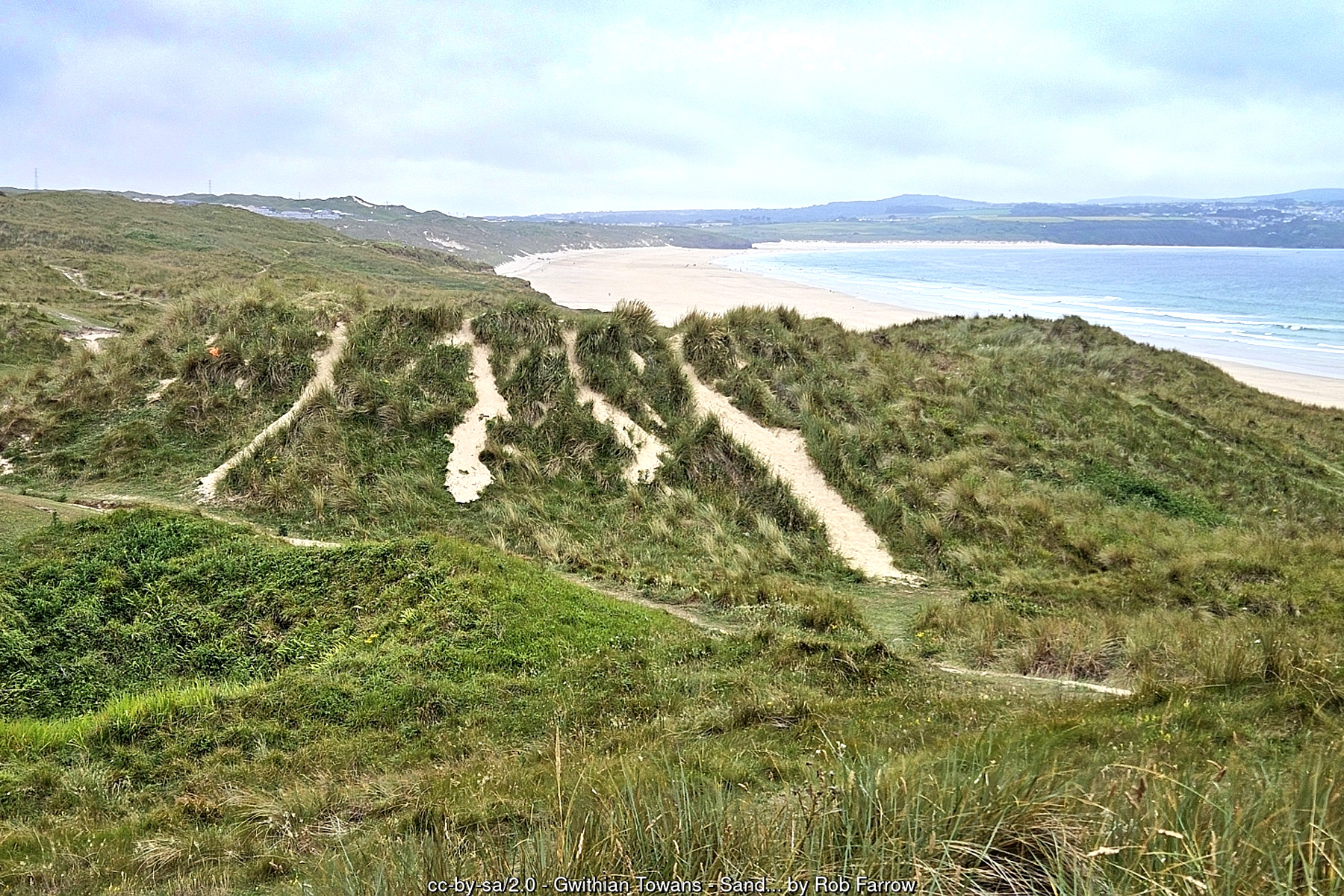
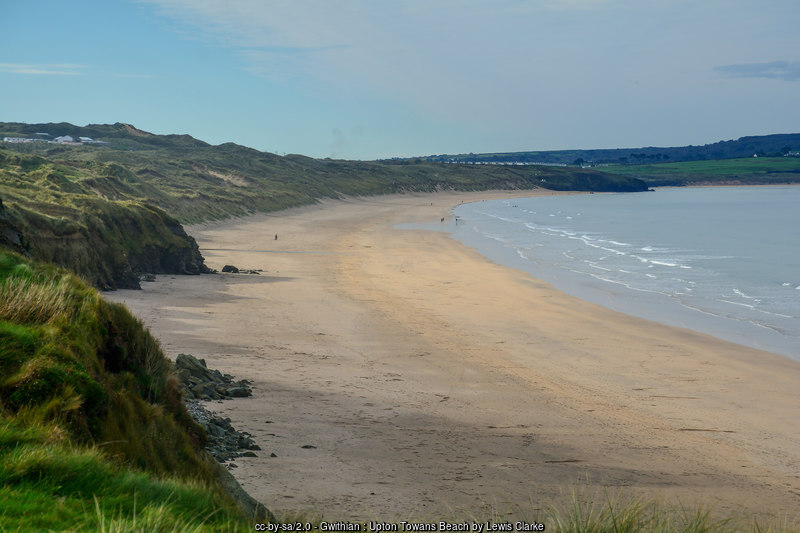
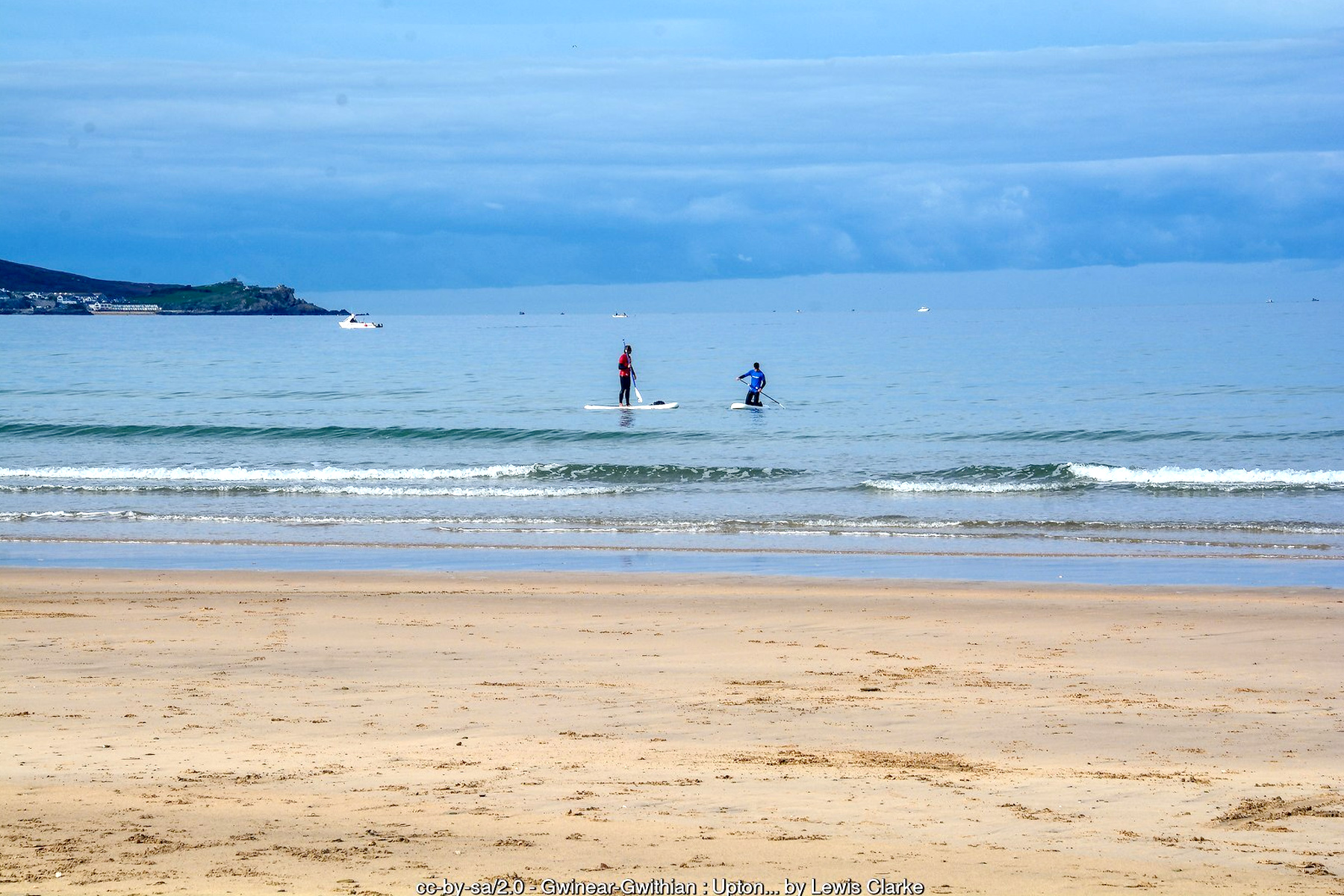
The beach itself is a genuinely large stretch of sand, around 1.3km in length, with one of the most dramatic tidal ranges on this part of the coast - the difference between high and low water can expose several hundred metres of firm, flat sand, making low tide here feel like a different beach entirely from high tide, when the sea can reach close to the base of the dunes. It is an exposed, west-facing beach that picks up plenty of Atlantic swell, which makes it a reasonable surfing spot, though it is not sheltered in the way a cove further along the coast might be, and it is rarely as busy as Gwithian or the main Hayle Towans beach further south, both of which have more parking, more facilities and an easier approach. That relative quietness is very much part of Upton Towans' character: this is a beach for people willing to walk a little further and manage without a beach cafe close at hand, in exchange for more space and a genuinely wild dune backdrop.
Long before any of that, this stretch of dune was known as Great Towan and supported a small farm, Upton Barton, worked from the drier ground at the landward edge of the sand hills. Local tradition holds that the farmhouse was overwhelmed by a sudden shift of the dunes sometime after 1650, buried more or less overnight by drifting sand - the kind of story told up and down this blown-sand coast, where the towans have a long history of moving, burying and occasionally giving up what they buried. Later attempts were made to bring the land back into productive use: in the late 1870s a local clergyman organised the cultivation of several acres of the towans for the benefit of the parish, and in the nineteenth century a handful of small mines - Wheal Lucy, Wheal Dream, Wheal Emily and the Boiling Well Mine, which worked copper, lead, zinc and silver from around 1815 to the 1860s - were sunk into the ground beneath and around the dunes, their remains now largely lost beneath sand and vegetation.
The site's best-known chapter, though, began in 1887, when the National Explosives Company - established with backing from the older Kennall Vale gunpowder concern near Ponsanooth - chose Upton Towans as the location for a new dynamite factory, giving the area its enduring local nickname of "Dynamite Towans." The choice of site was deliberate rather than incidental: a large, hollowed landscape of soft sand hills was exactly what an explosives manufacturer wanted, since the dunes could absorb and muffle the blast of any accidental detonation and limit the spread of debris and fire between buildings, which were themselves spaced apart and separated by earthen and sand-built protective banks known as traverses. Construction began in 1889 and the works were soon producing dynamite for Cornwall's mining industry; by the end of 1890 around 175 people were employed, turning out some three tonnes of dynamite a day. The business expanded steadily over the following two decades, adding nitric acid production and, by the First World War, cordite for the Royal Navy - output that pushed the workforce to a wartime peak of around 1,800, a large proportion of them women, working across a sprawling site of several hundred acres.
That scale of production came with real risk, and the works suffered at least two serious accidents during its operating life. On 5 January 1904 an explosion involving several thousand pounds of nitroglycerine killed five workers and injured many more; the blast was reportedly felt as far as fifteen miles away, and the official inquiry attributed it to a timber and lead tank lid dropped into a charge of nitroglycerine. A second major explosion in 1916, at the height of wartime production, killed two women and two men; because of wartime secrecy around munitions production, the precise cause was never established. Both accidents are recorded factually in Historic England's own scheduling documents for the site rather than as local legend, and they are worth remembering as part of the human cost behind what can otherwise read as a curious piece of industrial archaeology in the dunes. The company itself did not survive long after the war: falling demand for military explosives and a decline in Cornish mining pushed it into voluntary liquidation in 1919, with production ending in 1920 and the business absorbed into the wider Nobel explosives group, part of the same industry consolidation that shortly afterwards produced ICI. Some structures continued to be used for storing hazardous materials into the 1960s and 1970s before eventual demolition.
A surprising amount survives for anyone who takes the time to look. The most obvious landmark is a tall, cylindrical brick chimney - built in 1915 to serve the nitric acid works, around 21 metres high, and Grade II listed since 2019 - which still stands as a prominent feature of the dune skyline and gives its name to one of the reserve's better paths. Around it, scattered through the dunes, are concrete foundations from dozens of former buildings, the roofless brick shell of the old nitric acid works, several intact concrete magazine buildings with their distinctive arched window heads, lengths of narrow-gauge tramway and an old tramway incline, and the sand traverses themselves, now grassed over with marram but still clearly visible as raised embankments between building plots. The whole site - some 268 hectares of it - was formally scheduled as a monument in 2019 on Historic England's advice, recognising it as one of the best-preserved explosives factory landscapes in the country.
Nature has been the chief beneficiary of the works' closure. Cornwall Wildlife Trust now manages roughly 97 hectares of Upton Towans as a Local Nature Reserve, and the old industrial ground, never intensively farmed or built over in the way surrounding land eventually was, has developed into one of the richest wildflower habitats in the county - by some estimates supporting close to a quarter of all the plant species recorded anywhere in Cornwall. The reserve is particularly known for its silver-studded blue butterflies, a small species named for the metallic blue flecks on the underside of its wings, at their best here in June; for petalwort, a tiny and internationally rare liverwort with petal-like fronds; and for pyramidal orchids, glow-worms, skylarks, kestrels, stonechats and meadow pipits, along with adders, common lizards and common toads among the drier dune grassland and scrub. A tarmac path near the Dynamite Chimney gives wheelchair users and those with limited mobility a rare chance to get out into the dunes and reach a sea view, even though the beach itself remains accessible only across soft, uneven sand.
For visitors, the practical picture is straightforward: bring what you need, because there is very little at the beach itself. Parking is informal and limited - small areas holding around a dozen cars apiece sit off the B3301 near the gated entrance to the dunes, with a small free Cornwall Wildlife Trust car park serving reserve visitors close by, and no toilets, cafe or shop directly at the beach (the nearest of those are at Gwithian and around Hayle Towans, a walk or short drive away). RNLI lifeguards patrol seasonally, broadly from late May into late September, and given the strength of the tidal range and the currents that can build up around low water, swimming is best attempted at mid to high tide, ideally within sight of the lifeguard flags when they are up. Dogs are welcome on the beach and throughout the reserve all year round. Combined with Gwithian to the north and Mexico Towans to the south, Upton Towans forms a good stretch for a longer coastal walk along the South West Coast Path, taking in both the wildlife of the dune reserve and, for anyone interested, the quiet industrial archaeology of a factory that once made this an unexpectedly busy corner of the Cornish coast.
Visitor Information
Parking
No large formal car park. Small informal areas holding around a dozen cars each sit off the B3301 near the gated dune entrance, with a small free Cornwall Wildlife Trust car park serving the nature reserve nearby. Space is limited in summer - the formal car parks at Gwithian and Hayle Towans are a short walk or drive away.
Facilities
None directly at the beach - no toilets, cafe or shop. The nearest facilities are at Gwithian and around Hayle Towans/St Ives Bay Holiday Park. RNLI lifeguards patrol seasonally, broadly late May to late September.
Disabled Access
Limited. A tarmac path near the reserve's Dynamite Chimney is wheelchair-accessible and gives sea views, but the beach itself is reached only across soft, uneven dune sand with no boardwalk. No dedicated Blue Badge parking bays are provided at the informal car parking areas.
Things to Do Nearby
- Gwithian, the next beach north, with more parking and beach facilities
- Mexico Towans, immediately south along the same stretch of dune-backed beach
- Godrevy, a short walk or drive further north, known for its lighthouse and coastal views
- Upton Towans Nature Reserve - the Cornwall Wildlife Trust's own guide to the dune reserve and its wildlife
- South West Coast Path Guide - the coastal walking route linking Gwithian, Upton Towans and Hayle
Places to Stay
Frequently Asked Questions
Page last updated: 9 September 2026.