Godrevy Beach
A National Trust Headland of Lighthouse, Seals and Surf
Godrevy, Gwithian, near Hayle, Cornwall, TR27 5ED
Godrevy marks the dramatic northern tip of St Ives Bay, where a broad sweep of sand and low dunes gives way to a wild, National Trust-owned headland of cliffs, coastal heathland and one of Cornwall's most photographed views: the white tower of Godrevy Lighthouse, standing on its own small island a few hundred yards offshore. It is a beach of two very different characters in one place - a family-friendly stretch of sand backed by the Towans at its southern end, blending into Gwithian at low tide, and a rugged, elemental headland to the north where cliffs drop to secluded coves and grey seals haul out below the coast path.
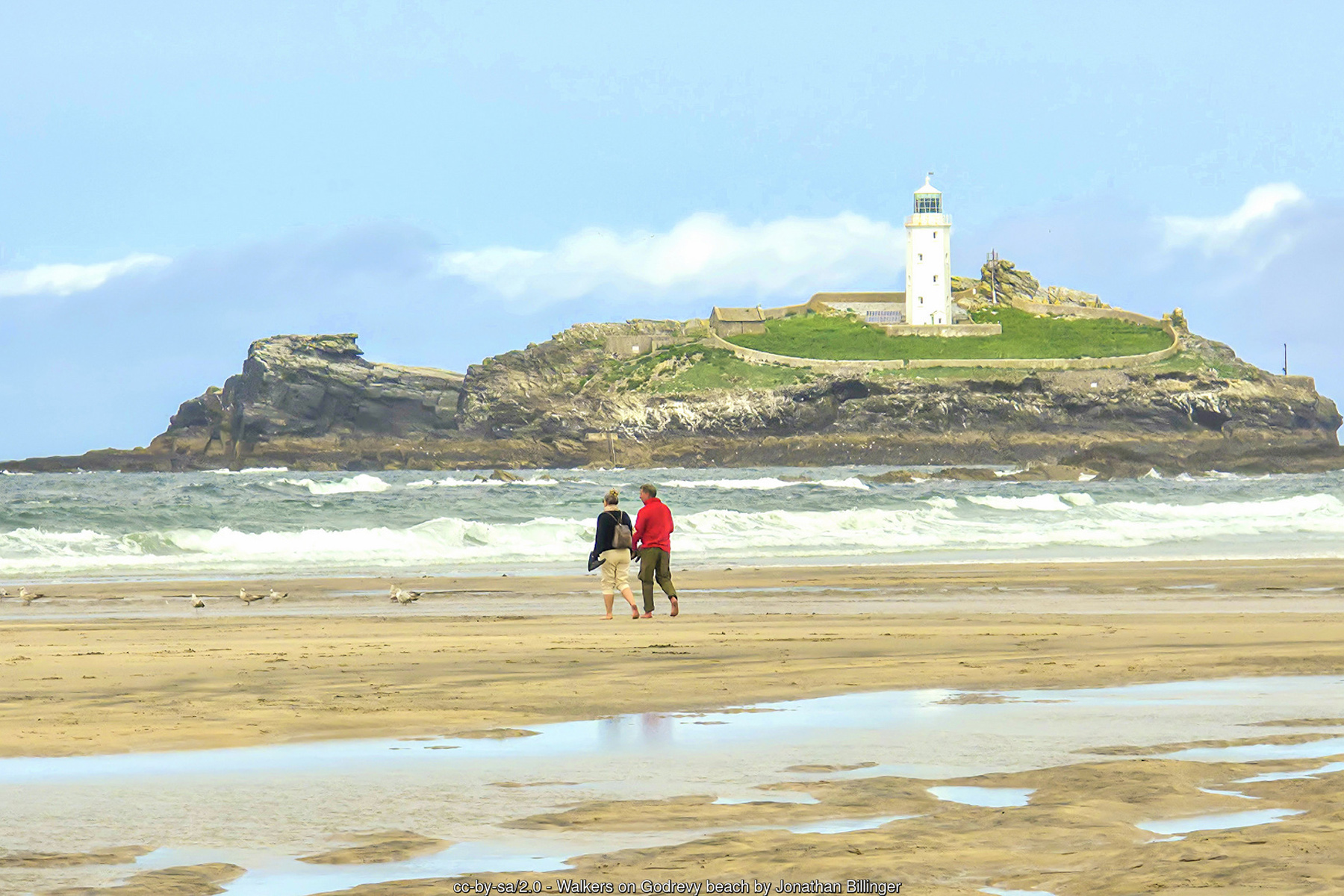
The headland has belonged to the National Trust since 1939, when 320 acres and five miles of coastline were donated by D. W. Thomas of Gwithian, with a further 19 acres added in 1962 - among the earliest and largest coastal gifts the Trust received in Cornwall, and the reason this stretch of St Ives Bay remains as undeveloped today as it was nearly a century ago. The roughly square promontory covers about a square mile, its cliffs rising to around 220 feet between the two headland points and to nearly 290 feet at their highest, and the whole area falls within the Cornwall Area of Outstanding Natural Beauty and the wider Godrevy Head to St Agnes Site of Special Scientific Interest, a twenty-kilometre run of coast protected for its geology and wildlife alike.
That geology is worth pausing for. The cliffs are built on Devonian sandstones and shales, laid down roughly 380 million years ago, but what makes Godrevy scientifically important is what sits on top of them: a cap of Ice Age deposits considered among the most significant Pleistocene sequences in southwest England, recording the periglacial conditions - freeze-thaw shattering, wind-blown loess, ancient soil layers - that shaped this coastline long before the last ice sheets retreated. It is a landscape that has been quietly recording its own history for hundreds of thousands of years, visible to anyone who looks closely at the exposed cliff sections above the beach.
No feature at Godrevy is better known than the lighthouse. Built by Trinity House in 1858-59 to a design by James Walker, it was commissioned after the paddle steamer SS Nile was wrecked on the nearby Stones reef in November 1854 with the loss of around forty lives - a disaster serious enough that local petitions pushed Trinity House to act within two years. The 85-foot tower first shone in March 1859, was automated in 1933 as one of the earliest lighthouses in the country to lose its keepers, converted to solar power in 1995, and in 2012 had its light transferred to a smaller platform, leaving the historic tower itself standing purely as a daymark - a landmark rather than a working light, though every bit as striking for it. It has been a Grade II listed building since 1988.
Godrevy Lighthouse's fame reaches well beyond maritime history, largely thanks to Virginia Woolf. As a child, Woolf spent her family's summers at Talland House in nearby St Ives, from where the lighthouse was visible across the bay, and she is widely believed to have drawn on those childhood memories when she wrote her 1927 novel To the Lighthouse - even though, in the finished book, she relocated the setting to Scotland's Hebrides rather than naming Godrevy directly. The connection is well documented rather than mere legend: Woolf visited the lighthouse itself in September 1892, aged ten, and signed the visitors' book in a party that also included the Pre-Raphaelite painter William Holman Hunt (her signature from that visit was later sold at auction for over £10,000). Whether Godrevy was the literal model or simply the formative image behind a more universal lighthouse, it remains the site most closely and consistently linked to one of the most celebrated novels of English modernism, and literary visitors make the pilgrimage to this day.
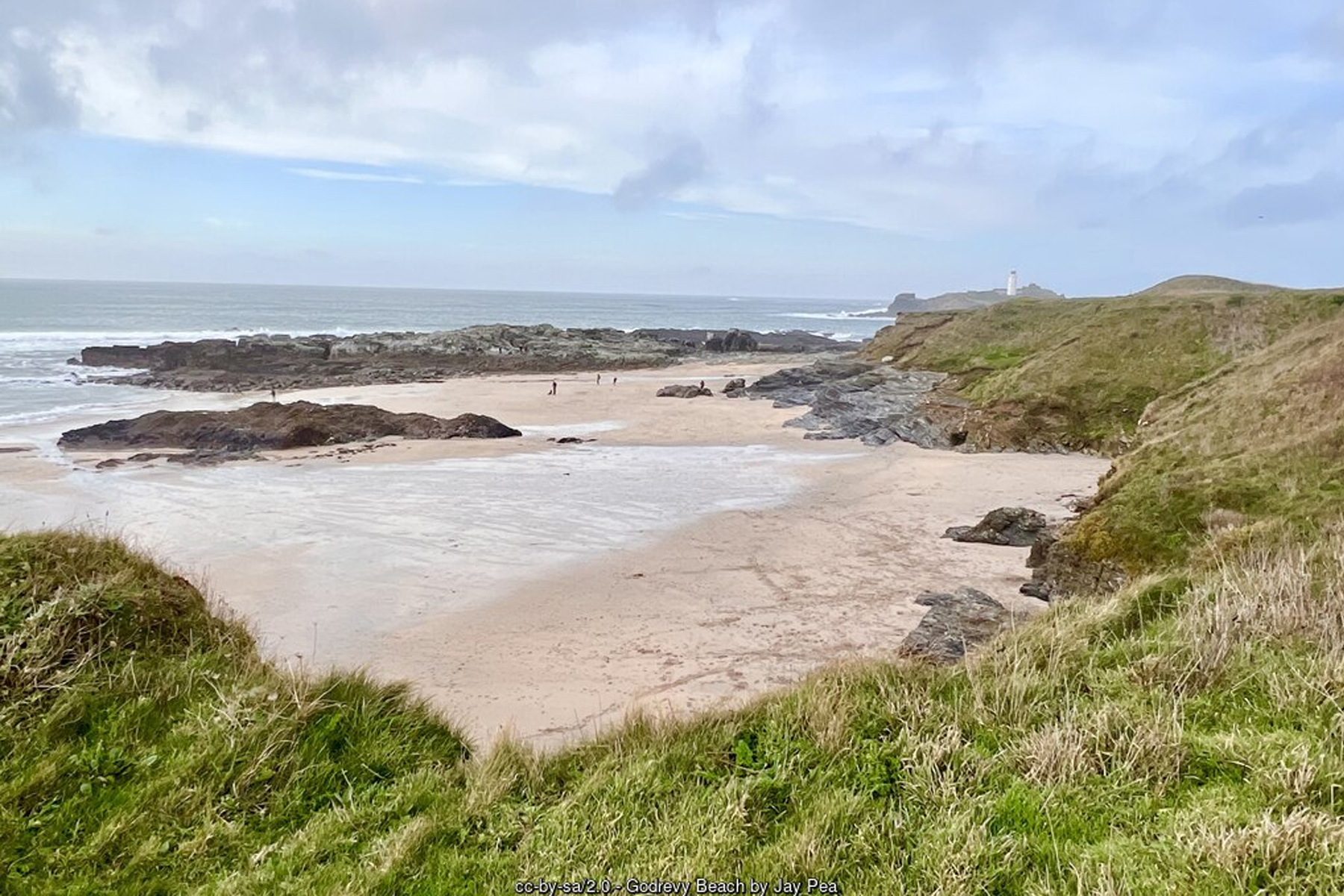
Wildlife is the other pillar of a visit to Godrevy, and grey seals are the headline act. A resident colony hauls out at Mutton Cove, a steep-sided, inaccessible inlet beneath the cliffs a short walk north of the car park - numbers vary through the year, from a handful of animals resting and feeding through summer to as many as a hundred or more gathering to moult and rest through the winter months. There is no route down to the cove itself, by design: the cliff is unstable, and the beach functions as an undisturbed haul-out site precisely because people cannot reach it. The National Trust's own advice is to view from the marked clifftop footpath a few minutes' walk from the car park, keep voices down, keep dogs on leads, leave drones at home, and bring binoculars rather than trying to get closer - approaching seals on their resting beach, even at a distance that feels respectful, can cause them to panic into the sea and abandon pups or waste energy they need to survive the winter.
Above the seals, the clifftops are managed as coastal heathland and maritime grassland, grazed in part by conservation-grazing Shetland ponies that keep scrub from swamping the wildflowers and rarer plants beneath. It is genuinely good ground for birdwatching: fulmars, cormorants, guillemots and razorbills work the cliffs and offshore rocks, gulls of several species nest around the headland, and spring and autumn migration can bring good numbers of wheatears, pipits, finches and swallows passing through, along with the occasional rarity that draws birdwatchers from further afield. Cornwall's choughs - the red-billed, red-legged corvid that vanished from the county for half a century before recolonising the Lizard in 2001 and slowly spreading since - are still more reliably seen at established strongholds further west and along St Agnes Head than confirmed as breeding at Godrevy itself, though as the wider population continues its recovery, sightings along this stretch of coast are not out of the question. Summer brings its own specialities: rare silver-studded blue butterflies colonise the heathland through June and July, alongside commoner blues, meadow browns, gatekeepers and dark green fritillaries, and in some years fields of purple phacelia, sown to support pollinators, colour parts of the headland.
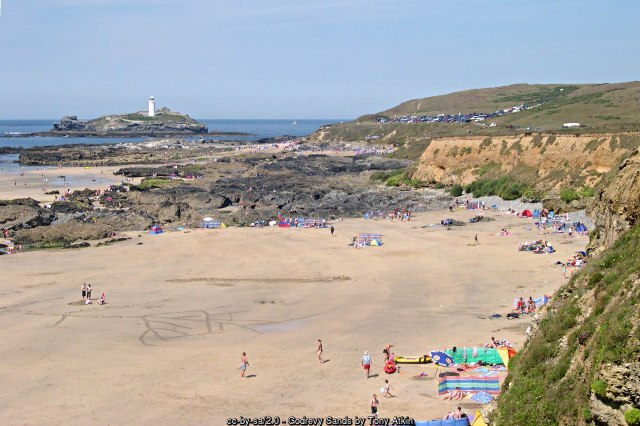
Down on the sand, Godrevy is very much a working Atlantic beach rather than a sheltered cove. It faces the full force of swell rolling into St Ives Bay, which makes it a popular, relatively beginner-friendly surf spot by Cornish north-coast standards, though conditions and currents can change quickly and should never be underestimated. At low tide the beach connects directly to neighbouring Gwithian, forming a huge, near-continuous expanse of sand that is one of the longest unbroken stretches in Cornwall; at high tide the sea pushes right up to the dunes and much of that sand disappears, so it pays to check tide times before planning a low-tide walk between the two beaches. RNLI lifeguards patrol daily through the main season, roughly mid-May to late September, from a station near Peter's Point at the southern end of the beach, and the flagged patrol area is the safest place to swim or bodyboard; outside those hours and dates, or beyond the flags, there is no supervision.
Beyond the beach itself, Godrevy rewards a longer visit. The South West Coast Path completely encircles the headland, giving walkers a loop of genuinely dramatic clifftop scenery with the lighthouse in view for much of the route, and footpaths lead inland to the wooded valley and lake of Tehidy Country Park, a popular family walking destination a few miles away. Evidence of much older human activity survives beneath the surface too - the headland has produced Stone Age and Bronze Age finds over the years, a reminder that people have used this exposed but resource-rich stretch of coast for many thousands of years before the lighthouse, the car parks or the surf schools arrived. Whether the draw is geology, wildlife, literary history or simply a long walk with the sea on one side and heathland on the other, Godrevy tends to be a place people return to rather than tick off once.
Visitor Information
Parking
National Trust car parks on the headland, including a large seasonal overflow field in busy months. Pay-and-display or via the JustPark app; free for National Trust members. Fills quickly on sunny days.
Facilities
Toilets at the headland car park (limited opening hours), plus the independently-run Godrevy Café serving hot and cold food and ice cream. RNLI lifeguards patrol daily from mid-May to late September.
Disabled Access
No officially designated wheelchair route, but a fairly level, gravelled path leads from the car park towards the Mutton Cove seal viewpoint. An accessible toilet with RADAR key access is provided at the headland car park, and Blue Badge holders park free of charge.
Things to Do Nearby
- Gwithian Beach, joined to Godrevy at low tide and a short drive or coast path walk south
- Godrevy (National Trust) - full visitor and walking information for the headland, lighthouse and seal colony
- Paradise Park, Hayle - wildlife sanctuary and indoor play centre
- Mineral Tramways Cycle Routes - traffic-free cycling and walking trails around Hayle and Camborne
Places to Stay
Frequently Asked Questions
Page last updated: 9 September 2026.