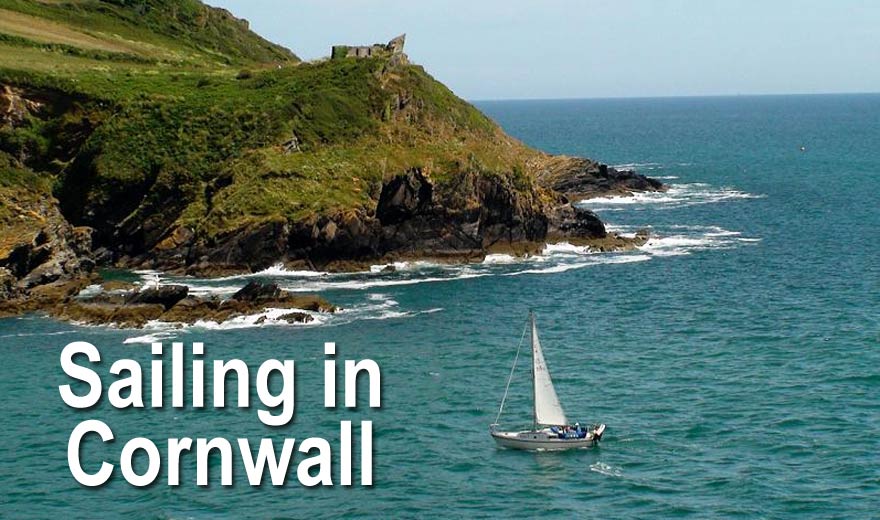
Sailing in Cornwall  

THE NORTH COAST

Padstow

Padstow is a noted centre for dinghy sailing, its sheltered harbour providing launching and mooring facilities for small craft of all types. The town itself is a popular holiday centre well provided with shops, which over the centuries have developed around the harbour.

The Camel Estuary, from which access to the harbour is gained, extends for a further 5 miles south-east to the market town of Wadebridge, which, at high water can be reached by medium sized boats. At low tide, however, vast acres of sand dry out.

Padstow stands about 2.5 miles from the mouth of the estuary, and is served by the Black Tor passenger ferry which is operated by the Padstow Harbour Commissioners. The first ferry to Rock is at 07.50; the last, according to season between 16.50 and 19.50.

Harbour Characteristics

The Inner Harbour is suitable for most yachts and all remain afloat.

Visitors' Moorings at Rock are available by arrangement with the Harbour Office. VHF channel 16 working channel 12.

Pilotage

With the exception of fishing vessels, all vessels of 20m and more, or 2.5m draft or more, are subject to compulsory pilotage. Vessels below this size will find the estuary channel marked by a red port-hand cone off Greenaway rocks leading to a starboard-hand buoy in the channel and a further middle ground buoy from which the harbour is visible. The approach is then strictly within the channel which is marked on the starboard-hand with lit beacons and on the port-hand by a red buoy (FI.R.5s) on Town Bar. Harbour dues are payable on all craft.

Newquay

Newquay offers some of the finest coastline and beaches in Europe. There are eleven beaches in all, and in high summer the population is quadrupled by holidaymakers, making it a hive of activity.

Although the town is well worth a visit with many tourist facilities and a wide range of shops, little provision is made for the visiting yachtsman. The harbour - a thriving fishing port - is a drying one, and has only limited accommodation for visiting craft. Quay berthing is strictly limited. An RNLI inshore lifeboat is stationed at the harbour.

Harbour Characteristics

Drying harbour; access to harbour three hours before and three hours after high water, dependent on sea and weather conditions. Approach relatively straightforward (see chart 1168).

Visitors' Moorings

Limited quay berthing only. Application for visiting craft to Newquay Harbourmaster by telephone. 0900 to 1700 hrs daily.

Pilotage

Care must be taken on approach of store pots and buoys in bay.

Portreath

Portreath is a small drying harbour, now used by forty local fishing, diving and pleasure boats and occasionally by visitors cruising along the North Cornwall Coast. At one time it was a busy port serving the mining and industrial towns of Redruth and Camborne, importing coal and exporting tin and copper. It is the only usable harbour between Padstow or Newquay and Hayle or St. Ives, but even so should be regarded with great caution.

Harbour Characteristics It should be noted that the entrance is dangerous when there is a heavy sea or ground swell running, or when it is blowing from west to north: in such conditions yachts should keep well away from this stretch of coast. The harbour is not lit, although it can be picked out by a white "pepperpot" day mark on the cliffs above the harbour.

Visitors' Moorings

Occasionally available. The harbour belongs to Kerrier District Council, but moorings are looked after by the Portreath Harbour Association. No mooring charges as such, but a donation would be accepted by the treasurer or secretary.

Pilotage

The middle basin dries about two metres. There is some water from half-tide upwards but, depending upon draught, the harbour is generally usable for two hours each side of high water. During entry, do not cut the corner around Horse Rock or the pier head. Come in 150°T, keeping the inner wall of the pier alongside the Round House just visible. Follow through the turning basin into the inner harbour. Moor fore and aft with anchor and warp to a breakwater, or alongside the wall. The inside dock shallows towards the far end, where there is a small slipway.

Lakes and Reservoirs

Siblyback Watersports Centre - nr Liskeard. The 140 acre Siblyback Lake is set in a scenic valley some 200m up on Bodmin Moor and is currently the major inland watersports venue in the South West. It is only about 25 miles from the centre of Plymouth and is easily reached in under 30 minutes along the A38, much of which is now dual-carriageway. It is signposted from the A38 at Dobwalls with brown tourist signs.

The Peninsula Watersports Centre offers tuition at all levels on first class equipment and there is always equipment available for hire. There is also a day launch facility, provided you have suitable Third Party insurance, for all types of craft. Other facilities include rescue boat cover during the day, showers and changing rooms and a teashop, situated above the watersports shop, open during the summer.

Roadford Watersports Centre - nr Liskeard. The newest and largest water resource to be built in the South West. Over 400 acres available for watersports which includes facilities for launch and tuition of sailing.

Tamar Lakes Waterpark - Bude. Tamar Lakes, situated on the border between Devon and Cornwall, is well placed to cater for the holiday trade of North Cornwall and is signposted from the A39 at Kilkhampton.

The Peninsula Watersports Centre is situated at the 80 acre Upper Lake and provides an excellent all round venue for expert and beginner alike. In light winds the lake provides the perfect introduction to dinghy sailing and lessons from qualified instructors are available. There is a good range of hire equipment, including Topper dinghies, to suit all tastes and this provides a cheap way for sailors to try out different craft before buying. When the wind starts to blow, the lake offers the experienced sailor an opportunity to practice their techniques on flat water or for intermediate sailors to try out more advanced equipment under the watchful eye of a rescue boat.

There are showers and changing facilities. ample lakeside parking and easy launch facilities as well as a children's play area, trout and coarse fishing and a teashop to ward off the cold.

THE FAR WEST

Isles of Scilly - St Mary's

The Isles of Scilly are an archipelago of many islands within a seven mile radius. Clear water flows over sand flats and granite ledges, long beaches link channels and bays. Anchorages are varied and plentiful. In settled summer weather a variety of craft are available for charter to enjoy this cruising paradise.

St Mary's Harbour is the maritime working centre of the Isles of Scilly and is the arrival point of the daily ferry from Penzance. The Scillonian III arrives at mid-day Monday to Friday and 13.30 on Saturdays through the summer. The quay is also used for local moorings, but visitors may moor in the area to the east of the lifeboat and lifeboat slip where there are 39 moorings available.

Harbour Characteristics

The harbour is formed by the granite quay which extends from the Old Quay to Rat Island and beyond. The harbour is the property of the Duchy of Cornwall and all vessels are subject to Harbour Dues. The Harbourmaster has an office on the quay by the call sign "St. Mary's Harbour" on Channel 16 (working channel 14) on VHF.

St. Ives

The fortunes of St. Ives, one of Cornwall's most popular holiday resorts have, over the centuries been inextricably tied to its harbour. It was from St. Ives that boats carried hard won tin to the burgeoning industrial centres, and it was from here that one of Cornwall's great fishing fleets set sail. Today, the harbour remains very much the focal point of the town.

St Ives is certainly worth a visit and offers the visitor cruising along the North Cornwall Coast an incomparable range of shops and services. The old town, built around the harbour, is a maze of cobbled streets and alleyways and jumbled granite cottages spilling to the water's edge. The Tate Gallery overlooking Porthmeor Beach, just 5 minutes walk away from the harbour, should not be missed.

Harbour Characteristics

A drying out harbour, like Padstow's with a sandy bottom. Few problems of approach or entry. Remains primarily a working harbour, and the quays are in constant use by fishing boats and pleasure craft.

Visitors' Moorings

Half-dozen within harbour; small number of others available. VHF Channel 16.

Pilotage

Only hazard is the inappropriately-named New Pier, an old wooden pier SW of Smeaton's Pier which is submerged except at low-water. Marked at end by green conical buoy.

Penzance

Penzance is much more of a leisure harbour than neighbouring Newlyn, and from May until September is invariably busy. The town is a holiday centre and as much a market town as a port, so there is a wide range of shops.

The whole of Mount's Bay provides ideal sailing conditions although there is a tendency for the wind to fade during the evening.

The South Pier of Penzance harbour is the normal berth for the Scillonian, the Isles of Scilly ferry, although this berth is normally occupied only between 1830 and 0930 the following morning on Mondays to Fridays, and additionally between 1130 and 1400 on summer Saturdays and alt day on Sundays. At other times this pier may be used by vessels waiting to enter the wet dock.

It should be noted that during periods of bad weather, particularly south-westerly gales, the South Pier is swept by seas at high water. On such occasions the ferry will normally berth at the inner end of the Albert Pier.

Harbour Characteristics

The harbour consists of a wet dock in which craft drawing up to 4.5m can lie afloat, and there is a drying harbour alongside. Approach and entry are straightforward.

The dock gates are open every tide from two hours before high water until one hour after high water. Two red lights displayed vertically on the signal mast on the north side of the dock gate indicate that the gate is open, a red light over a green light indicates that the gate is closed.

Visitors' Moorings

All available moorings in the outer harbour are normally used by local craft and visiting vessels normally lie alongside in the security of the wet dock where 50 berths are made available.

The port maintains VHF watch on Channel 16 and 12 from HW-2 until HW + 1 daily and from 0900 to 1200 hrs and 1300 to 1600 hrs every weekday.

Anchorages

There is a fair-weather anchorage for small craft 500ft to the east-north-east of the end of the Albert Pier. Craft using it must ensure they do not obstruct fairway into the harbour or wet dock.

Newlyn

Newlyn, although very much a working harbour, is a convenient choice for overnight stay for boats en route to the Isles of Scilly or across the English Channel to Brittany. It is well used by Cornish yachtsmen, because it is accessible at all states of the tide.

Up to 150 boats fish out of Newlyn, making it the largest fishing port in England, and it is as well to bear this fact in mind.

Visitors, although welcome for overnight stays, will not entirely be able to escape the bustle and atmosphere of those landing fish. As it is, visiting boats normally tie up on the western side of the jetty in the centre of the harbour.

The town itself, adjoining Penzance, is well placed for visiting the Land's End peninsula.

Harbour Characteristics

The harbour is formed by the long arm of the busy North Pier, which adjoins the fish market, and at 90 degrees to it, the South Pier. Entrance between the two is 150ft wide.

Visitors' Moorings

Overnight only. No moorings provided: up to 30 boats can tie up alongside the fishing boats. VHF Channel 16, working Channel 12.

Pilotage

Approach and access straightforward,10ft at low water springs.

THE SOUTH COAST

Porthleven

Porthleven is an old fishing harbour situated in Mount's Bay, halfway between Penzance and Lizard Point. It can be visited in fair weather by bilge keel yachts or other vessels prepared to take the ground, but even at the best of times approach and entrance require care. Visiting boats should not cut close to the pier or the rocks opposite, but keep to the safe channel midway.

The outer harbour is exposed to south-west and west winds and swells. When strong winds are blowing from SE to WSW, or if such winds of Force 7/8 are forecast, or if there is a heavy swell running, the inner harbour entrance may be closed by large timber baulks lowered between the inner breakwaters. The outer harbour is not a safe anchorage, and so Porthleven harbour is effectively closed at these times. In doubtful weather, always ascertain if the harbour is open by contacting the Falmouth Coastguard on VHF Channel 16.

Closure is signalled by hoisting a red ball on the flagstaff near the prominent clock tower. By night, the fixed green leading lights are OFF when the harbour is closed.

Harbour Characteristics

A small drying harbour. The outer harbour is open to the weather and swell: the buoys are fishing marks and should not be taken as moorings. There are two metres of water just inside the inner harbour at half-tide, although the harbour is shallower at the northern end.

Visitors' Moorings

Visiting yachts are recommended to come alongside the Quay on the eastern side by the Harbour Hotel (there are ladders). Mooring available alongside the wall (subject to length).

Pilotage

Porthleven is to the north of the long, sandy beach of Loe Bar. On approach keep offshore and out of shallow water until harbour entrance can be picked up by the conspicuous clock tower and vessel is in a position to make an entry.

There are shelves of rock on either side of the harbour entrance and the swell becomes more uncomfortable in the shallower water near the entrance (in rough weather, the surf can break right across). An accurate entry is therefore required, parallel to pier in mid channel. By night the leading marks are the two fixed green lights, the outer light to be left close by to starboard to pass inside the pier. Do not moor alongside the pier or wall of the outer harbour as the foundations are fringed with rocks that dry at low water.

Falmouth

Falmouth is not as old as many of Cornwall's towns and it was not until Sir Walter Raleigh put into the Fal on his return from New Guinea that the expanse of sheltered water in the Carrick Roads became known outside the local area. Before this time it had been used by local fishing boats and, of course, by pirates and smugglers, who knew well the advantages of such a sheltered anchorage.

Truro, 11 miles up the river Fal, and Penryn were both flourishing ports and the proposals for the development of a new port at the mouth of the river were wholly opposed by both towns. However, the objections were overruled and by 1670 the new town of Falmouth had a quay and a rapidly growing maritime trade. In 1688 Falmouth was selected as a Mail Packet Station carrying mail to and from London and the rest of the world.

The port also became popular as the first and last port of call for the big sailing ships of the grain trade and it was only the advent of steamships that stopped Falmouth from growing to be the most important port on the south coast. When at last Falmouth was linked to London and the rest of the country by rail, in 1863, the mail trade had already moved to Southampton and the port of Falmouth was in decline.

By fortuitous chance this decline coincided with the beginning of the holiday travel business and Falmouth, with its striking scenery and mild climate, rapidly became a major centre for tourism, which it has held to this day. The town itself is split into two, with the harbour and town centre on the north side and the beach resort, with hotels, guesthouses and gardens to the south. The long main street of the town runs parallel with the water, and stepped alleys run down to the river giving glimpses of the estuary and the boats. The Maritime Museum is well worth a visit and it features boats moored alongside as well as a land based museum concentrating on the seafaring history of the town. Another historic building of interest is Pendennis Castle, built by Henry VIII as part of the south coast defences to resist invasion by the French. It is now owned by English Heritage and is immaculately preserved.

Harbour characteristics

Beyond Black Rock, which lies slightly to the west of centre of the harbour entrance and is well marked, there are few hazards. Keep an eye open for vessels using the docks, on the port side.

Visitors' Moorings

Visitors' Yacht Haven (172 metres of floating pontoons situated at North Quay): space for about 50 boats of up to 12 metres (40 ft) and up to 1.8 metres draught (6ft). VHF radio: Channels 16 and 12.

Deep water moorings

Space for half a dozen moorings exclusively for the use of visitors, the largest of which is capable of taking yachts or other vessels up to 100 ft in length. These moorings are marked by green buoys and are situated nearest the Falmouth side of the main channel between Greenbank Quay and Prince of Wales Pier. These moorings allocated on arrival by contacting the Harbour Patrol or Harbour Office.

Falmouth Yacht Marina (pontoons): proportion of 230 berths reserved for visitors. Up to 70ft; 10ft draught. Off North Parade, Falmouth. Contact Falmouth Yacht Marina; VHF channel 37 (m). Grove Place Boat Park, a boat park where small boats may be launched, recovered and stowed ashore.

Pilotage

Only navigational problem is the Black Rock virtually in the middle of the Fal Estuary entrance. It is marked by a black conical beacon topped by two spheres, erected on the rock, Though the beacon is unlit, the nearby Black Rock Buoy is lit and should be left to port when entering the harbour.

Falmouth Harbour is easily entered at night.

Other Harbours of the Carrick Roads

The Fal Estuary is the third largest natural harbour in the world and the area known as the Carrick Roads extends 4 miles from Black Rock to Turnaware Point with nowhere being less than 1 mile wide. Its huge expanse of sheltered water is accessible in all weathers and at all states of the tide.

The famous Helford River is close by, and the many miles of beautiful waters within the estuary provide enjoyable sailing even when there is a full gale in the English Channel.

The shoreline of the Fal Estuary is broken by creeks and inlets, the exploration of which can be vastly rewarding. But, although the presence of boats at moorings often indicates the channels, those with deep-draft boats would be wise to make their first visit on a flood tide.

There is an 8 knot speed limit in force within the Penryn River, Falmouth Inner Harbour (i.e. all that area west of the docks) and north of Turnaware Bar. There is a 5 knot speed limit in force within the Percuil River and St. Mawes, St. Just Creek, Mylor Creek and Restronguet Creek.

Take care to avoid anchorage or grounding on the oyster beds, which cover a considerable area and are marked with withies.

Penryn

At HALF-TIDE, it is possible to follow the Penryn River as far as the ancient town of Penryn. The Town Quay is extensively used by fishing boats and it is wise to have a word with the Harbourmaster, whose office is on the quay, if you come alongside.

Mylor

Mylor Yacht Harbour was for many years the smallest Royal Navy dockyard in the country. There are impressive facilities, including a well-stocked chandlery, a fuelling berth, boat hoist and cranes, workshops and a visitors' pontoon.

Malpas & Truro

Vessels bound for Malpas and Truro may anchor outside the navigable channel, and may lay alongside Town Quay, Truro outside the Harbourmaster's Office. The Harbour Office also monitors Channel 12 VHF (call sign Carrick One). There are a number of deepwater fore and aft yacht moorings for large yachts 40-100 feet LOA in addition to the visitors' moorings at Malpas. For those wishing to anchor, please remember to keep dear of the channels and fairways, and show anchor lights and/or shapes. Good anchorages can be found at Channels Creek, (although you may have to move if a laid up vessel is entering the port) Kea Rech, Coombe Creek and Tolverne.

St Mawes

St Mawes boasts a wide entrance, the only hazard being Lugo Rock which is always covered and is marked by a South Cardinal buoy. No boats to lay alongside quay steps except for embarkation and disembarkation. Visitors' moorings by arrangement.

Helford River

The Helford River offers a straightforward approach, the only danger being a reef to the north of the entrance known as August Rock. or The Gedges. lt is marked by a green conical buoy (Fl G.5s). Further upriver, the channel to Gweek looks formidable but is in fact well marked with port and starboard-hand top marks.

Stithians Lake

Situated deep in the heart of Cornwall, only three miles from Redruth and 7 miles from Falmouth, and is best reached off the A30 through Redruth. Although it is only 170m above sea level, the 270 acre lake is one of the windiest places in England and the prevailing south westerly winds blow cross shore, providing superb sailing for improvers and experts. Stithians is not just for the experienced sailor, however, and the Centre provides tuition by qualified instructors.

There is an extensive array of equipment available for hire to suit all levels of ability and there is rescue boat cover during the day. There is plenty of car parking space and a large lakeside area for rigging and launching as well as a slipway for larger craft. Showers and changing facilities are available.

THE EAST COAST

Mevagissey

Mevagissey is one of Cornwall's most photographed old fishing harbours, and has the distinction of remaining a true fishing harbour. Up to 50 fishing boats sail out of the harbour, and tourist craft add to the inevitable congestion in high season. As a consequence, berths for visitors are reasonably difficult to obtain.

The harbour is well protected from the weather, with the notable exception of a southeasterly wind. In such winds a strong swell makes the outer harbour dangerous, and entrance should never be attempted because seas can break off the mouth. There are submerged rocks to the north and south of the harbour and on both sides of the north pier. Once ashore, facilities for visitors are good.

Harbour Characteristics

The Inner harbour and sides of the outer harbour dry out, though a central area remains in which boats can stay afloat.

Visitors' Moorings

Provision made on South Pier. Temporary berths needed by fishing craft must be vacated immediately. VHF Channel 16. A safe anchorage is available off the harbour wall in calm conditions of offshore winds. Moorings for visiting boats up to 18 feet in length are available throughout the season. Owners to enquire at Harbour Office.

Visiting craft should moor alongside South Quay, and owners/masters report to the Harbourmaster.

Pilotage

Approach and entry are uncomplicated, subject to weather conditions mentioned above.

Fowey

Fowey, like Falmouth, has an outstanding and extensive natural harbour, which makes it one of Cornwall's primary sailing centres. Its size ensures that it is rarely uncomfortably congested, and there are facilities for all types and sizes of craft.

The River Fowey is a long, navigable river with numerous inlets and creeks, extending north to the historic town of Lostwithiel. Deep water extends as far as the north end of Wiseman's Reach; above this point the river can dry out and should be navigated with caution and with regard to the tide tables.

The town and its twin on the east bank of the river, Polruan, is a commercial port, largely concerned with the shipment of china clay. More than a million tonnes are exported annually in 500 ships. The commercial jetties to the north of Bodinnick on the west side of the river are privately operated and must not be used by visiting craft.

Information and assistance can be obtained from the Harbourmaster's office on Albert Quay and it is here that harbour dues are paid. During the summer months the Boat Marshall is afloat in the Harbour Patrol boat to assist and collect harbour dues. VHF Channel 12.

A water taxi is operational in the summer, called on VHF Channel 06, for ease of getting ashore.

Harbour Characteristics

Approach and entry are straightforward in any conditions and at any state of the tide. If required, there are Fowey Harbour Commission pilots on 24-hour call. Foot passenger ferries cross the harbour between Fowey and Polruan, with a car ferry upriver at Bodinnick.

Visitors' Moorings

Visitors' pontoons provided by the harbour commissioners. Moorings are white and marked FHC VISITORS, and are situated at the north end of Polruan Pool and on the east side of the river opposite the town and at the entrance to Pont Creek. Multi-berthing may be required at busy times. RNSA has a swinging mooring (members only) at north end of Polruan Pool. Anchoring permitted at direction of Harbourmaster, depending on movement of commercial shipping. Harbour Office is on Albert Quay; open weekdays 0900 to 1700 hrs, Saturday 0930 to 1200 hrs. VHF Channel 12.

Pilotage

Deep water harbour channel, 200 metres wide, kept clear for commercial shipping. Pilotage is compulsory for any craft over 37.5 feet. Pilots operate on VHF Channel 9.

Looe

East Looe and West Looe stand on either side of a tidal river, together forming one of south east Cornwall's major tourist centres. One of the resort's outstanding attractions is a fine land-locked harbour formed by two rivers which unite just above the town, and there is an equally fine seven-arched. Bridge spanning the river and uniting the two communities. The harbour entrance is picked out by the distinctive banjo-shaped pier. The harbour itself is a drying one, and primarily caters for a fishing fleet of 35 boats and pleasure craft Looe is also notable for its dinghy sailing, the sailing club having hosted a series of national championships, and for its shark fishing. The Shark Angling Club of Great Britain has its headquarters here.

For small craft of up to 16ft the river is navigable at high water for perhaps 2 miles, though the river itself runs almost to Liskeard 9 miles to the north. For larger boats, the bridge provides an effective stop.

The town is well supplied with shops and facilities, but no great provision is made for visiting yachters.

Harbour Characteristics

Landlocked, drying harbour, largely used by fishing boats and other commercial craft and by pleasure craft. Looe Island - also known as St. George's Island - lies 300 metres from the harbour entrance, but approach and entry remain uncomplicated.

Visitors' Moorings

Quayside berth on port-hand side, marked yellow, can cater for small boats further upriver. Commercial activities preclude anchorage in harbour middle.

Pilotage

Rocks to port side of harbour entrance and to west side of beaches are marked; flashing light at night. Nailzee Rock, close under cliffs, submerged at high tide, also marked.

Torpoint

Torpoint Marina stands just inside the western bank of the River Tamar, facing Plymouth's great naval dockyard. Although not a holiday resort, its situation makes it a natural centre for sailing as well as for sea and river angling.

The town itself has no harbour as such, but in recent years the 200-year-old Ballast Pound, a scheduled ancient monument, has been developed into a yachting harbour capable of accommodating up to 100 craft.

The Ballast Pound is a square tidal harbour on the foreshore, 3 miles from the breakwater. Built by the Navy Board in 1784 as a shelter for ballast barges which served the sailing ships of that day, it consists of four 240ft walls enclosing 1.25 acres of water. Access to the river can be gained at every tide through a 35ft entrance on the seaward side. The River Tamar itself is navigable well past the ancient town of Saltash where the twin Tamar and Royal Albert Bridges span the river between Cornwall and Devon. Just beyond the town the St. Germans (or Lynher) River branches off west to St. Germans, Cornwall's ecclesiastical capital, offering a further 5 miles of creeks and tributaries. Outside the breakwater, there are anchorages off Kingsand and Cawsand for those not wanting to venture upriver.

Harbour Characteristics

Ballast Pound is well sheltered and the channel has been dredged to 6ft below chart datum and is accessible at all states of the tide.

Visitors' Moorings

Pontoon moorings on deep water are available as well as quayside moorings for vessels able to take the ground.

Pilotage

Normal charter pilotage from Plymouth breakwater, through the narrows, to west bank of River Tamar, Ballast Pound quarter of a mile downstream from chain ferry. Bearing 31 0°T from Battery Buoy in the narrows.


Errors & Ommissions excluded. Please verify all information before using.
Cornwall Online will not be held responsible for the information provided through this website.

Click here to find out more about Cornwall
Promoting your business on Cornwall Online

Copyright © 2000 - Disclaimer