Porthleven Beach
The Sandy Beach Beyond Cornwall's Most Southerly Harbour
Harbour Head, Porthleven, Cornwall, TR13 9EA
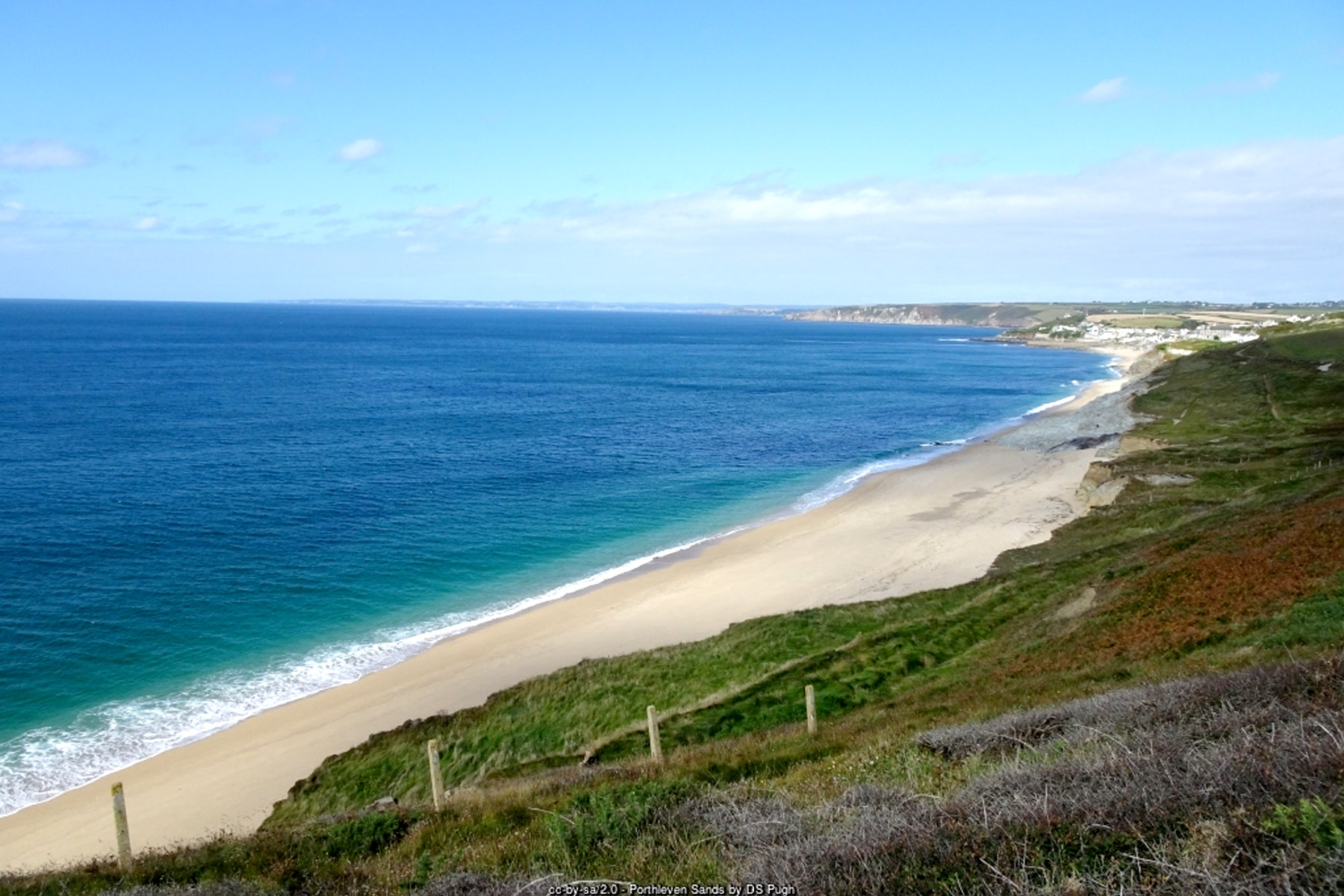
Porthleven Beach is the sandy shore that opens out immediately beyond the harbour wall of one of Cornwall's most distinctive small ports, sitting at OS grid reference SW 6304 2535 on the western edge of Mount's Bay. At higher tides it is a modest strip of sand tucked hard against the harbour arm; as the water falls back, it broadens considerably and the sand runs on towards Loe Bar, the great shingle bar around half a mile to the south that separates the sea from Loe Pool, Cornwall's largest natural freshwater lake. Few beaches in the county sit in quite such dramatic company - a working harbour on one side, a clock tower and Victorian institute rising above the quay, and a genuinely wild expanse of dune, bar and lake stretching away to the south - and fewer still have become as instantly recognisable, thanks to a reputation for winter storms that has made Porthleven's harbour one of the most photographed stretches of coast in Britain.
The harbour that gives this beach its character has a history stretching back far longer than most visitors realise. Porthleven was first documented as a fishing settlement in 1529, a small cove community working the open shore of Mount's Bay long before any harbour existed to shelter it. That changed in 1811, when an Act of Parliament authorised the Porthleven Harbour Company to compulsorily purchase land and build a proper harbour - one that would go on to be described as Britain's most southerly port, and unusual among Cornish harbours for facing almost directly into the prevailing south-westerly wind rather than sheltering from it. The scale of the undertaking was such that the renowned engineer Thomas Telford was consulted on the design, and after an early section of breakwater was washed away, the harbour company rebuilt it angled inward from the sea end to better withstand the swell. It was not a cheap fix: the finished harbour cost in the region of £200,000, several times over the original £60,000 estimate, before finally being completed on 16 August 1825.
Financially, the harbour struggled in its early decades, and in 1855 it was bought by Harvey & Co of Hayle, the great Cornish engineering and shipbuilding firm, who invested in further breakwaters and two jetties fitted with a timber baulk and sluice gate to help scour the harbour clear of silt. Under Harvey & Co's ownership Porthleven grew into a genuinely busy working port: china clay and china stone were shipped out from 1856 through to 1930, with exports rising from around 150 tons of china stone and 30 tons of clay in 1826 to over a thousand tons of clay alone by the 1880s, while the fishing fleet built up to a peak of around 130 boats and some 600 crew - men and boys - with hundreds more Porthleven residents working ashore processing and selling the catch. Four local boat-building firms kept that fleet supplied, and fifty-two fishing boats alone were recorded as built in the harbour between 1877 and 1883. A Royal National Lifeboat Institution station operated at Porthleven from 1863 until its closure in 1929, by which time the herring and pilchard fishery that had sustained the town for a century was already in steep decline.
Two buildings from that Victorian high point still dominate the view from this beach today. St Bartholomew's Church, built in 1842, sits above the town on rising ground, while down on the harbourside the Bickford-Smith Institute - opened on 17 December 1884 and named for the prominent local Bickford-Smith family, of Bickford, Smith & Co safety fuse fame - remains the single most photographed building in Porthleven. Its 70-foot clock tower, added at the harbour's western corner, has become the visual shorthand for the whole town, appearing behind more storm-wave photographs than perhaps any other structure on the Cornish coast; the Institute itself, built to house a reading room and library for the town's fishermen and their families, was grade II listed in 1991 and still serves community and cultural purposes today. A little further inland, and considerably older again, Wheal Rose and Wheal Penrose - reputedly among the oldest lead mines anywhere in Cornwall - were being recorded in this area as far back as 1625, a reminder that Porthleven's industrial story runs deeper, and further back, than the harbour alone.
It is that same harbour, built to face straight into the weather rather than away from it, that has given Porthleven its modern fame. When a big Atlantic low pressure system sends heavy swell up the English Channel and around the Lizard into Mount's Bay, the waves that meet Porthleven's harbour wall have nowhere gentle to go, and the results - spray thrown clean over the clock tower, green water breaking across the harbour mouth, the Institute standing defiant against a wall of white water - have made this one of the most photographed and filmed spots in Cornwall during winter storms, regularly featured across national news coverage of the season's worst weather and shared widely on social media whenever a named storm tracks in from the Atlantic. Photographers and storm-watchers travel from well beyond Cornwall specifically to capture the harbour in full fury, standing well back from the wall itself as advised by the coastguard, since waves here have on occasion been powerful enough to throw spray and debris some distance inland. The same exposure that makes for such dramatic storm photography also makes for a genuinely serious wave in the water: the reef break close to the harbour mouth is internationally known among surfers for its power, producing heavy, fast-breaking barrels during big winter swells that draw experienced surfers from across the country and beyond, and that have featured in surf media coverage of Cornwall's most testing breaks for decades. This is emphatically not a beginner's wave - the shallow reef, the harbour wall close at hand and the sheer force of the swell mean Porthleven is strictly for confident, experienced surfers only, and it has built a reputation to match, regularly ranked among the best and most demanding reef breaks in England.
Beyond the storms and the surf, Porthleven's harbour has also become a genuine year-round draw for its food and drink scene, most visibly at the annual Porthleven Food and Music Festival, usually held over the late April bank holiday weekend, when the harbourside fills with stalls, cookery demonstrations and live music drawing crowds from across the South West. It is one of a number of events through the year that make the most of the harbour setting this beach sits within, alongside the working boats, potting sheds and net stores that still give Porthleven a more authentic, less manicured feel than some of Cornwall's larger resort harbours - a legacy, in its way, of the fishing and boat-building trade that once supported so much of the town.
Away from the harbour wall itself, the beach is a rather gentler proposition. The sand beyond the harbour is a popular spot for a walk, a paddle or simply watching the fishing boats and pleasure craft come and go, and at lower tides it opens out generously towards Loe Bar, making a there-and-back walk along the sand one of the best short outings this stretch of coast offers - the bar and Loe Pool beyond have their own history and their own page on this site, but the walk between the two beaches along the open sand is one of the simple pleasures of a visit here. Swimming does need a degree of care, however: the proximity to Loe Bar means currents can be present, and the sea here can turn rough quickly, so conditions are best treated with caution at low tide and whenever the swell is up - precisely the conditions, of course, that also draw the surfers to the reef.
RNLI lifeguards have provided seasonal cover at Porthleven in recent summers, with patrols typically running from around the first week of July to the start of September, though as with any seasonal service visitors should check current dates locally before relying on it, since exact start and end dates can shift slightly from year to year. Outside those patrol hours, and at any time of year on the harbour wall and reef itself, visitors should exercise the same sensible caution as at any unsupervised stretch of Cornish coast. Dogs are welcome on Porthleven Beach for most of the year, subject to a seasonal restriction at the town end of the beach: no dogs are permitted between 10am and 6pm from 1 July to 31 August, in line with restrictions common across Cornwall's more popular summer beaches, and it is always worth checking current signage on arrival in case of any local updates. Porthleven does not currently hold Blue Flag or Seaside Award status - Cornwall Council's official list for the 2026 season does not include the beach - which is worth stating plainly, though it takes nothing away from the setting itself.
Facilities for a day at the beach are all close at hand, since everything a visitor might need is available in the town of Porthleven itself, a short walk from the sand. The harbourside in particular has built a strong reputation for its eating spots, with a good cluster of cafes, pubs and restaurants making the most of the harbour view - a pattern typical of Cornwall's smaller working ports, where the working boats and the visitor trade have learned to share the same quay without either crowding out the other. Parking is available near the harbour, though spaces can fill quickly on a fine day or when a big swell is forecast and half the county turns out to watch the waves; arriving early, particularly in winter storm season, is the safest way to guarantee a space and a good vantage point alike.
Taken as a whole, Porthleven Beach earns its place as the flagship beach of this small but distinctive stretch of the Cornish coast not through size or soft golden sand, but through the sheer density of history and character packed around it: a harbour authorised by Act of Parliament and shaped with advice from Thomas Telford, a Victorian institute and clock tower that have become genuine national landmarks in storm season, a fishing and boat-building heritage that once supported well over a thousand livelihoods, and a reef break that has earned real respect among surfers who know exactly how heavy Cornish waves can get. Add the walk south towards Loe Bar and the wild freshwater lake beyond, and it is easy to see why Porthleven, for all that it is only a two-beach town, more than holds its own against far larger resorts along this coast.
Visitor Information
Parking
Parking is available near the harbour, within easy walking distance of the beach. Spaces can fill quickly on fine days and especially when a big winter swell is forecast, so arriving early is advisable.
Facilities
All facilities are available in the town of Porthleven, a short walk from the beach, including a well-regarded cluster of cafes, pubs and restaurants around the harbour. RNLI lifeguards provide seasonal cover, broadly early July to early September - check current dates locally.
Disabled Access
The harbourside and quay are level and easy to navigate, giving good views over the beach and harbour without needing to descend onto the sand itself, which is reached via slipways and can be uneven underfoot. Blue Badge parking provision near the harbour should be confirmed with Cornwall Council before you travel.
Things to Do Nearby
Places to Stay
Frequently Asked Questions
Page last updated: 11 September 2026.