Back to English Heritage Cornwall
Off B3254, Nr Darite, St Cleer, Cornwall PL14 5JY | 0370 333 1181
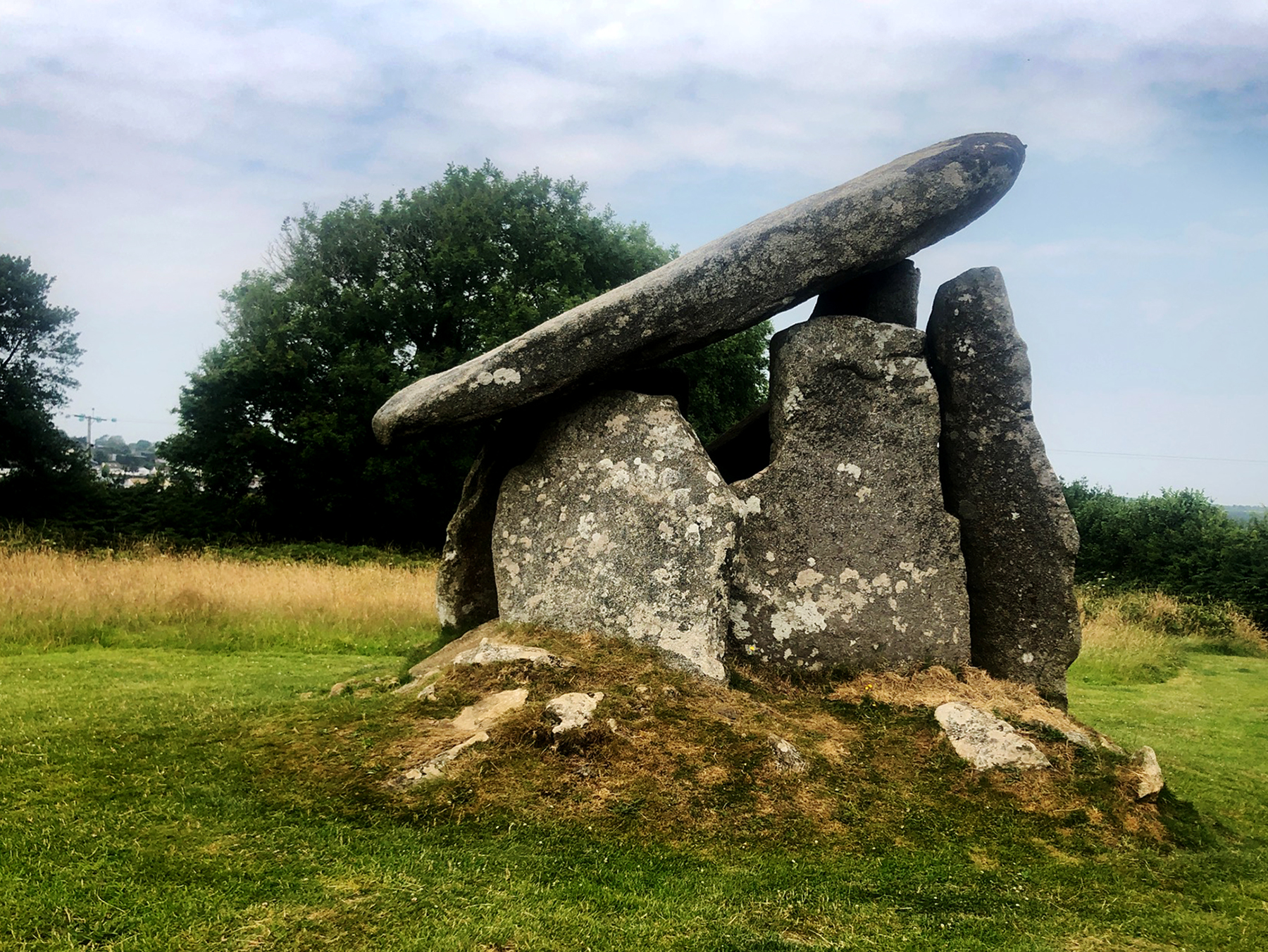
Rising dramatically above a small field near the village of Darite, Trethevy Quoit is widely regarded as one of the finest and most complete Neolithic portal dolmens anywhere in Britain. Five massive upright stones support an enormous, steeply sloping capstone weighing an estimated 20 tonnes, a striking piece of prehistoric engineering that has stood on the southern edge of Bodmin Moor for around five thousand years.
The monument dates to the early or middle Neolithic period, roughly 3500 to 2500 BC, placing it among the earliest surviving structures built by Britain's first farming communities. Though commonly described as a burial chamber, English Heritage notes that portal dolmens like Trethevy may have served as multipurpose shrines rather than tombs alone, places where the ancestral dead were seen as mediators between the living community and its gods, making them important focal points for gathering as well as for burial.
Trethevy's scale sets it apart even among Cornwall's other fine prehistoric monuments. The capstone's pronounced tilt is the result of the collapse of the westernmost supporting stone rather than any part of its original design, while a curious hole near the highest corner of the capstone appears to be deliberately man-made, its purpose long forgotten. Traces of a low mound are still visible around much of the monument's base, hinting that it was originally covered by a cairn, except at the eastern entrance, where a small stone antechamber remains clearly defined.
Trethevy Quoit is owned by English Heritage and managed by the Cornwall Heritage Trust, and remains free to visit throughout the year. Its dramatic profile, framed against the open moorland and surrounding farmland of this corner of Bodmin Moor, makes it one of the most photographed and instantly recognisable prehistoric monuments in Cornwall.
Location Map
Visitor Guide
Trethevy Quoit stands just off the B3254 near the village of Darite, a short drive from St Cleer. A small parking area is provided directly adjacent to the site, and the monument itself stands only a short walk away within a small field, making it one of the quickest and easiest prehistoric sites in Cornwall to reach and explore.
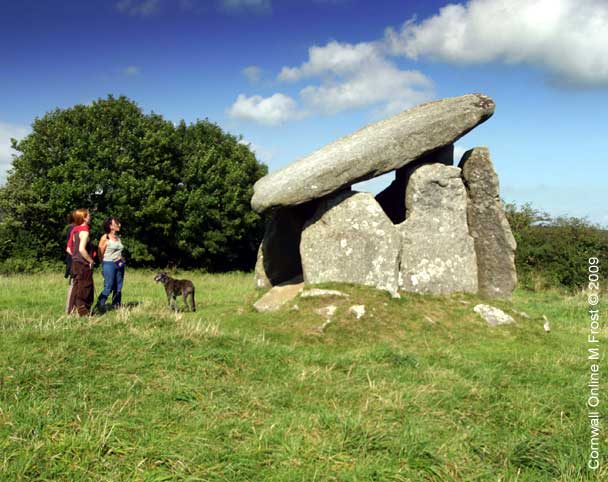
Once inside the field, visitors can walk right up to the monument and view the chamber from multiple angles, including through the entrance formed by the small stone antechamber on its eastern side. The sheer scale of the capstone is best appreciated up close, where its size relative to the supporting stones becomes properly apparent, along with the small man-made hole near its highest corner whose original purpose remains a mystery.
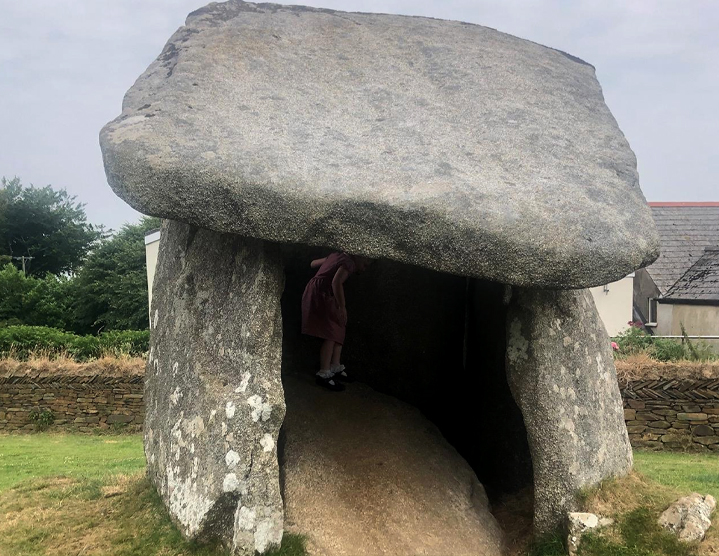
A visit to Trethevy Quoit need only take fifteen to twenty minutes, making it easy to combine with the nearby Hurlers Stone Circles and King Doniert's Stone, both a short drive away on the southern edge of Bodmin Moor. St Cleer, the nearest village, has a shop, public toilets and a pub, while Liskeard offers a fuller range of facilities for a longer day exploring this part of Cornwall.
Photographers and visitors alike are drawn to the quoit from every angle, since its dramatic silhouette against the sky changes considerably depending on the direction of approach; the steep tilt of the capstone is at its most striking when viewed from the west, where the collapsed supporting stone is most clearly visible.
History
Trethevy Quoit is an exceptionally well-preserved portal dolmen on the southern fringes of Bodmin Moor, dating to the early or middle Neolithic period, around 3500 to 2500 BC, a time when Britain's earliest farming communities were beginning to shape the landscape with permanent monuments. Its construction, five standing stones supporting a single enormous capstone, represents a remarkable engineering achievement for a society without metal tools or wheeled transport.
Although commonly described as a burial chamber, the true function of monuments like Trethevy remains debated among archaeologists. English Heritage suggests that portal dolmens may have served as "multipurpose shrines" rather than tombs in the narrow modern sense, reflecting a worldview in which the ancestral dead were considered mediators between the living community and its gods. This would have made structures like Trethevy important gathering places for the community as well as sites associated with the dead, their significance likely extending well beyond simple burial.
The monument's original contents, whatever they may have been, were removed long ago, and no formal excavation record survives to describe what was found within the chamber. Comparable sites elsewhere have produced pits and post-holes containing charcoal and cremated bone, and many portal dolmens across Britain are known to have been reused for further cremation burials during the Middle Bronze Age, suggesting such monuments often remained significant to local communities for many centuries after their original construction.
Trethevy Quoit currently stands around 2.7 metres high, its capstone sloping at a steeper angle than originally intended after the collapse of the westernmost supporting stone at some point in its long history. Traces of a low mound remain visible around much of the monument's perimeter, indicating it was probably once covered by a cairn, with the clear exception of the eastern entrance, where a small stone antechamber was left deliberately open.
Trethevy Quoit has attracted antiquarian and archaeological attention for centuries, appearing in early county surveys and engravings long before the modern discipline of archaeology existed, and it remains one of the most frequently illustrated prehistoric monuments in Cornwall. Its dramatic silhouette, standing alone within a small field rather than tucked away in woodland or moorland, has made it an accessible and enduring symbol of Cornwall's deep prehistoric past for generations of visitors, antiquarians and local residents alike.
Today the quoit is owned by English Heritage and cared for by the Cornwall Heritage Trust, remaining one of the most visited and photographed prehistoric monuments on Bodmin Moor, and a fitting complement to the nearby Hurlers stone circles and King Doniert's Stone within this remarkably dense concentration of ancient sites in south-east Cornwall.
Important Features
- The capstone: an enormous single stone weighing an estimated 20 tonnes, among the largest of any British portal dolmen.
- Five supporting stones: forming the chamber, with the westernmost stone collapsed inward, tilting the capstone.
- The eastern antechamber: a small stone entrance structure, the one part of the mound deliberately left open.
- The mysterious hole: a man-made opening near the capstone's highest corner, its original purpose unknown.
- Remains of the covering mound: traces of a low cairn still visible around much of the monument's base.
- Bodmin Moor setting: one of a dense cluster of prehistoric monuments including the Hurlers and King Doniert's Stone nearby.
Visitor Information
Parking
A small parking area is provided immediately adjacent to the site.
Facilities
None at the site itself. St Cleer, a short drive away, has a shop, toilets and a pub.
Disabled Access
Limited. The monument is reached across a field with uneven ground and no formal step-free path.
- Opening times: open any reasonable time during daylight hours, year-round.
- Public transport: limited bus services run to St Cleer and Darite; the quoit is then a short walk from the roadside.
- Toilets: none at the site; facilities are available in St Cleer.
- Food and drink: none on site; the nearest public house is "The Crows Nest" in Darite and a pub and shop are available in St Cleer.
- Shop: no shop on site; a small shop is in St Cleer.
- Dogs: must be kept on leads — sheep occasionally graze the field around the quoit.
- Booking: not required — free entry, no ticketing.
- Family facilities: none on site; the field setting means close supervision of children is advised.
- Additional access: climbing on the stones is not permitted; smoking, vaping, barbecues and naked flames are prohibited.
- Visit duration: around fifteen to twenty minutes.
Things to Do Nearby
King Doniert's Stone
Nr. St Cleer
Two carved fragments of a 9th-century Celtic cross commemorating a Cornish king, a short drive away.
Find Out MoreThe Hurlers Stone Circles
Minions
Three Bronze Age stone circles set on the open moorland of Bodmin Moor, a grouping unique in England.
Find Out MoreSt Cleer
Nearest village
A Bodmin Moor village with a shop, pub and public toilets, the nearest facilities to Trethevy Quoit.
Find Out MoreMinions
Bodmin Moor
The highest village in Cornwall, a good base for exploring the Hurlers, Stowe's Pound and the Cheesewring.
Find Out MoreLiskeard
South-east of St Cleer
A historic market town with shops, cafes and the nearest railway station to Bodmin Moor's eastern side.
Find Out MoreFrequently Asked Questions
Official English Heritage Site
For the latest access information, events and any temporary restrictions, check the official English Heritage page for Trethevy Quoit before you travel.
Explore More Cornwall Heritage
All English Heritage Sites Cornwall Attractions National Trust Cornwall
Page last updated: 25 August 2026.