Back to English Heritage Cornwall
St Cleer, Liskeard, Cornwall PL14 6EG | 0370 333 1181
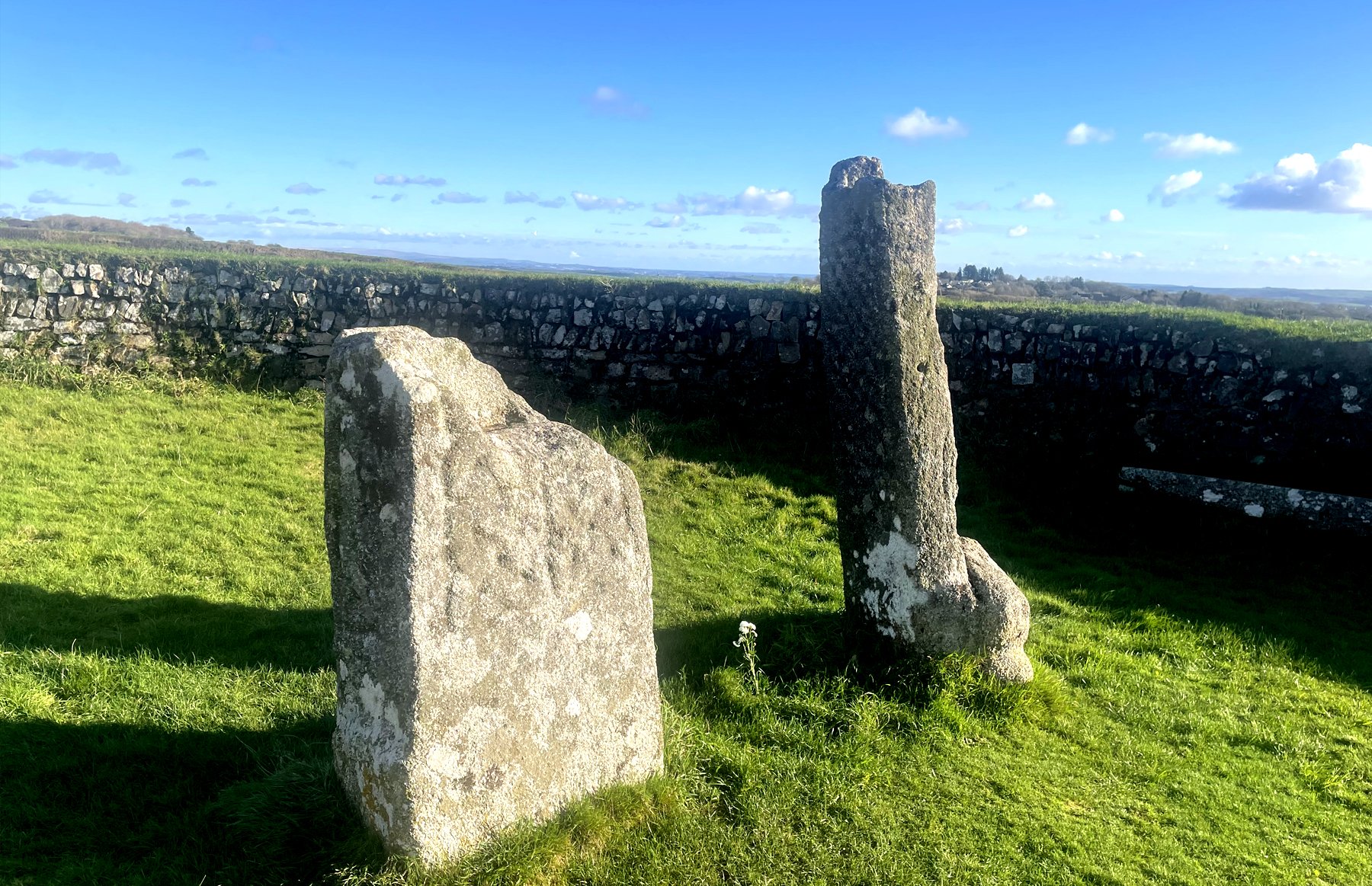
King Doniert's Stone is one of Cornwall's most historically significant early medieval monuments: two carved fragments of a 9th-century Celtic cross standing in a small enclosure beside the road linking the A38 to Minions, on the south-eastern edge of Bodmin Moor. Small compared with the county's stone circles and barrows, it is exceptional for a different reason — it carries a genuine inscription naming a real Cornish ruler, giving it a direct and unusually personal connection to Cornwall's political history more than eleven centuries ago.
The taller of the two stones bears a Latin inscription reading Doniert Rogavit Pro Anima, "Doniert has asked for prayers for his soul", commemorating Dungarth, a King of Dumnonia traditionally said to have drowned in the nearby River Fowey around AD 875. Dungarth is often identified as the last recorded independent King of Cornwall, making this modest roadside monument a rare, tangible link to the final years before the region came fully under West Saxon control.
Both fragments are decorated with interlaced carving typical of early medieval western Britain, work that parallels comparable crosses and monuments in Wales and Ireland. The stones may once have formed part of a single, larger cross or cross-shaft, and their survival beside what was likely already an established route across the moor speaks to a period when carved crosses served as visible markers within a landscape people were actually travelling through, not isolated objects hidden away.
The site is owned by English Heritage but managed day-to-day by the Cornwall Heritage Trust, and is free to visit at any reasonable time. There are no facilities on site, and a visit typically takes only a few minutes, making King Doniert's Stone an easy and worthwhile addition to a longer day exploring the prehistoric and early medieval landscape of Bodmin Moor around St Cleer and Minions.
Location Map
Visitor Guide
King Doniert's Stone stands in a small enclosed plot immediately beside the road about a mile north-west of St Cleer, off the B3254. A small layby right next to the site makes it one of the easiest English Heritage properties in Cornwall to reach, though there is a high step up from the road level to the ground around the stones, so care is needed getting in and out of the enclosure.
The two stones are best appreciated close up. The taller, standing stone carries the Latin inscription commemorating Doniert, its lettering still legible after more than a thousand years, while the second, fallen fragment shows the remains of interlaced decorative carving in a style shared with early medieval crosses elsewhere in western Britain. A short information panel on site helps explain the significance of both pieces and their probable connection to a single original monument.
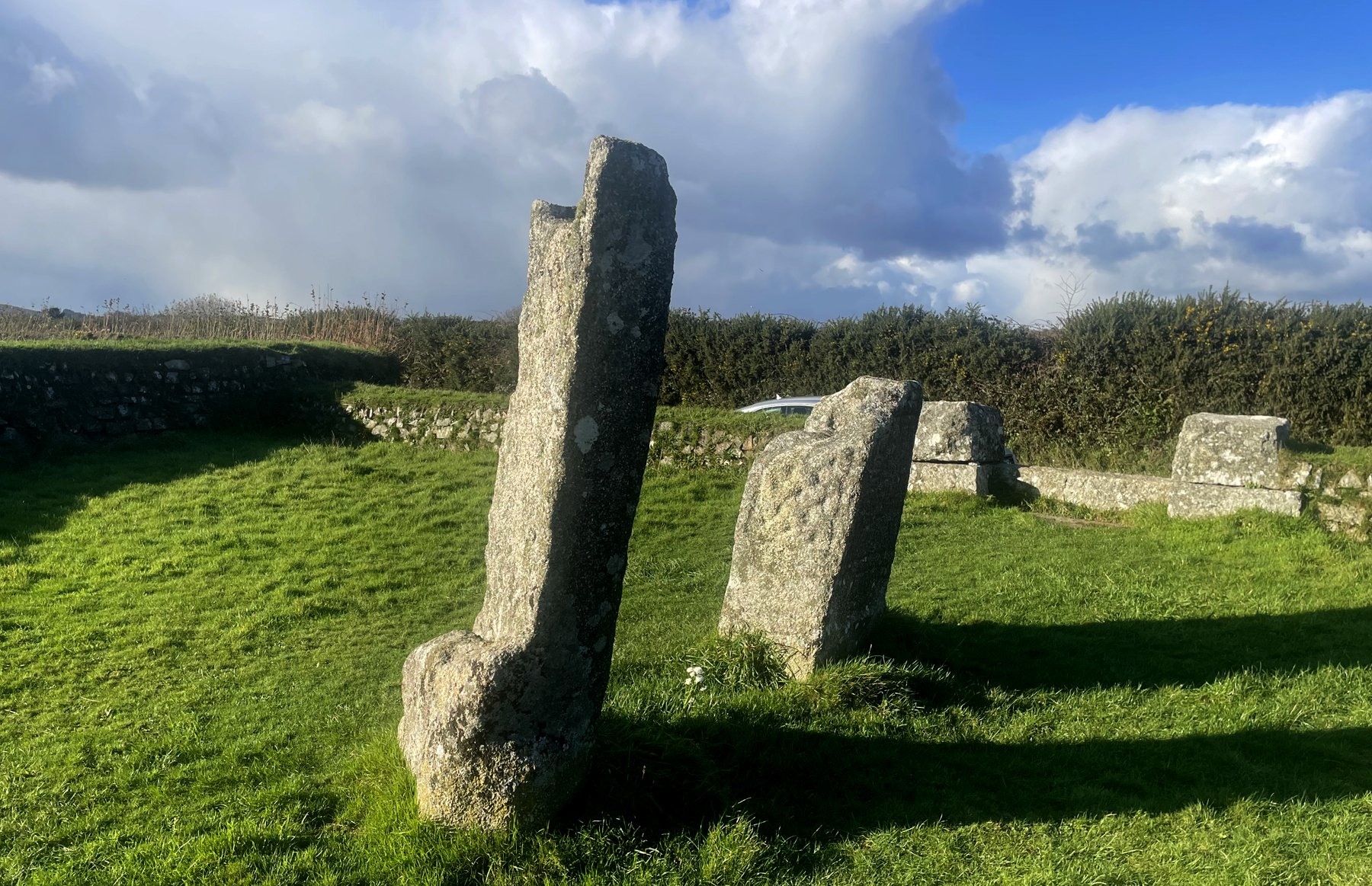
Because the site is so compact, a visit typically takes only five to ten minutes, making it an easy stop rather than a destination in its own right. Most visitors combine it with other nearby sites on Bodmin Moor's eastern edge: The Hurlers Stone Circles and Stowe's Pound near Minions, or Trethevy Quoit, a dramatic Neolithic burial chamber a short drive away near Darite. Together these sites trace an unusually long span of Cornish history, from the Neolithic through the Bronze Age and into the early medieval kingdom of Dumnonia, within just a few miles of open moorland.
There are no facilities at King Doniert's Stone itself, so it's best visited as part of a wider day on the moor, with the village of Minions, a short drive away, offering a shop and licensed tea room for refreshments.
History
King Doniert's Stone consists of two surviving portions of a richly carved 9th-century stone cross, standing together in a small enclosure beside an ancient route across Bodmin Moor. The taller, standing stone carries a Latin inscription, Doniert Rogavit Pro Anima, "Doniert has asked for prayers for his soul", a memorial formula typical of early medieval Christian monuments across Britain and Ireland. The second, fallen fragment is decorated with interlaced carving in a related style, and the two pieces may originally have formed part of a single, larger cross or cross-shaft.
The inscription commemorates Dungarth, recorded in Welsh chronicles as king of Dumnonia, the British kingdom that once covered much of Cornwall and Devon. Dungarth is traditionally said to have drowned in the nearby River Fowey around AD 875, and he is widely identified as the last recorded independent King of Cornwall, ruling in the years immediately before the region came under the control of Wessex. This makes King Doniert's Stone one of only a handful of Cornish monuments that can be directly connected, by name, to a specific historical ruler from this period.
The monument is historically significant for several reasons beyond its royal connection. Its carved decoration, featuring the interlaced patterns characteristic of early medieval western Britain, places it within a wider artistic tradition shared with comparable crosses in Wales and Ireland. The inscription itself is also an unusually direct piece of evidence for literacy and Latin Christian culture in Cornwall during this period, at a time when written records from the region are extremely scarce. Its position beside what was likely an established medieval route further suggests that early medieval crosses of this kind served a public, visible role within the travelled landscape, rather than being private or hidden monuments.
Modern conservation has focused on protecting the carved surfaces from weathering and erosion while keeping the inscription and decoration legible to visitors. The site is now a scheduled monument owned by English Heritage and managed day-to-day by the Cornwall Heritage Trust, which cares for several other prehistoric and early medieval sites in this part of Cornwall, including The Hurlers Stone Circles nearby. Together with its neighbouring monuments, King Doniert's Stone helps trace an unbroken sequence of human activity on this part of Bodmin Moor stretching from the Neolithic period through the Bronze Age and into the early medieval kingdom of Dumnonia.
Important Features
- The inscribed cross: the taller stone carries a Latin inscription commemorating Dungarth, or Doniert, King of Dumnonia.
- The fallen fragment: a second stone decorated with interlaced early medieval carving, probably from the same original cross.
- Royal commemoration: one of only a few Cornish monuments directly linked by inscription to a named early medieval ruler.
- Roadside setting: positioned beside what was likely an established medieval route across Bodmin Moor.
- Interlaced carving: decorative style paralleled in early medieval crosses in Wales and Ireland.
- Part of a wider prehistoric and early medieval landscape: close to The Hurlers, Stowe's Pound and Trethevy Quoit.
Visitor Information
Parking
A small layby is available immediately beside the site, on the road linking the A38 to Minions.
Facilities
There are no facilities on site. A shop and licensed tea room are available in nearby Minions village.
Disabled Access
The stones can be viewed from the roadside layby, but there is a high step up to the ground surrounding them.
- Opening times: open any reasonable time during daylight hours, year-round.
- Public transport: limited bus services run towards St Cleer and Minions from Liskeard, which has the nearest railway station.
- Toilets: none on site; nearest facilities are in St Cleer or Minions.
- Food and drink: none on site; the Minions Shop & Tea Room is a short drive away.
- Shop: no shop on site.
- Dogs: welcome on leads.
- Booking: not required — free entry, no ticketing.
- Family facilities: no baby-changing or family facilities on site.
- Additional access: the high step into the enclosure limits step-free access; the stones are visible from the roadside for those unable to enter.
- Visit duration: around five to ten minutes, best combined with nearby sites.
Things to Do Nearby
The Hurlers Stone Circles
Minions
Three Bronze Age stone circles arranged in a line, a grouping unique in England.
Find Out MoreTrethevy Quoit
Darite, nr. St Cleer
One of Cornwall's finest Neolithic burial chambers, a dramatic granite dolmen.
Find Out MoreSt Cleer
About a mile away
A moorland-edge village with a historic church and holy well, close to the site.
Find Out MoreMinions
Nr. St Cleer
The highest village in Cornwall, with a shop, tea room and access to Bodmin Moor's prehistoric landscape.
Find Out MoreLiskeard
South-east of St Cleer
A historic market town with shops, cafés and the nearest railway station.
Find Out MoreFrequently Asked Questions
Official English Heritage Site
For the latest access information, events and any temporary restrictions, check the official English Heritage page for King Doniert's Stone before you travel.
Explore More Cornwall Heritage
All English Heritage Sites Cornwall Attractions National Trust Cornwall
Page last updated: 24 August 2026.