Back to English Heritage Cornwall
Sancreed, Penzance, Cornwall TR20 8RB | 0370 333 1181
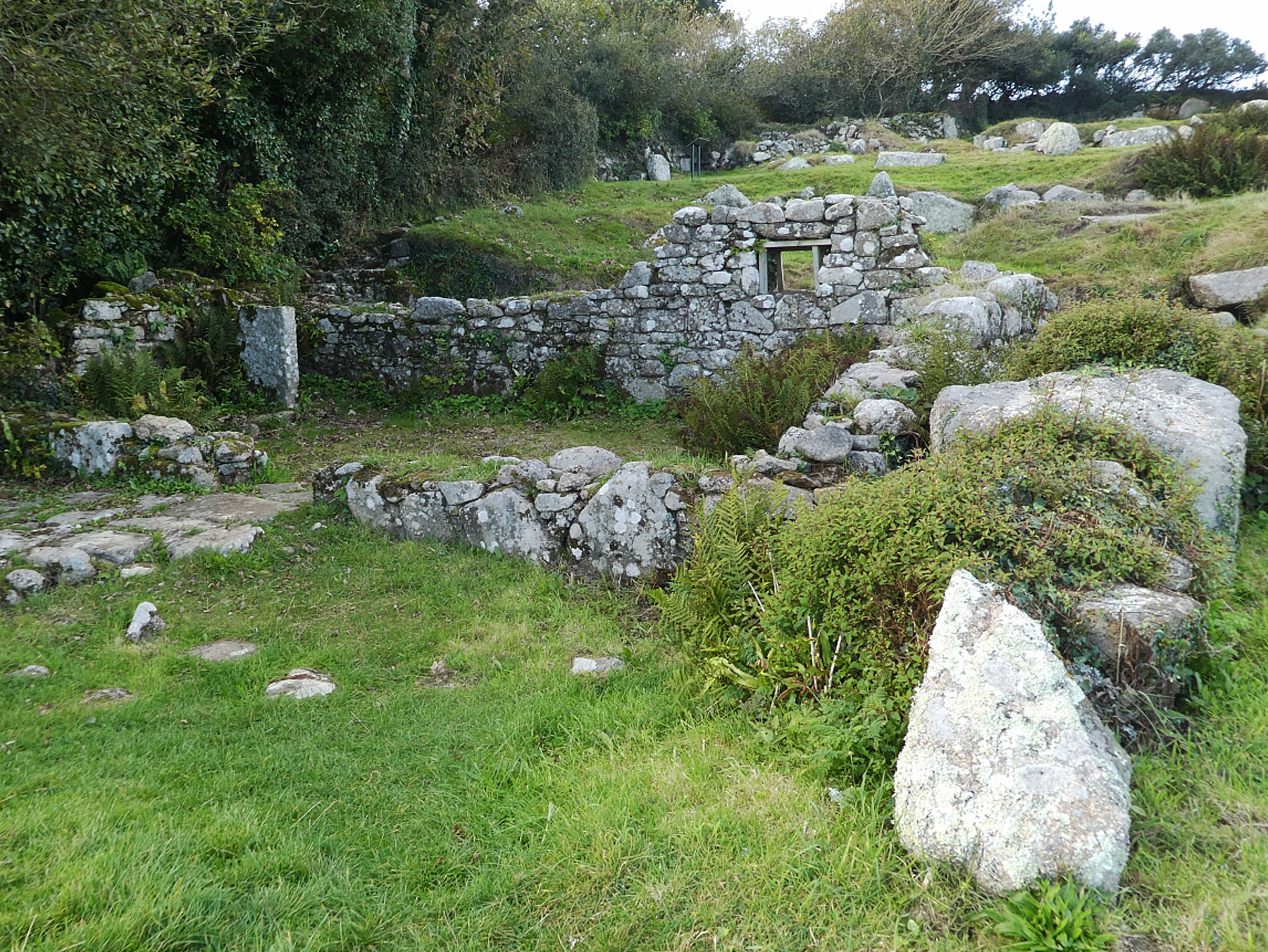
Carn Euny is one of the most atmospheric ancient settlements in Cornwall: a cluster of stone-walled houses, courtyards and lanes occupied for centuries by an Iron Age and Romano-British farming community, tucked into a quiet valley near the hamlet of Brane. Its most famous feature is a fogou — a stone-built underground passage unique to far-western Cornwall — complete with a rare curved side chamber that makes it one of the finest surviving examples of its type anywhere in the county.
Unlike Cornwall's castles and grander monuments, Carn Euny offers something quieter and more intimate: the chance to walk among the actual homes of people who farmed this landscape more than two thousand years ago. The settlement's stone walls, still standing waist- to shoulder-height in places, define individual houses and courtyards clearly enough that visitors can trace the layout of the village room by room, giving a rare and vivid sense of everyday life in ancient Cornwall.
The village sits within the wider prehistoric landscape of West Penwith, one of the richest concentrations of Iron Age and Bronze Age remains in Britain, and pairs naturally with a visit to Chysauster Ancient Village a few miles away, where a similar community of courtyard houses survives on a larger scale. Both sites help explain how West Cornwall's Iron Age and Romano-British communities lived, farmed and built, largely undisturbed by the Roman administration that reshaped much of the rest of Britain.
Carn Euny is cared for by English Heritage and remains free and open to the public throughout the year. There is no visitor centre or facilities on site, and the approach on foot from the small car park crosses farmland, so it suits visitors happy to combine a little walking with their archaeology, ideally with sturdy footwear for the sometimes muddy final approach.
Location Map
Visitor Guide
A visit to Carn Euny begins with a short walk from the small car park near Brane, along a farm track that crosses at least two stiles before reaching the settlement. The path can be muddy after rain, so sturdy, waterproof footwear is recommended whatever the season. Once at the site, a network of informal paths leads between the stone house foundations, allowing visitors to explore at their own pace.
The fogou is the highlight for most visitors. A stone-lined passage leads down into the ground, opening into a long, roofed chamber built from massive stone slabs, with a rare curved side passage branching off it — a feature found at very few other Cornish fogous. The entrance includes a partially hidden, sheer drop into the passageway, so visitors should take care, particularly with children, and those uncomfortable with confined or underground spaces may prefer to view it from the entrance.
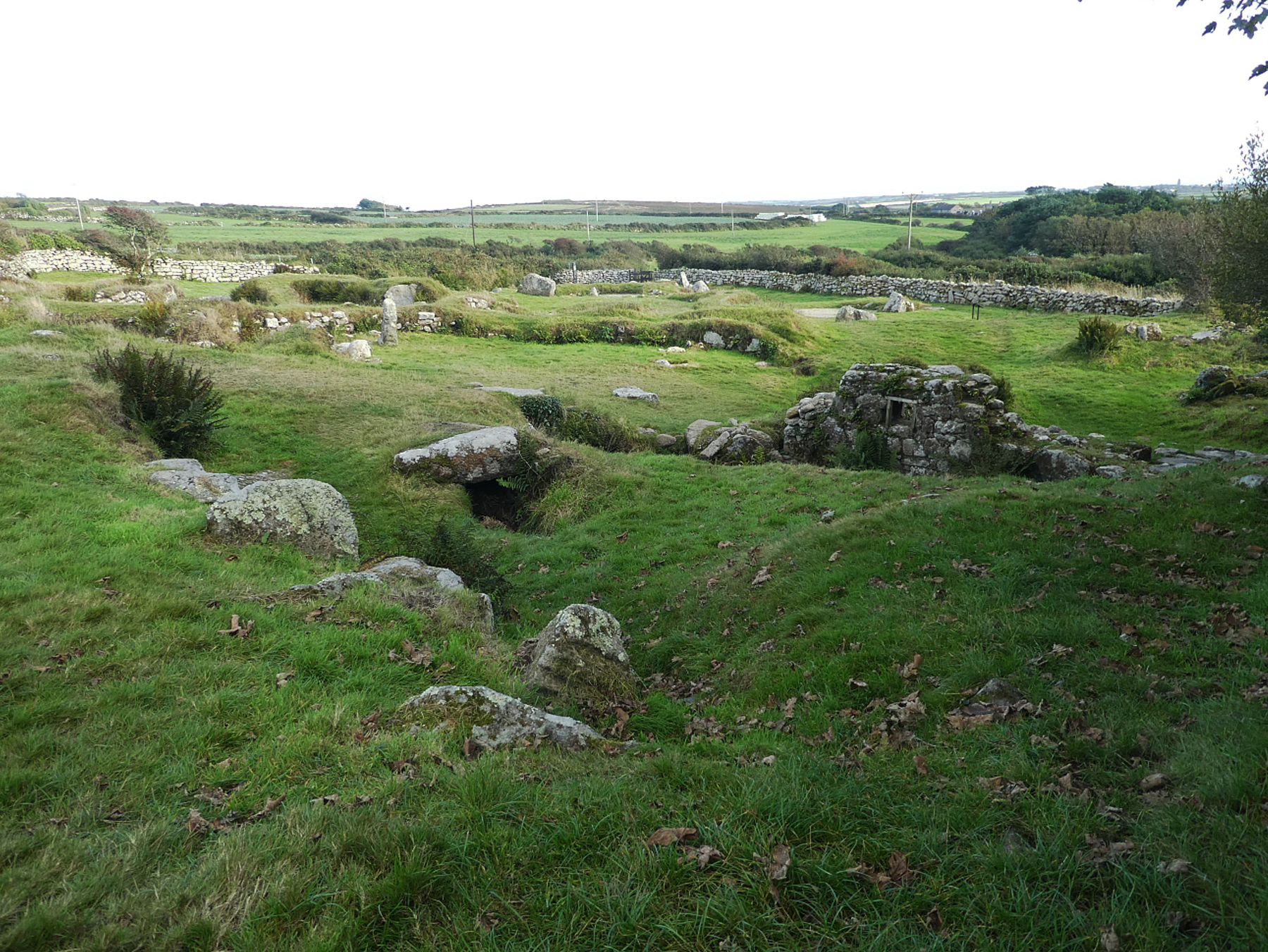
Beyond the fogou, the settlement's courtyard houses are well worth exploring in their own right. Walking between the low stone walls, visitors can pick out individual rooms, hearths and doorways, giving a strong sense of the layout of a working Iron Age and Romano-British farmstead. Information panels around the site help explain what is being seen, though much of the pleasure of Carn Euny lies simply in its quiet, undeveloped setting, with skylarks overhead and the surrounding Penwith moorland stretching away on all sides.
Allow around forty-five minutes to an hour for a visit, longer if combined with a longer walk in the surrounding countryside. There are no facilities on site, so it is best visited as part of a wider day exploring West Penwith's ancient sites, with Chysauster Ancient Village and the town of Penzance both within easy reach.
History
Carn Euny was occupied for an exceptionally long period, from the Iron Age into the Romano-British era, spanning roughly the 5th century BC to the 3rd or 4th century AD. Its stone-built houses, courtyards and surrounding field system show how communities in far-western Cornwall lived both before and during Roman rule, adapting their settlement gradually over many generations rather than building it in a single episode.
The site's most famous feature, the fogou, was probably constructed during the later Iron Age, though its purpose remains genuinely uncertain. Fogous are found only in western Cornwall, and theories about their function range from storage and shelter to ritual or ceremonial use. The example at Carn Euny is particularly significant because it retains a rare curved side chamber, a detail found at very few comparable sites, and its careful construction suggests it held real importance within the life of the settlement.
Life at Carn Euny continued with relatively little disruption through the Roman period. Communities in far-western Cornwall maintained their own Celtic building traditions, farming systems and, most likely, their own language, even as Roman administration reshaped much of the rest of Britain. Evidence from Carn Euny and comparable settlements such as Chysauster suggests that Roman-period Cornwall retained a strongly local, agricultural character, connected to but not absorbed by the wider Roman world.
Carn Euny appears to have been gradually abandoned in the later Roman centuries, and the settlement was left undisturbed within the surrounding agricultural landscape for well over a thousand years before archaeological investigation began in earnest in the 20th century. Excavations revealed the fogou, the courtyard houses and the wider layout of the settlement, establishing Carn Euny as one of the most important and best-understood Iron Age and Romano-British sites in Cornwall.
Today the site is cared for by English Heritage as a scheduled monument. Modern conservation focuses on keeping the stonework legible while protecting it from erosion and uncontrolled access, and Carn Euny remains one of the most rewarding places in Cornwall to encounter the everyday, working life of an ancient Cornish community, rather than the monuments of the powerful or the dead.
Important Features
- The fogou: a stone-built underground passage with a rare curved side chamber, one of the finest surviving examples in Cornwall.
- Courtyard houses: stone-walled foundations of Iron Age and Romano-British homes, still standing to a good height in places.
- Village lanes and courtyards: the layout of paths and open spaces between houses is still clearly traceable on the ground.
- Long occupation sequence: continuously inhabited from the Iron Age into the Romano-British period, roughly the 5th century BC to the 3rd or 4th century AD.
- Surrounding field system: traces of the farmed landscape that supported the settlement survive in the wider area.
- West Penwith archaeological landscape: part of one of the densest concentrations of prehistoric remains in Britain.
Visitor Information
Parking
A small car park lies about 600 metres from the village, reached via narrow lanes near Brane. The lanes are unsuitable for coaches or large vehicles.
Facilities
There are no facilities on site. Pubs and cafés are available in surrounding villages, with a fuller range in Penzance, about six miles away.
Disabled Access
The approach track can be extremely muddy and crosses at least two stiles. The site has uneven ground and a partially hidden drop into the fogou passage.
- Opening times: open any reasonable time during daylight hours, year-round.
- Public transport: limited rural bus services run towards Sancreed and Brane; Penzance, around six miles away, has the nearest regular services and railway station.
- Toilets: none on site; nearest facilities are in Penzance.
- Food and drink: none on site; pubs and cafés are available in nearby villages and in Penzance.
- Shop: no shop on site.
- Dogs: welcome on leads. Please keep dogs under close control around livestock and the fogou entrance.
- Booking: not required — free entry, no ticketing.
- Family facilities: no baby-changing or family facilities on site; the muddy approach and stiles make pushchair access difficult.
- Additional access: an alternative byway route to the site exists north-west of the car park, accessed via a stone stile.
- Visit duration: around forty-five minutes to an hour, longer if combined with a wider walk.
Things to Do Nearby
Chysauster Ancient Village
Newmill, nr. Penzance
One of Britain's best-preserved Romano-British villages, with distinctive courtyard houses and its own fogou.
Find Out MoreBallowall Barrow
St Just
A unique, multi-phase Bronze Age entrance grave on the cliffs near St Just.
Find Out MorePenzance
About 6 miles away
West Cornwall's largest town, with shops, restaurants, a harbour and the Penlee art gallery.
Find Out MoreLand's End
Sennen, nr. Penzance
Mainland Britain's most westerly point, with dramatic clifftop scenery and family attractions.
Find Out MoreSt Just
Nr. Sancreed
A characterful mining town with independent shops, cafés, galleries and pubs.
Find Out MoreFrequently Asked Questions
Official English Heritage Site
For the latest access information, events and any temporary restrictions, check the official English Heritage page for Carn Euny Ancient Village before you travel.
Explore More Cornwall Heritage
All English Heritage Sites Cornwall Attractions National Trust Cornwall
Page last updated: 24 August 2026.