Back to English Heritage Cornwall
St Buryan, Penzance, Cornwall TR19 6BQ | 0370 333 1181
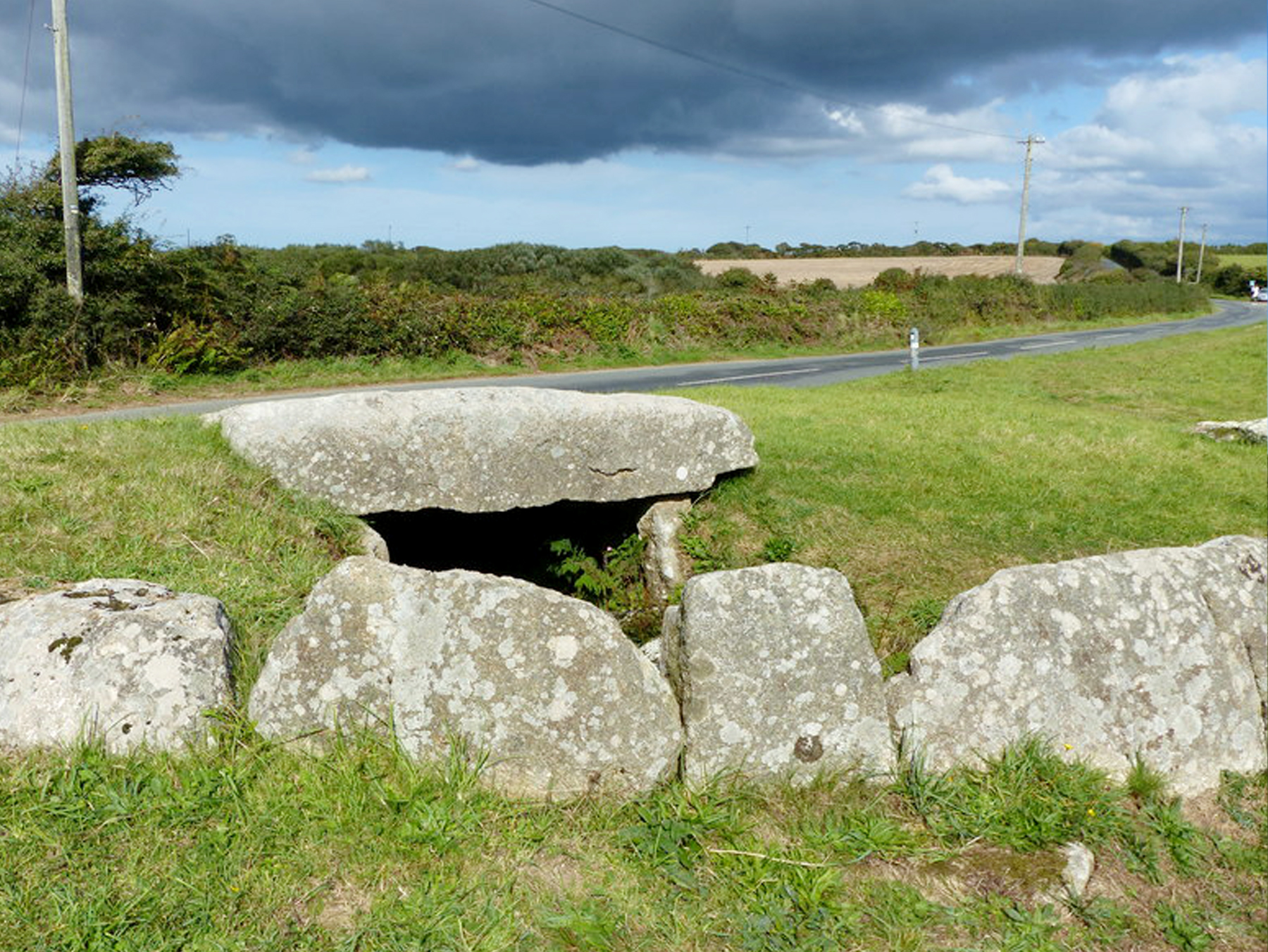
Standing right beside the road two miles south-east of St Buryan, Tregiffian Burial Chamber is one of the finest surviving examples of an entrance grave in Cornwall — a distinctive type of prehistoric tomb found almost nowhere else in Britain outside the far west of the county and the Isles of Scilly. Despite the loss of its covering mound and some damage from 19th-century road building, Tregiffian retains around two-thirds of its original stone chamber, making it one of the most complete and accessible monuments of its kind.
Entrance graves belong to a period stretching from the later Neolithic into the middle Bronze Age, roughly 3000 to 1000 BC. Of the 93 known examples in England, the great majority, 79 in total, are found on the Isles of Scilly, with the remainder confined almost entirely to Cornwall's Penwith peninsula; closely related monuments are also known from the Channel Islands and Brittany, hinting at long-distance connections across the western seaways in prehistory. Tregiffian's chamber measures around 16 feet long by up to 6 feet wide and 3 feet high, built from a combination of edge-set slabs and roughly coursed rubble walling, roofed by four substantial capstones.
The site's most remarkable feature is its portal stone, which was once covered by a network of 25 carved hollows, or cup marks — potentially the oldest known prehistoric rock carving in south-west England. The genuine carved slab is now preserved at the Royal Cornwall Museum in Truro, with a faithful cast displayed at the site itself, allowing visitors to appreciate this remarkable piece of Neolithic or Bronze Age artistry in its original setting.
Tregiffian is owned by English Heritage and managed by the Cornwall Heritage Trust, and remains free to visit throughout the year. It stands only a short walk from the Merry Maidens, one of Cornwall's best-preserved Bronze Age stone circles, and the two sites are usually explored together using the same small roadside parking area, making this one of the most rewarding short prehistoric walks anywhere in Penwith.
Location Map
Visitor Guide
Tregiffian Burial Chamber lies on the B3315 two miles south-east of St Buryan, right beside the road and within a small parking area shared with the nearby Merry Maidens stone circle. Visitors should take care walking along the grass verge from the parking area to the chamber, as a sheer drop lies close by, and the ground underfoot is uneven throughout.
Because the site sits so close to the road, a visit to Tregiffian can be brief, but it rewards a closer look: the surviving two-thirds of the original chamber, the massive capstones still spanning the roof, and the cast of the remarkable cup-marked portal stone are all easily appreciated in a few minutes. Most visitors combine Tregiffian with the short walk to the Merry Maidens, a well-preserved Bronze Age stone circle of nineteen stones a few minutes' walk away, making the two sites together a highlight of any visit to the Penwith peninsula's dense prehistoric landscape.
Allow around fifteen to twenty minutes for Tregiffian alone, or closer to an hour if combining it with the Merry Maidens. St Buryan, a short drive away, has a shop, public toilets and a pub, while Penzance offers a full range of facilities for a longer day exploring West Cornwall's ancient sites.
History
Tregiffian is classified as an entrance grave, a distinctive type of funerary monument built between the later Neolithic and middle Bronze Age, roughly 3000 to 1000 BC. These tombs typically consist of a roughly circular mound of heaped rubble and earth built over a rectangular stone chamber, constructed from edge-set slabs or rubble walling and roofed with large stone capstones. Of the 93 recorded examples in England, the overwhelming majority, 79, are found on the Isles of Scilly, with the small remaining number confined to Cornwall's Penwith peninsula; related monuments are also known from the Channel Islands and Brittany, suggesting entrance graves formed part of a wider Atlantic-facing prehistoric tradition.
Excavations at entrance graves elsewhere have uncovered cremated human remains and pottery urns, though archaeologists continue to debate whether these monuments served purely as burial places or also functioned as ritual shrines used by the living community, perhaps for ceremonies connected to ancestors rather than solely for the deposition of the dead. Tregiffian's chamber measures around 16 feet long by up to 6 feet wide and 3 feet high, its walls a careful combination of edge-set slabs and roughly coursed rubble, with four massive capstones spanning the roof — among the most substantial surviving in any Cornish entrance grave.
The chamber's most celebrated feature is its portal stone, entirely covered by a network of 25 carved cup marks — small, shallow, man-made hollows whose meaning remains uncertain but which are thought to represent one of the oldest known pieces of prehistoric rock art anywhere in south-west England. The genuine carved slab was removed for safekeeping and is now held at the Royal Cornwall Museum in Truro, with a faithful cast installed at the site so that visitors can still appreciate the carving in its original context.
The construction of a road across part of the site in the 1840s damaged a portion of the covering mound, removing some of the material that once concealed the chamber, though the chamber itself survived largely intact. Today Tregiffian is owned by English Heritage and cared for by the Cornwall Heritage Trust, standing as a well-preserved and easily visited example of one of Cornwall's most distinctive prehistoric monument types, a short walk from the Merry Maidens stone circle with which it shares this small corner of the Penwith landscape.
Important Features
- The chamber: around two-thirds of the original structure survives, roofed by four substantial capstones.
- The cup-marked portal stone: a cast of the carved slab bearing 25 prehistoric cup marks; the original is at the Royal Cornwall Museum, Truro.
- Entrance grave construction: edge-set slabs combined with roughly coursed rubble walling, typical of Penwith and Scilly examples.
- The Merry Maidens: a well-preserved Bronze Age stone circle a short walk away, sharing the same parking area.
- 1840s road damage: the construction of the B3315 removed part of the original covering mound.
- Roadside setting: one of the most easily accessible entrance graves in Cornwall, viewable in a short stop.
Visitor Information
Parking
A small parking area is shared with the Merry Maidens stone circle, a short walk from the chamber.
Facilities
None at the site. St Buryan, a short drive away, has a shop, toilets and a pub.
Disabled Access
Limited. The chamber is reached along an uneven grass verge, with a sheer drop hazard close by.
- Opening times: open any reasonable time during daylight hours, year-round.
- Public transport: limited bus services run along the B3315 near St Buryan; the chamber is then a short walk from the roadside.
- Toilets: none at the site; facilities are available in St Buryan.
- Food and drink: none on site; a pub and shop are available in St Buryan.
- Shop: no shop on site; a small shop is in St Buryan.
- Dogs: welcome on leads.
- Booking: not required — free entry, no ticketing.
- Family facilities: none on site; please take care of children near the sheer drop close to the chamber.
- Additional access: take care walking along the grass verge; visitors are asked not to climb on the stones.
- Visit duration: around fifteen to twenty minutes, longer if combined with the Merry Maidens.
Things to Do Nearby
Merry Maidens Stone Circle
St Buryan
A remarkably complete Bronze Age stone circle of nineteen stones, a short walk from Tregiffian.
Find Out MoreCarn Euny Ancient Village
Sancreed
An Iron Age and Romano-British village with a remarkable underground fogou, a short drive away.
Find Out MorePorthcurno & Minack Theatre
Porthcurno
A spectacular sandy cove overlooked by the world-famous open-air Minack Theatre carved into the cliffs.
Find Out MoreLand's End
Sennen
Mainland Britain's most westerly point, with dramatic clifftop scenery and Atlantic views.
Find Out MorePenzance
West Cornwall's main town
A historic harbour town with shops, restaurants and the gateway to St Michael's Mount.
Find Out MoreFrequently Asked Questions
Official English Heritage Site
For the latest access information, events and any temporary restrictions, check the official English Heritage page for Tregiffian Burial Chamber before you travel.
Explore More Cornwall Heritage
All English Heritage Sites Cornwall Attractions National Trust Cornwall
Page last updated: 25 August 2026.