Back to English Heritage Cornwall
Castle Drive, St Mawes, Nr Truro, Cornwall TR2 5DE | 01326 270526
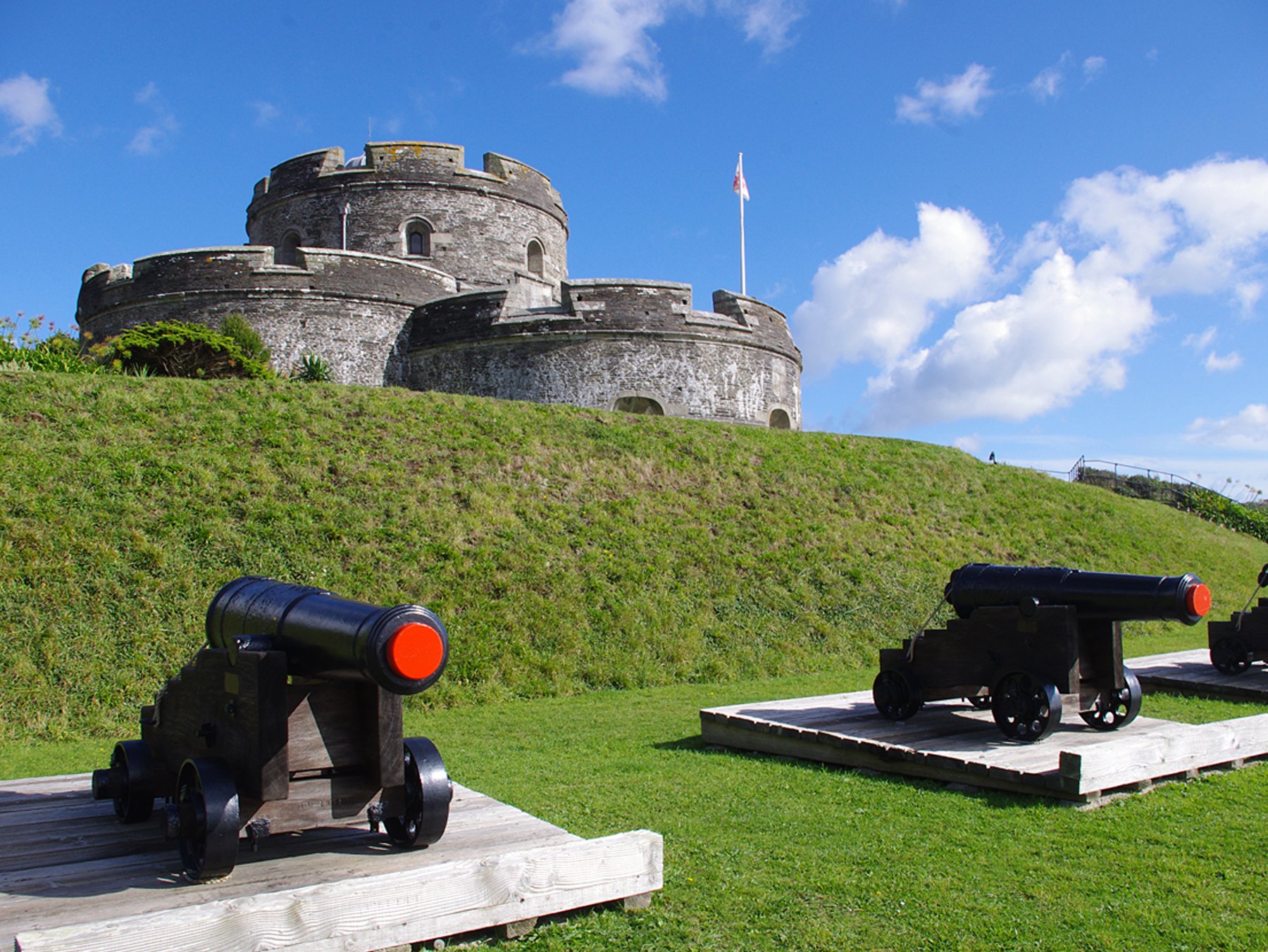
St Mawes Castle is one of the best-preserved of all Henry VIII's coastal artillery forts, its distinctive clover-leaf plan of a central tower and three round bastions rising above the harbour on the eastern shore of the Fal estuary. Built between 1539 and 1545 to guard the vital anchorage of Carrick Roads alongside its larger sister fortress, Pendennis, across the water, St Mawes survives today with an unusually complete set of Tudor decorative carving, making it as much a showcase of Henrician stonemasonry as of military engineering.
Where Pendennis is famous for the six-month siege it withstood during the Civil War, St Mawes tells the opposite story: built low on the hillside rather than on a defensible summit, it was surrendered to Parliamentarian forces almost without a fight once its vulnerability from landward attack became clear. That contrast between the two castles, standing in full view of one another across the estuary, is part of what makes a visit to either site more rewarding when paired with the other.
The castle's decoration sets it apart from most Tudor fortifications. Carved string courses, gargoyles, a Royal Coat of Arms above the entrance and Latin inscriptions proclaiming loyalty to Henry VIII line the exterior, while inside the keep, surviving wooden carvings of a cherub, a monk, Tudor roses and fleur-de-lis speak to a fort built as much to display royal authority to passing ships as to defend the coast. The castle stayed in active military use for over four hundred years, its guns upgraded repeatedly from the Napoleonic Wars through to the Second World War, before finally passing into state care in 1956.
St Mawes today is reached either by road, via the King Harry Ferry crossing from Feock, or — for many visitors, the highlight of the trip — by the passenger ferry that runs year-round between Falmouth's Prince of Wales Pier and St Mawes, arriving directly below the castle walls. The dramatic coastline around St Mawes, glimpsed from the battlements, was also used as a filming location for the television series Poldark, adding a further layer of interest for visitors exploring this stretch of the Roseland Peninsula.
Location Map
Visitor Guide
Most visitors reach St Mawes Castle either by car, via the A3078 and the King Harry Ferry crossing from Feock, or by the passenger ferry that runs daily throughout the year between Falmouth's Prince of Wales Pier and St Mawes harbour, a short walk from the castle gates. Arriving by water is well worth considering: it approaches the castle from the direction any hostile ship would have faced in the 16th century, and gives a clear view of how the fort's three gun bastions cover the whole width of the estuary entrance.
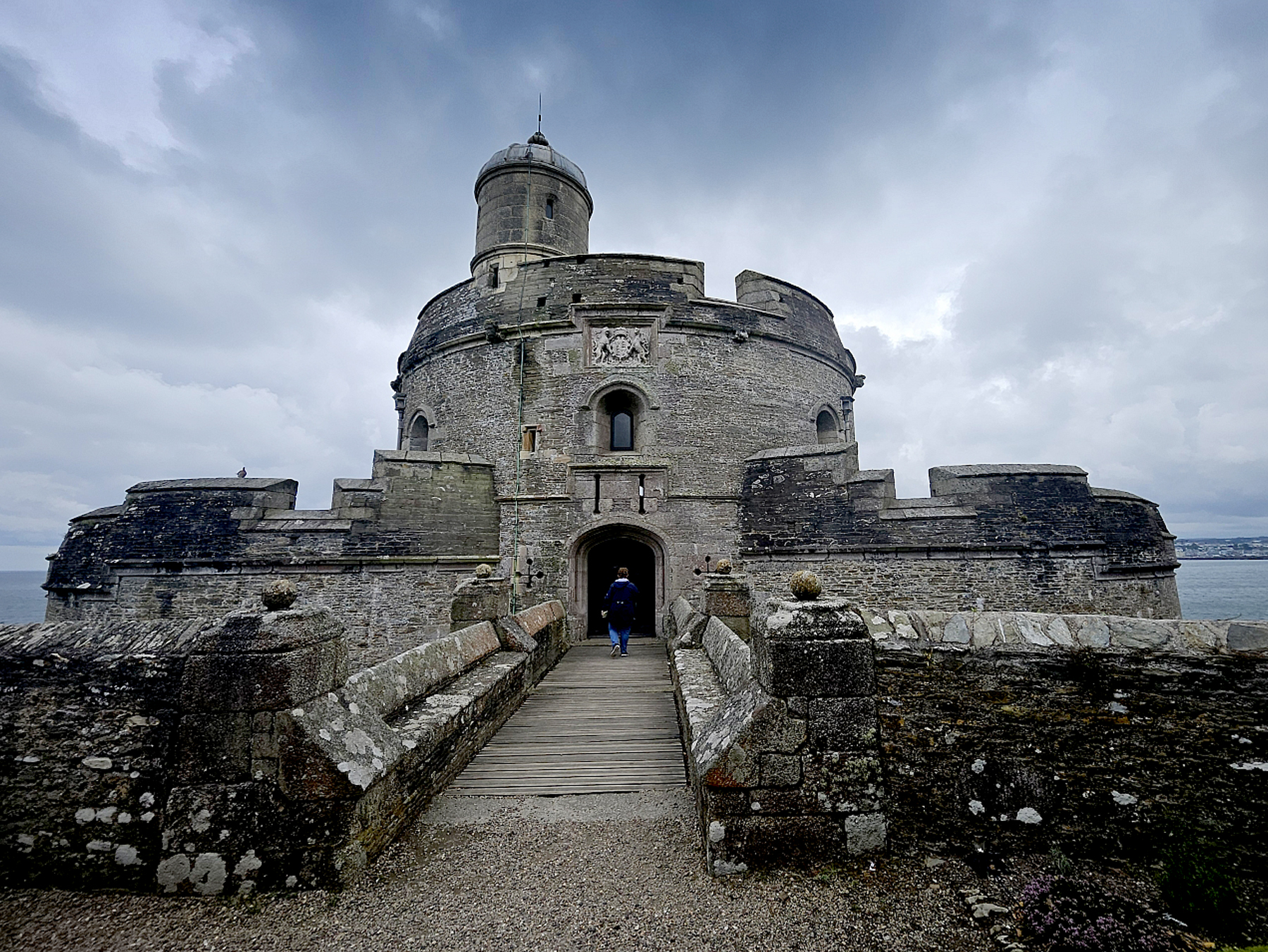
Inside, the compact central tower rises through four floors, reached by a bridge to the third level much as Tudor visitors would have entered. The elaborately carved decoration is one of the castle's real highlights: look for the Royal Coat of Arms above the entrance, the Latin inscriptions proclaiming loyalty to Henry VIII and his son Edward VI, and the surviving wooden carvings inside the keep, including a cherub, a monk, Tudor roses and fleur-de-lis. The forward gun room displays a collection of historic cannon, and visitors can still see the sockets cut into the walls that once held the beams used to manoeuvre the heaviest guns into position.
Outside, the castle's grounds and gun platforms give sweeping views across Carrick Roads to Pendennis Castle on the opposite headland, and out towards St Anthony Lighthouse at the mouth of the estuary. Benches are placed throughout the grounds, and the upper gun deck's ventilation shafts, designed to disperse gun smoke, are a reminder of how carefully the fort's Tudor engineers thought through the practicalities of artillery warfare, not just its symbolism.
Allow around an hour to an hour and a half for a visit, longer if combining it with a walk around St Mawes village or along the coast path, which begins nearby and offers some of the finest coastal walking on the Roseland Peninsula. There's a shop at the entrance selling gifts, books and light snacks, but no café on site, so many visitors combine their visit with lunch in one of St Mawes's harbourside cafés or pubs.
History
St Mawes Castle owes its existence to the international tensions of the late 1530s. In 1537, the local landowner John Arundell petitioned Henry VIII to fortify the Fal estuary, and the king, then engaged in an ambitious national programme of coastal defence following his break with Rome and the resulting threat of a joint Catholic invasion from France and Spain, agreed. Construction of St Mawes began around 1539, one of roughly thirty new fortifications built along the English coast during this period, and was substantially complete by the mid-1540s. An inscription within the castle records that it was built "in the 34th year of his reign" for the soul of Henry VIII, a rare piece of contemporary written testimony to the building's origins.
The castle's design is one of the most distinctive of the entire Henrician building programme: a central tower surrounded by three large circular bastions arranged in a clover-leaf or trefoil pattern, giving gunners a wide field of fire covering almost every angle of approach to the anchorage. St Mawes was built as a deliberate pair with the larger, more strategically sited Pendennis Castle on the opposite headland; together, the two forts were designed to create overlapping crossfire across the entrance to Carrick Roads, one of the finest natural deep-water anchorages in Britain and a vital shelter for shipping. A typical garrison at St Mawes numbered no more than around fifteen men, swelled by local militia and volunteers during periods of heightened alert.
Despite the scale of the building programme, St Mawes and Pendennis saw remarkably little direct action during the Tudor period itself. The castle remained on high alert during the Spanish Armada's approach in 1588, though the fleet sailed past without attacking the Cornish coast. Renewed Spanish raids on Cornwall in 1595, which saw Penzance and Mounts Bay attacked and burned, prompted Elizabeth I to order further improvements to the county's coastal defences, including at St Mawes, in anticipation of a larger invasion that ultimately never came; a further Spanish attempt on Carrick Roads in 1596–97 was foiled by adverse weather rather than by force of arms.
The castle's most dramatic moment came not against a foreign enemy but during the English Civil War. Both St Mawes and Pendennis declared for the Royalist cause, but their fates diverged sharply. Pendennis, secure on its hilltop and commanded by Sir John Arundell with the assistance of Sir Henry Killigrew, withstood a Parliamentarian siege for six months, one of the last Royalist strongholds in England to fall. St Mawes, by contrast, had been built halfway down its hillside rather than on the high ground, leaving it dangerously exposed to attack from the landward side. When Parliamentarian forces closed in, the Royalist commander recognised the castle's hopeless position and surrendered with barely a shot fired, a striking contrast between two sister fortresses built for exactly the same purpose just a few years apart.
St Mawes remained garrisoned, in a much reduced way, through the seventeenth and eighteenth centuries. During the American War of Independence, local militia were mobilised at St Mawes between 1779 and 1783 amid fears of a French invasion, and the French Revolutionary and Napoleonic Wars of 1793–1815 saw the castle re-armed with ten heavy 24-pounder guns positioned on a shore battery nearby. A period of relative calm followed the end of the Napoleonic Wars in 1815, but renewed fears of French naval power in the 1850s led to a significant programme of modernisation, including a new Grand Sea Battery designed for powerful 8-inch guns and an accompanying ammunition magazine. Further upgrades followed as artillery technology advanced: 64-pounder rifled guns arrived in the 1880s, and by the 1890s quick-firing 6-pounder guns and machine guns had been added to counter the new threat posed by fast torpedo boats.
St Mawes was garrisoned once again during the Second World War, with twin 6-pounder guns installed on the shoreline to the north-west of the castle. The site saw particularly intense activity during the spring and summer of 1944, when American troops and equipment gathered in the area for pre-invasion training ahead of the D-Day landings in Normandy, part of the huge build-up of Allied forces that took place across Cornwall's harbours and estuaries in the months before June 1944. St Mawes remained in military use until 1956, when advances in rocket technology finally rendered traditional coastal artillery obsolete, bringing over four hundred years of continuous military significance to an end. The castle then passed into state care, and it survives today as one of the most complete and best-preserved examples of Henry VIII's coastal artillery forts anywhere in England.
Important Features
- Clover-leaf plan: a central tower surrounded by three large circular gun bastions, one of the most distinctive designs of Henry VIII's coastal fortifications.
- Latin inscriptions: carved text within the castle records its construction "in the 34th year" of Henry VIII's reign.
- Royal Coat of Arms: carved into the stonework above the entrance, proclaiming royal authority to ships entering the estuary.
- Tudor wood carvings: surviving decoration inside the keep includes a cherub, a monk, Tudor roses and fleur-de-lis.
- Forward gun room: historic cannon on display, with surviving wall sockets that once held the beams used to manoeuvre the guns.
- Ventilated gun platforms: the upper gun deck includes shafts designed to disperse smoke from the castle's cannon.
- The Grand Sea Battery: a 19th-century addition built to house more powerful 8-inch guns as artillery technology advanced.
- Second World War gun emplacements: twin 6-pounder guns installed on the shoreline during the site's final period of military use.
- Views to Pendennis Castle: sweeping views across Carrick Roads to St Mawes's sister fortress on the opposite headland.
- Ferry approach: the Falmouth–St Mawes passenger ferry offers a dramatic water-level view of the castle's defensive design.
Visitor Information
Parking
An upper car park has 15 standard spaces plus 2 disabled spaces, with a lower car park offering further space. Parking is free for English Heritage members and charged for non-members; off-site village parking is also available.
Facilities
A shop at the entrance sells English Heritage gifts, souvenirs, snacks, drinks and books. There's no café on site, but toilets with baby-changing facilities are available near the shop, along with picnic tables in the grounds.
Disabled Access
Wheelchair access is very limited: there are no ramps, and an uneven spiral staircase connects the floors of the keep. Disabled parking is around 30 yards from the entrance, but paths and steps follow beyond that point.
- Opening times: daily, 10am–5pm, with last entry at 4:30pm. Check the official website for any seasonal changes before travelling.
- Public transport: bus 50 connects Truro to St Mawes; the passenger ferry from Falmouth's Prince of Wales Pier runs daily year-round and lands a short walk from the castle.
- Toilets: available near the shop, with baby-changing facilities.
- Food and drink: no café on site; the shop sells snacks and drinks, and St Mawes village has cafés, pubs and restaurants a short walk away.
- Shop: English Heritage gifts and themed souvenirs, including children's merchandise, books, pewter figures, tankards and rugs.
- Dogs: assistance dogs are welcome; check current policy for other dogs with English Heritage before visiting.
- Booking: ticketed entry with Standard, Saver and Super Saver pricing tiers; booking online in advance gives a discount, and entry is free for English Heritage members.
- Family facilities: three picnic tables in the grounds allow access for a wheelchair or pram; baby-changing facilities are provided in the toilets.
- Additional access: no wheelchair loan, lift or onsite transport is available; handrails are provided in some areas and staff can advise on the best route for visitors with limited mobility.
- Visit duration: around an hour to an hour and a half, longer if combined with a walk around St Mawes or the coast path.
Things to Do Nearby
Pendennis Castle
Falmouth, across the estuary
St Mawes's larger sister fortress, reachable by ferry across Carrick Roads or by road around the estuary.
Find Out MoreFalmouth
Across Carrick Roads
A historic harbour town with shops, restaurants and the Prince of Wales Pier ferry terminal.
Find Out MoreNational Maritime Museum Cornwall
Falmouth
An award-winning museum of boats, seafaring and Cornwall's maritime history, a short ferry ride away.
Find Out MoreThe Roseland Peninsula
St Mawes's home peninsula
A quiet, unspoilt peninsula of creeks, coast path and villages, with St Mawes as its best-known village.
Find Out MoreSt Just in Roseland
Nr. St Mawes
A famously picturesque waterside churchyard and sub-tropical garden, a short drive from the castle.
Find Out MoreFrequently Asked Questions
Official English Heritage Site
For the latest opening times, admission prices, booking and any event or access changes, check the official English Heritage page for St Mawes Castle before you travel.
Explore More Cornwall Heritage
All English Heritage Sites Cornwall Attractions National Trust Cornwall
Page last updated: 24 August 2026.