Back to English Heritage Cornwall
Week St Mary, Holsworthy, Cornwall EX22 6XW | 0370 333 1181
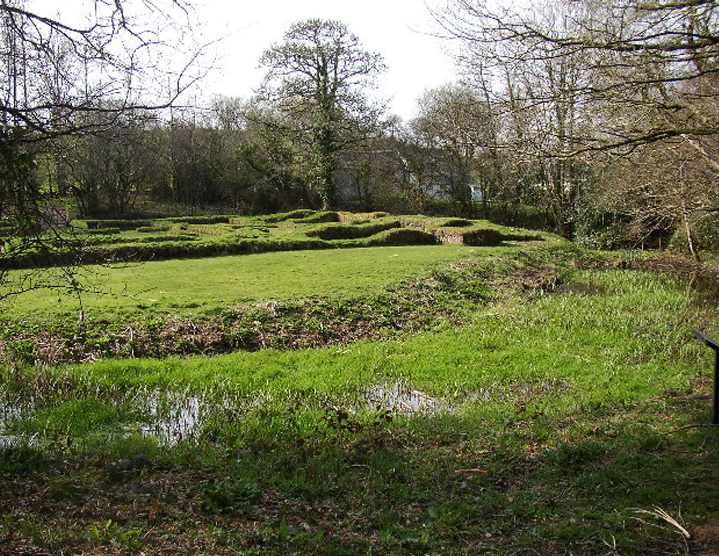
Deep in a quiet wooded valley near Week St Mary, Penhallam Manor is one of the most complete surviving examples of a moated medieval manor house anywhere in south-west England. Its low, grass-covered walls trace out the full ground-plan of a substantial 13th-century home, abandoned so early in its life that no later building work ever disturbed the layout beneath the turf.
The manor was built by the de Cardinham family, minor Cornish barons whose fortunes rose sharply through service to King John in the early 13th century. Robert Fitzwilliam de Cardinham became one of the king's principal agents in the county, and his son Andrew inherited an enlarged and enriched estate, including Restormel Castle near Lostwithiel. It was Andrew who undertook the main building phase at Penhallam in the 1220s and 1230s, creating a comfortable, moated residence that may have replaced an earlier, less defensible manor site nearby at Week St Mary itself.
Penhallam's story is unusually short. When Andrew de Cardinham died around 1256 without a surviving male heir, his estates were divided between his daughters, and by 1270 Penhallam had passed through the female line to the Champernowne family, who did not live there themselves. The manor was let to tenants, its lands partitioned by 1330, and the buildings were rapidly abandoned and stripped of usable material by the surrounding community — a swift decline that, paradoxically, is exactly what has preserved its complete ground-plan so well.
Archaeological excavation between 1968 and 1973 uncovered and consolidated the remains, revealing the full layout of the hall, chambers, chapel, gatehouse and surrounding moat. Today the site is managed by English Heritage as a peaceful nature reserve, free to explore and reached along a scenic woodland walk that is as much a part of the experience as the ruins themselves.
Location Map
Visitor Guide
A small, free car park is provided at the head of a half-mile track leading to Penhallam Manor. The car park itself keeps restricted hours — 10am to 6pm from April to October and 10am to 4pm from November to March — though pedestrian access along the track remains possible outside these times during daylight hours. The walk in is through peaceful woodland, following the valley of a small stream, and is one of the quieter, more contemplative approaches to any English Heritage site in Cornwall.
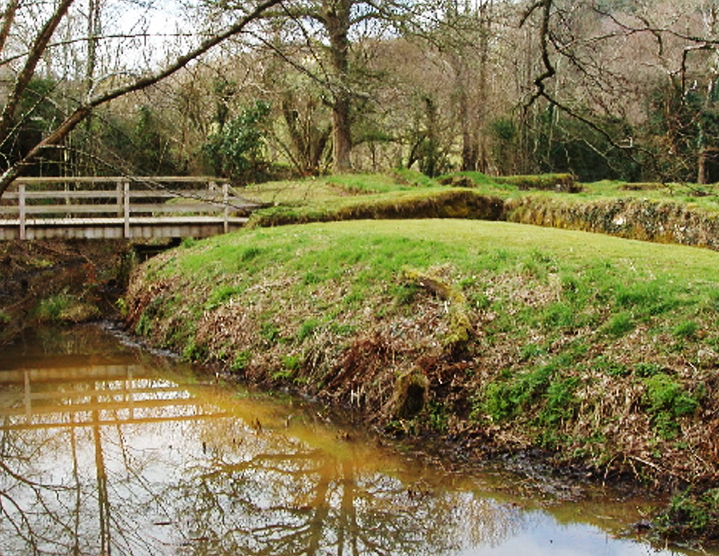
On arrival, the moat itself is the most immediately striking feature, a broad, tree-lined ditch still holding water in places and crossed by a modern footbridge on the line of the medieval entrance. Beyond it, the grass-covered footings of the hall, private chambers, chapel and gatehouse can all still be traced, laid out much as they would have been when the de Cardinham family lived here in the 13th century.
There is no visitor centre, shop or shelter at Penhallam, and no mobile signal in the valley, so it rewards visitors who come prepared to enjoy its remoteness rather than expecting the facilities of a larger attraction. Allow around forty-five minutes to an hour for the round walk in, exploration of the site, and the walk back out, longer if combined with a wider woodland ramble. The nearest facilities, including a small shop and public toilets, are in the village of Week St Mary.
History
Penhallam Manor takes its name from the valley in which it stands and was built by the de Cardinham family, minor barons who transformed their standing in Cornwall through service to the crown in the early 13th century. Robert Fitzwilliam, Lord of Cardinham, became one of King John's principal agents in the county, using his position within the justice system to expand his family's wealth and influence considerably during a turbulent period of English royal politics.
His son Andrew de Cardinham inherited this enlarged estate, which by then also included Restormel Castle near Lostwithiel. Building at Penhallam took place across several phases from the late 12th into the early 14th century, but it was Andrew who carried out the principal building campaign in the 1220s and 1230s, creating the moated manor house whose complete ground-plan survives today. It has been suggested that this new, sheltered valley site may have replaced an earlier, more exposed earthwork castle associated with the family at nearby Week St Mary.
The manor's occupation, however, proved surprisingly brief. Andrew de Cardinham died around 1256 leaving no male heir, and his lands were divided among his daughters. By 1270 Penhallam had descended through the female line to the Champernowne family, who held numerous other properties and did not make it their principal residence. The manor was let to tenants, and by around 1330 the estate had been further partitioned, triggering the rapid abandonment of the buildings and the salvage of usable stone and timber by people living in the surrounding area.
This early and complete abandonment is precisely what makes Penhallam so valuable today. Because no later manor house or farm was ever built over the site, its 13th-century ground-plan survived beneath the grass largely undisturbed for over six centuries. Archaeological excavation between 1968 and 1973 uncovered and consolidated the remains of the hall, private chambers, chapel, gatehouse, kitchen and moat, revealing one of the most complete surviving plans of a minor medieval manor house anywhere in England. The site is now cared for by English Heritage as both a scheduled monument and a peaceful woodland nature reserve, freely open to visitors throughout the year.
Important Features
- The moat: a broad, water-filled ditch encircling the manor site, crossed by a modern footbridge on the medieval entrance line.
- The hall range: grass-covered footings marking the manor's principal domestic and reception rooms.
- The chapel: foundations of a private chapel forming part of the complete 13th-century ground-plan.
- The gatehouse: remains marking the controlled entrance into the moated enclosure.
- 1968–1973 excavation: the archaeological campaign that uncovered and preserved the site's complete layout.
- The woodland approach: a half-mile walk through a quiet valley, considered part of the Penhallam experience.
Visitor Information
Parking
A small free car park at the head of the approach track, open 10am–6pm (Apr–Oct) and 10am–4pm (Nov–Mar).
Facilities
No facilities at the site itself. A small shop and public toilets are available in Week St Mary village.
Disabled Access
Limited. The half-mile approach track and grassy site are uneven and can be muddy, with areas of deep water in the moat.
- Opening times: open any reasonable time during daylight hours; car park hours are seasonal (see above).
- Public transport: very limited; the nearest bus services run to Week St Mary, around a mile from the site.
- Toilets: none on site; public toilets are available in Week St Mary.
- Food and drink: none on site; a small shop is available in Week St Mary village.
- Shop: no shop on site; a small village shop is in Week St Mary.
- Dogs: welcome on leads.
- Booking: not required — free entry, no ticketing.
- Family facilities: none on site; children should be supervised closely near the water-filled moat.
- Additional access: no weather shelter on site; smoking, vaping, barbecues and naked flames are not permitted.
- Visit duration: around forty-five minutes to an hour, including the walk in and out.
Things to Do Nearby
Launceston Castle
Launceston
A Norman castle with a unique tower-within-a-tower keep, once the administrative capital of Cornwall.
Find Out MoreWeek St Mary
Nearest village
A small Cornish village with a shop and public toilets, the nearest facilities to Penhallam.
Find Out MoreBude
North Cornwall coast
A popular seaside town with sandy beaches, a historic canal and a good range of shops and restaurants.
Find Out MoreCrackington Haven
North Cornwall coast
A dramatic cove with towering cliffs and coast path walks, a short drive from Week St Mary.
Find Out MoreBoscastle
North Cornwall coast
A picturesque harbour village with a National Trust visitor centre and dramatic coastal scenery.
Find Out MoreFrequently Asked Questions
Official English Heritage Site
For the latest access information, events and any temporary restrictions, check the official English Heritage page for Penhallam Manor before you travel.
Explore More Cornwall Heritage
All English Heritage Sites Cornwall Attractions National Trust Cornwall
Page last updated: 25 August 2026.