
Eden Project
Bodelva, St Austell,
Cornwall PL24 2SG Tel: 01726 811911
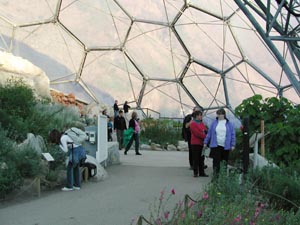
Warm Temperate Biome.
The Warm Temperate Biome allows you to experience the diversity of plant species that have evolved to survive in the semi drought conditions that exist in the Mediterranean Basin, California and South Africa. These are the lands that are hot and dry in summer, have poor, infertile soil and sporadic rains during the winter months.
Mediterranean Basin
 The
Mediterranean Basin was the cradle of our society. The Ancient Greek culture
has been attributed to the trade in Olive Oil.
The
Mediterranean Basin was the cradle of our society. The Ancient Greek culture
has been attributed to the trade in Olive Oil.
The Mediterranean is the natural habitat of this special species, which will grow in poor, salty soil, is able to survive drought and the intense dry heat of summer.
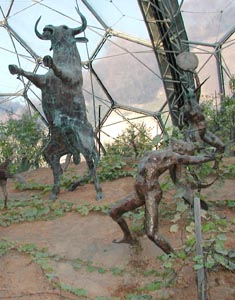
The other typical Mediterranean plant is the Vine. Linked to the Roman Civilisation this species seams to burst into life each summer from stems that appear to be dead. Falmouth based artist, Tim Shaw, has created a stunning sculpture based on the legend of Dionysus, the Greek god of the vines (the Roman Bacchus). In the Work Dionysus is depicted by Tim as a Bull, surrounded by Maenads - his followers, dancing ecstatically through the vines.
AS you wander along the path you arrive at the Citrus section of the biome before you reach the South African section.
 South
African Afro-Montane
South
African Afro-Montane
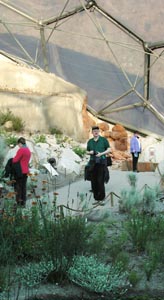
The flora of the Cape is in a class of its own, with a unique collection of species. The biome has examples of Protea family and heath plants from the Fynbos region and the daisy like flowers of the baking hot Namaqualand.
California
The path winds back on itself towards the entrance - into the Californian, South San Francisco Bay exhibit. The Eden Project has put together a display of central valley prairie vegetation and chaparral species from the foothills of Nevada.
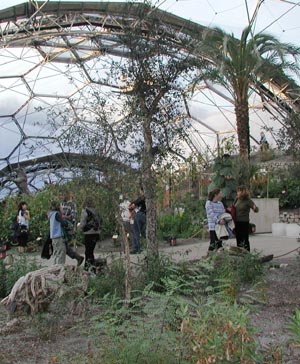
Opposite the California floral carpet, you find the Cork trees of the Mediterranean exhibit. The exhibit features the Quercus suber trees, whose bark is harvested every 9 to 12 years to supply corks for the wine industry.
 Managed,
Cork Oak Pastures woods known as montados in Portugal and as dehesas in
Spain, can also be used for secondary crops, such as charcoal, or for
raising meat - with pigs feeding beneath the trees. The agricultural method
also provides a valuable natural habitat for many species of wildlife,
such as the rare Black Vulture and the Short Toed Eagle, as well as many
indigenous plant species.
Managed,
Cork Oak Pastures woods known as montados in Portugal and as dehesas in
Spain, can also be used for secondary crops, such as charcoal, or for
raising meat - with pigs feeding beneath the trees. The agricultural method
also provides a valuable natural habitat for many species of wildlife,
such as the rare Black Vulture and the Short Toed Eagle, as well as many
indigenous plant species.
The Cork trees in the display are complemented by the cork pig sculptures at their bases. The sculptures are the work of Heather Jansch, who has used the media to create some stunning creatures.
As you return to the entrance, you come across the Plants for Perfume display and the floral beauty display.
