 LOSTWITHIEL
and district
LOSTWITHIEL
and district
Boconnoc
(Connoc's Dwelling or Bo-Con-Oke - Place
of Stunted Oaks)
Three miles east of Lostwithiel, Boconnoc can trace its history back to the Normans. The estate and house were taxed in the Domesday Roll A.D.1087. The current building at Boconnoc House is Grade II listed, and was built in the 18th century by two members of the Pitt family: one wing was built ca. 1721 by Thomas Pitt, Governor of Madras, and the other in 1772 by Thomas Pitt, 1st Baron Camelford.
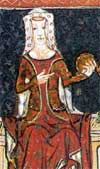 The
first recorded owners were the De Cant family (1268) and in 1320
- 1386, the Manor was owned by the Carminows. Latterly by Sir Oliver
Carminow who married a daughter of Joan,
Countess of Kent ( known to history as The
Fair Maid of Kent, was the first post-conquest Princess of
Wales), a grand-daughter of Edward I, who married the Black Prince as
her second husband, for whom the Duchy of Cornwall was created.
The
first recorded owners were the De Cant family (1268) and in 1320
- 1386, the Manor was owned by the Carminows. Latterly by Sir Oliver
Carminow who married a daughter of Joan,
Countess of Kent ( known to history as The
Fair Maid of Kent, was the first post-conquest Princess of
Wales), a grand-daughter of Edward I, who married the Black Prince as
her second husband, for whom the Duchy of Cornwall was created.
Through the centuries, Boconnoc has been associated with many of this country's famous names and history-makers including Lord Russell, Earl of Bedford who sold Boconnoc in 1579 to Sir William Mohun who rebuilt it. Later, Thomas Pitt purchased the estate with the proceeds of the famous Pitt Diamond which he sold to the Regent of France where it ended up in the hilt of Napoleon's sword. Pitt's grandson, William, became Prime Minister. Eventually, the estate was bequeathed to the Fortescue family who still own it although, since 1969 the house has not been lived in due to deterioration and subsidence.
During the Second World War, Boconnoc House and the surrounding buildings were occupied by American troops and the grounds used as an ammunition dump in preparation for the invasion of Europe.
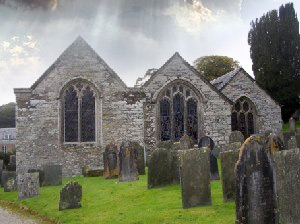 In
the grounds (actually the largest park in Cornwall) positioned at the
heart of the Boconnoc Estate, looking south down the Lerryn Valley is
Boconnoc Church. The original dedication is unknown, but the church
is believed have been consecrated in 1413. The Nave is circa C14 with
south aisle and short north chancel aisle (family chapel) circa late C15.
South porchcirca C16. South west turret attributed to George Matthew Fortescue
who died in 1877. the church was Restored in 1873 and repaired in 1935.
In
the grounds (actually the largest park in Cornwall) positioned at the
heart of the Boconnoc Estate, looking south down the Lerryn Valley is
Boconnoc Church. The original dedication is unknown, but the church
is believed have been consecrated in 1413. The Nave is circa C14 with
south aisle and short north chancel aisle (family chapel) circa late C15.
South porchcirca C16. South west turret attributed to George Matthew Fortescue
who died in 1877. the church was Restored in 1873 and repaired in 1935.
The most prominent monument is the Obelisk which is 123 feet high and was erected in 1771 by Thomas Pitt, 1st Lord Camelford, in memory of his wife's uncle and benefactor, Sir Richard Lyttelton.
The Obelisk is situated between Boconnoc and Braddock churches in the middle of an old military entrenchment near to where the Battle of Braddock Down was fought in the Civil War 1642-1646. During this period Boconnoc was involved in two significant battles. In January 1643 the Parliament forces under Col. Ruthven impatiently attempted to enter Cornwall, which was strongly Royalist.
The opposing forces met near Braddock Church, the Royalists being commanded by Bevil Grenville and Ralph Hopton (both subsequently Knighted) marching from Boconnoc Park where they had bivouacked overnight. In a short time the Parliament forces were routed. A more important clash took place the following year when the King's cause was beginning to wane. Lord Robartes of Lanhydrock (a sour Puritan) had indicated to the Earl of Essex, then commander-in-chief of the Parliament Army, that the Cornish were ready to surrender. Essex marched into the west, to be met by a strong force under Richard Grenville and Lord Goring and found he was pursued from the east by no less a person than the King with an a army of several thousands. The King made his headquarters at Boconnoc and the unfortunate Roundheads were gradually squeezed into Lostwithiel and Fowey, to their ultimate surrender at Castle Dore.
There are approximately 100 head of dear in the Deer Park contained within the grounds and also a garden of 20 acres which is open in the Spring for various charities. Boconnoc House and Park have been used for numerous film locations including the BBC Poldark series and scenes from the 1993 film of The Three Musketeers.
Braddock Church
 Believed
to be a Cornish/Celtic corruption of Broad Oak, the Church of St Mary
the Virgin at Bradoc (Braddock today) stands on a high hill amid beautiful
green surroundings. The present building is 13thcentury and stands on
the site of a former Church of which the Tower and the Norman arch leading
into the Tower still remain. The Tower houses five bells, cast in 1845.
The font is Norman and has fourcorner faces and large trees of life. Nearby,
at Largin Farm are the trenches used by the Roundheads during the Battle
of Braddock Down, whilst nearby, in Largin Wood, is Largin Castle - a
camp or fort from the Iron Age. Also, near the village of West Taphouse,
are 9 tumuli or barrows in three fields which are said to be the burial
places of tribal kings. Bradoc Church was used for the wedding scene in
the filming of Daphne du Maurier's "My Cousin Rachel".
Believed
to be a Cornish/Celtic corruption of Broad Oak, the Church of St Mary
the Virgin at Bradoc (Braddock today) stands on a high hill amid beautiful
green surroundings. The present building is 13thcentury and stands on
the site of a former Church of which the Tower and the Norman arch leading
into the Tower still remain. The Tower houses five bells, cast in 1845.
The font is Norman and has fourcorner faces and large trees of life. Nearby,
at Largin Farm are the trenches used by the Roundheads during the Battle
of Braddock Down, whilst nearby, in Largin Wood, is Largin Castle - a
camp or fort from the Iron Age. Also, near the village of West Taphouse,
are 9 tumuli or barrows in three fields which are said to be the burial
places of tribal kings. Bradoc Church was used for the wedding scene in
the filming of Daphne du Maurier's "My Cousin Rachel".
St Winnow Church.
Set
in another beautiful river situation, this church stands on what was probably
a 7th century Celtic monastery 500 years before the Conquest. It is mentioned
in Domesday as San Winnuc and still has some remains of the Norman building.
In the 15th century, the aisle and tower were added and the east windows
are magnificent examples of glass craft and details much of the dress
of the period. St Winnow Church is well known for its bench ends, carved
from around 15th to 17th century and still in excellent condition. There
is a plaque commemorating 2 parishioners who fought in the Zulu Wars and
there are a number of South African connections with the church. Some
scenes from the BBC Poldark series were filmed here. Also at St Winnow
can be seen a unique Farm Museum.
