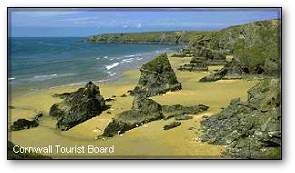
Carnewas, Bedruthan Steps

National Trust Houses and Gardens in Cornwall
Nr. Bedruthan, St Eval, Cornwall PL27 7UP Tel: 01637 860563

National Trust - Bedruthan StepsBedruthan Steps is a truly spectacular landscape on the north Cornish coastline, a few miles east of Newquay. The cliffs at Bedruthan have been systematically eroded over the years, leaving a series of impressive volcanic rock stacks. Theses pillars of detached clif rise majestically from Bedruthan Beach, forming a series of columns that stretch across the bay from Pendarves Island to Diggory's Island.

The area around Bedruthan Steps is ideal for walking, particularly between Bedruthan and Carnewas. There are stunning views from the cliff tops past the stacks- to the distant promontory of Park Head. Within two miles of Bedruthan Steps, there are two Iron Age hill forts and six Bronze Age burial Barrows.

There is ample parking in the National Trust Car Park, a short walk from the cliff top. The car park has toilets, a National Trust Shop and a Café, for refreshments. Paths have been created across the cliff tops in an attempt to reduce the environmental impact that the numerous visitors have on the area. The paths are steep in places, requiring a fair degree of physical exertion. The steps down to the beach are extremely difficult, requiring a degree of agility, stamina and care. Sensible walking shoes are strongly recommended for anyone who wishes to make the decent down to the beach.

A series of steep steps has been cut into the cliff face to take people down to the inviting sands below. The path down is quite difficult, but worth the effort, as the beach is a fascinating place. You can explore the large cave adjacent to the foot of the steps; stroll around the stacks that rise from the beach; or sunbath on the almost perfect sands.

There is no swimming from the beach at Bedruthan, as the strong under currents are a danger to anyone who ventures into the water. A memorial plaque has been placed on the cliff top, dedicated to Alex Laurie from Derby, who drowned in the waters off Bedruthan Beach, in 1903. His friends, who were with him at the time, survived the incident and erected the plaque in his memory and as a warning to others.

Bedruthan became a popular tourist location during the Victorian era. As, nearby, Newquay grew in popularity as a holiday destination, more and more of the tourists began to make journey to Bedruthan - to see the dramatic coastal landscape. Local farmers responded to the opportunity and began to make an income from this growing trade - charging tolls for each horse that pulled the visitor's carriages to the site. It is thought that the local population embellished the experience by attributing the creation of this impressive landscape to 'Bedruthan,' a Cornish Giant, who used the stacks as stepping-stones across the bay.

One of the stacks is known as the 'Samaritan'. The Samaritan was a cargo vessel that was wrecked against the pillar in 1846, with the loss of nine lives. The local population benefited from the tragedy by salvaging the 'Samaritans' cargo of barreled beef and printed cloth. A song was composed to commemorate the event;

'The Good Samaritan came ashore,
To feed the hungry and clothe the poor.
With Barrels of beef and Bales of Linen,
No Poor Soul shall want for a Shilling'.

From time to time the strong currents that are prevalent in the bay, shift the sands from around the base of the 'Samaritan', exposing the remnants of the rotting keel of its namesake.

The name Bedruthan Steps, though currently applied to both the beach and the stacks, originally referred to the perilous steps that were hewn out of the cliff face. Originally there were two separate rock stairways leading down the cliff face to the beach. A steep decent, near to the location of the present day steps, that Charles G. Harper in 'The Cornish Coast' - published in 1910, describe as:

'Rude flights of steps, cut into the profile of the cliffs, and fortified here and there by a crazy iron or timber hand rail… The steps are ancient beyond knowledge, and have given a name to the place.'

And, Pentire Steps, a more winding path that zig zagged its way down to the beach, just north of Diggory's Island. Landslides destroyed both of the original routes to the beach during the 1960's and early 1970's - closing the beach below. The National Trust opened the current steps in 1975. Wire netting was bolted into the sheer cliff face to fix the rock adjacent to the path securely in place and to protect visitors from falling debris. The National Trust close the beach during the winter months, due to the increased danger of rock falls.

Bedruthan Steps

The Heritage Trail has One character property in the local area.

Trethiggey Farmhouse
Quintrell Downs

A beautiful large farmhouse (sleeps up to 15 in 6 bedrooms) set in the splendid isolation of its own grounds with wonderful views across a valley, and within 10 minutes of the Atlantic Ocean.
Click here to find out more about Cornwall
Promoting your business on Cornwall Online

Copyright © 2001 - Disclaimer